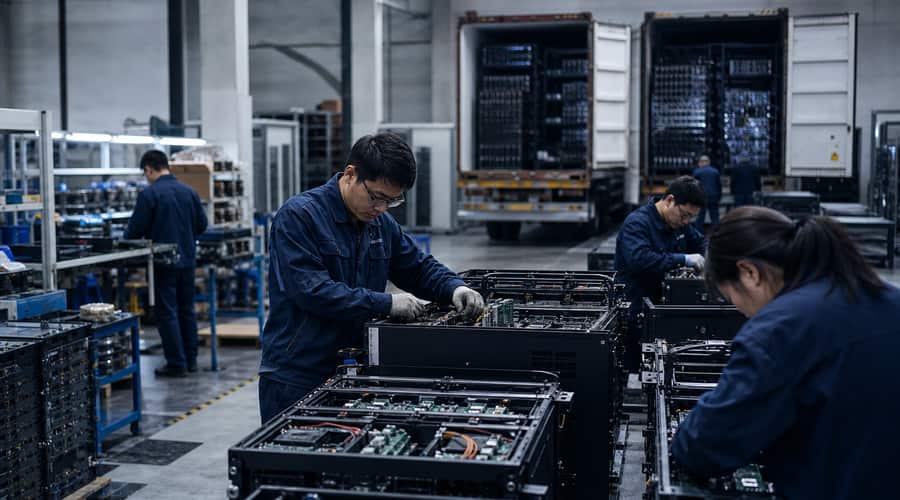
China's factories just posted their strongest export month since 2021, and the reason has almost nothing to do with cheap consumer goods anymore.
China's General Administration of Customs reported Tuesday that exports jumped 27% in June from a year earlier to a record $412 billion, well ahead of the roughly 18% gain economists had expected and the fastest pace since October 2021. That's a wide beat. Imports rose 36% to $286.76 billion, pushing the trade surplus to $125.62 billion from $105.43 billion in May, according to figures reported by AP and The Wall Street Journal from the customs release.
You don't get numbers like that from t-shirts and toys. The category that explains June sits several pages into most trade reports: electronic components, computer parts and other computing hardware. Trade in that group jumped nearly 57% to 5.1 trillion yuan, or about $760 billion, in the first half of the year, according to data cited by AP from China's customs figures. Semiconductor prices are up, AI infrastructure orders are up, and China's factories sit at the center of both trends.
That's the real story buried inside a trade release. China isn't only buying chips from Nvidia and shipping them to data centers. It's making an enormous share of the servers, boards and other hardware the global AI buildout actually runs on. Exports to Southeast Asia rose about 35% in June. Shipments to the European Union climbed more than 18%. Latin America rose more than 28%. Those regions are adding data center capacity, power equipment and logistics links, and Chinese factories are filling the orders.
The Squeeze From Washington #
The same week China posted these numbers, Nvidia was tightening the door on who gets to buy from it. The Financial Times reported that Nvidia has cut more than half of its approved Asian buyers of advanced AI chips, narrowing a new approved buyer system after months of stepped-up due diligence in Singapore, Malaysia and Japan. The list got a lot shorter. The move follows U.S. Commerce Department pressure aimed at stopping advanced chips from reaching Chinese-linked entities through overseas subsidiaries, after concerns that restricted Blackwell processors were being routed through Malaysia. Smaller neocloud providers, the resellers that rent out AI computing capacity, took much of the hit.
Here's the tension. Washington is trying to control where advanced AI silicon ends up. Beijing's factories, meanwhile, are exporting the surrounding hardware faster than ever. You can restrict the chip. You can't easily restrict every server tray, circuit board, power unit and chassis built around it.
TSMC's numbers make the same point from a different angle. The chipmaker's June sales hit about NT$442.68 billion, or roughly $13.8 billion, up nearly 68% from a year earlier and the biggest monthly total in its history, according to market reports based on the company's disclosure. Its second quarter revenue came in around NT$1.27 trillion, a gain of about 36% from a year earlier, ahead of the full earnings report due July 16. Demand for the physical infrastructure of AI isn't slowing anywhere obvious in the supply chain, whatever export controls Washington writes.
The Cost Side Is Messier #
China's import number shouldn't be read as a clean sign of domestic strength. The Wall Street Journal reported that higher semiconductor prices helped lift the value of imports even as China's property market and household spending stayed weak. That is an awkward mix: factories are busy shipping AI-linked hardware to the world while the home economy still looks uneven.
Energy adds another complication. The Iran conflict and the disruption around the Strait of Hormuz have pushed oil prices higher, but China has also cut crude purchases sharply. Axios reported in late May that China's oil imports had fallen from about 11 million barrels a day before the war to 9.3 million in April, with May and June projected near 6.5 million. That is not normal buying behavior. Beijing has leaned on inventories and lower demand to avoid paying up for every missing barrel, but you can't run that play forever.
Frankly, that makes June's export boom look less simple than the headline number. Some of the surge may reflect exporters rushing shipments out ahead of possible U.S. tariff increases, the kind of pull-forward that borrows from future months rather than creating fresh demand. First-half figures were softer than June alone, with exports up 17.6% and imports up 26.6% over the six months.
Still, the direction is clear enough. Whoever wins the argument over which country builds the next generation of AI chips, China has already made itself close to indispensable in building the machines those chips sit inside. That's why this customs release matters to you. It shows that the AI race is not only a contest over model labs, chip designers and export licenses. It is also a factory story, and China is still very hard to route around.
Also read: An MIT Spinout Just Raised $134 Million to Drill for Superhot Rock in Oregon • Re-Q Gives Every Audio Output Its Own EQ instead of Forcing One Sound Everywhere • Nvidia halves its list of approved Asian chip buyers to cut off China