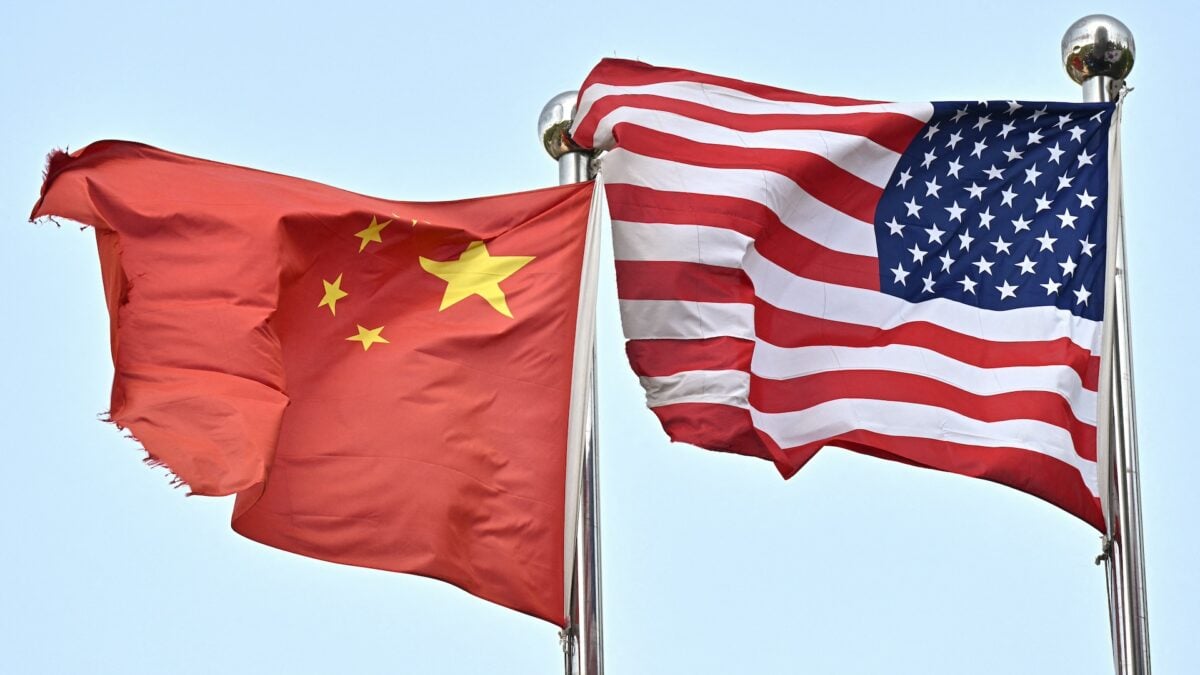
China has been making big strides in its sprint to catch up with the American AI industry lately, thanks in large part to its focus on open source models, which have growing appeal for cash-strapped U.S. businesses. But that accessibility could soon be limited, as Beijing weighs the possibility of cutting off foreign access to the country’s top AI systems.
Chinese state officials met with Chinese tech developers Alibaba, ByteDance, and Z.ai over the past month to discuss limitations on overseas access, according to a Tuesday report from Reuters. The limitations would reportedly apply to both open source and proprietary models, including those that have yet to be released. They could also place restrictions around which business entities could provide funding to Chinese AI startups. On Beijing’s orders last month, Meta cut off all operations and data-sharing with Manus, just around six months after it had acquired the Chinese-founded AI startup in a $2 billion deal.
Many Chinese AI developers, meanwhile, have reportedly been cutting ties with U.S. chipmaker Nvidia in favor of Chinese silicon providers, following a commitment from Beijing to invest around 2 trillion yuan (equating to $294 billion) in domestic data center development over the next five years.
Technical gains, and fears of Mythos
The decision-making apparatus of the Chinese state is as opaque to outsiders as that of a large language model. But some key recent developments are likely behind the country’s nascent push to insulate its AI industry. First and foremost, there’s the fact that its own AI models have been closing the performance gap separating them from the most advanced models built by U.S. companies like OpenAI and Anthropic.
Last month, for example, the release of Z.ai’s latest model, GLM-5.2, shocked Silicon Valley by performing comparably to proprietary U.S. models in key cybersecurity benchmarks after supposedly being trained at a fraction of the cost. Anthropic and OpenAI have accused Chinese tech companies of harnessing American AI to build new models, but at least for the moment that kind of international, large-scale distillation is just frowned upon, rather than technically illegal—although that could change now that the Trump administration has also pledged to crack down on it.
Training methods aside, there’s a growing sense that Chinese models can hold their own against their competitors in the U.S., especially in light of their lower costs.
China has also been rattled by Anthropic’s Mythos, which has been hailed as a kind of cybersecurity Houdini—an AI model that can detect flaws in even the most robust cyberdefenses.
Given Beijing’s history of imposing strict, top-down control over Chinese cyberspace, such a model being developed by a U.S. company obviously poses a major threat. Zhou Hongyi, founder of Chinese cybersecurity firm 360 Security Technology, reportedly said during a recent conference in Beijing that the Chinese AI industry could not afford to allow the U.S. to command such a dominant position in global balance of cybersecurity capabilities. The push to cut off the country’s top AI models from foreign access and from Nvidia chips is very likely motivated by a desire to protect valuable Chinese IP in the age of Mythos.
The Silicon Curtain
In both Beijing and Washington, AI has become a critical piece on the geopolitical chessboard; there’s a deeply felt sense at the highest levels of government that the country that commands AI will command the world order in the twenty-first century.
It remains to be seen whether Western capitalism or the Chinese model of top-down state control will be the quickest route to victory. The American AI industry is in a bit of an awkward phase, as it struggles to come to terms with a president who says he’s a champion of a free market but also increasingly insists on imposing federal control over how, when, and to whom new models are released. That could turn out to be a positive first step towards broadly beneficial regulation down the road, but in the short-term the lack of clarity around the new rules has also arguably benefited China, as businesses using American AI have been given reason to fear sudden and inexplicable suspensions of service.
What does seem clear at this point is that no matter who wins the AI race, the evolution of AI is going to look a lot different in the U.S. than it does in China. Developers will be subject to different rules, and the AI systems they design will adhere to different legal codes and cultural norms. The author and historian Yuval Noah Harari has called this burgeoning technological-ideological divide the “Silicon Curtain.” Like the so-called Iron Curtain during the Cold War separating the U.S.- and Russian-controlled spheres of influence, the Silicon Curtain, Harari says, could mark an invisible, AI-enabled barrier across which political cooperation and even mutually agreed upon rules of discourse becomes close to impossible.
The Silicon Curtain has not yet closed over the world, but the growing insularity within both the U.S. and Chinese AI industries indicates that it could very well be waiting in the wings.