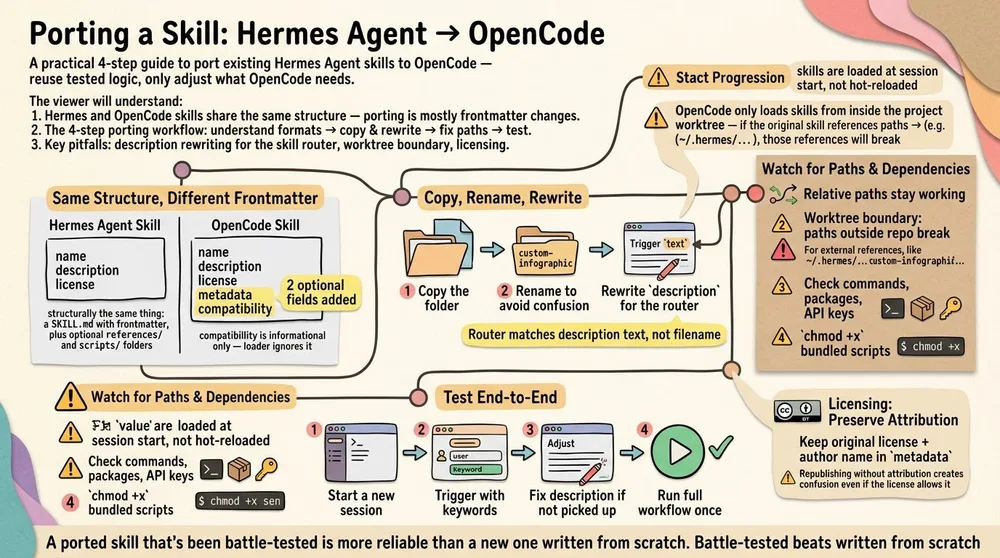
If you're looking for a practical tutorial on how to move these over, you basically need to strip the Hermes-specific decorators and re-map the input/output schemas to fit the OpenCode architecture.
The Migration Workflow #
- Isolate the Logic
First, pull the core function out of the Hermes skill. You want the raw Python function that performs the action, devoid of any framework-specific metadata. If your skill relies on a specific Hermes state manager, you'll need to replace those calls with OpenCode's context handling.
- Define the OpenCode Schema
OpenCode is stricter about how it perceives tool descriptions. You need to rewrite your function docstrings to be extremely explicit. While Hermes might have been lenient, an LLM agent in OpenCode needs a clear "Reason for use" and "Parameter descriptions" to avoid hallucinating arguments.
- Implement the Wrapper
Wrap your isolated logic into the OpenCode tool format. It usually looks something like this:
def get_weather_data(city: str):
    """
    Fetches current weather for a given city.
    Args:
        city (str): The name of the city to check.
    """
    return f"The weather in {city} is sunny."
- Validation and Testing
This is where most ports fail. You can't just assume it works because it worked in Hermes. You need to run a deep dive on the prompt engineering side to ensure the OpenCode agent is actually triggering the tool when it should. Use a few edge-case queries to see if the agent misinterprets the ported parameters.
Is the effort actually worth it? #
I'm skeptical about "seamless" migrations. While the code moves over easily, the behavior often shifts. Hermes and OpenCode handle agentic loops differently, meaning a skill that was reliable in one might become erratic in the other due to how the system prompt influences tool calling.
Effort level: Low to Medium (depending on how tightly coupled your logic was to Hermes).Risk: Moderate (behavioral drift in the LLM).Benefit: High (saves you from rewriting complex API integrations).
If your skill is just a simple API wrapper, porting takes ten minutes. If you have complex state management or multi-step dependencies, you might find that a clean rewrite from scratch is actually faster than debugging a ported mess. For most of us, however, keeping the "battle-hardened" logic is the only way to maintain consistency across different AI workflows.
Next Why is OpenAI suddenly buying up Ethereum projects from →
a practical ChatGPT prompt guide, with plenty of directly applicable cases.