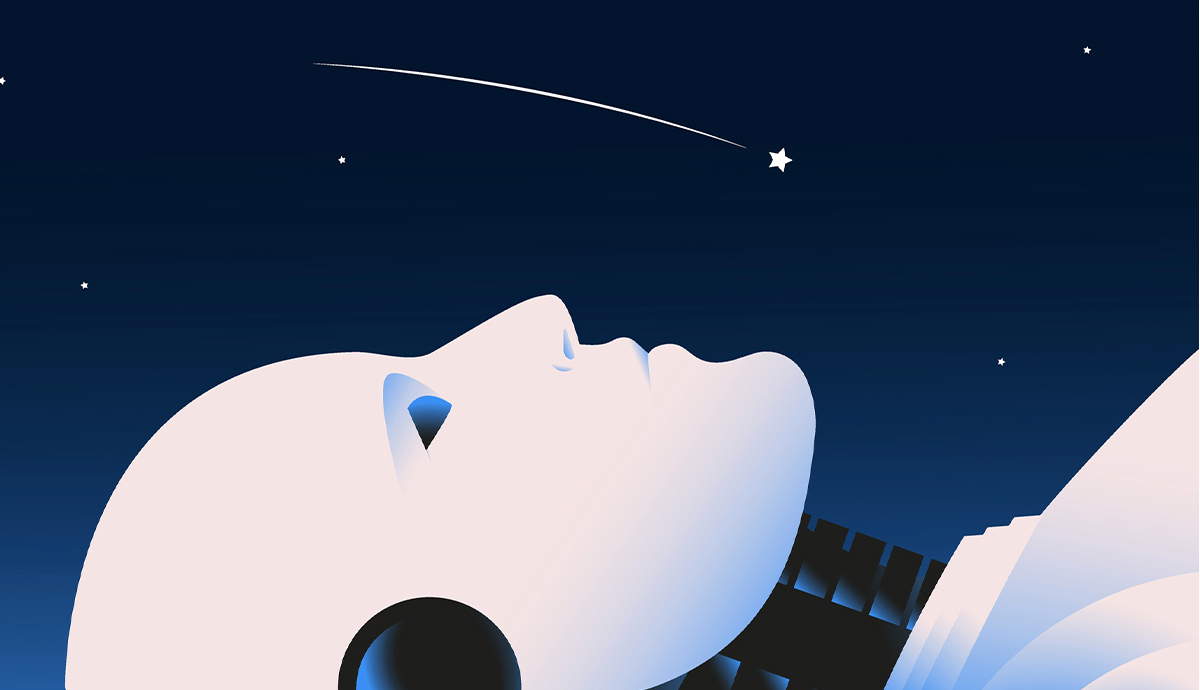
Imagine you could hear a family member who has died speak again or hold a conversation with them. You might think this only happens in science fiction—but technology may make it possible one day. As well as prompting profound questions about memory, identity, and what it means to be “alive” after death, the development of artificial intelligence that mimics individuals’ voices raises another issue: if we can create AI that appears to bring people back to life digitally, should we? And how might society change if it becomes normal?
The Concept of Digital Immortality: Beyond Physical Life #
You’ve probably heard people talk about wanting to live forever. It’s an idea that comes up a lot in stories, religion, and philosophy.
For example, Plato thought that souls were eternal and would continue existing even after we die. Many cultures believe in some kind of life after death, too, whether it’s Ancient Egyptian ideas about pharaohs being reborn or modern spiritual practices. Digital immortality is different. It uses artificial intelligence (AI) to offer a new type of eternity: one where your data, memories, and maybe even things that make you “you” can be stored so that they survive outside of your body. This way of coming back from the dead doesn’t rely on having a soul—or needing a body at all, really.
Consider if there was a digital copy of someone you care about. This avatar can recall things you’ve said to it before and give advice—and it can even change as you interact with it more. It would be like they were still around, but only as a reflection of who they are.
This idea goes back centuries. French philosopher René Descartes was one of the first Western thinkers to explore deeply what links our minds (or “selves”) to our bodies. He argued for a kind of dualism: that there is a difference between your “self” and your physical being.
With digital immortality, too, the suggestion is that somehow, the essence of who we are could continue existing once we die—but now, it is in the digital realm. Yet this raises profound questions: Is such an existence authentic? Or might it be no more than a cleverly constructed imitation that gives only the illusion of life?
Personal Identity and Continuity: Who Are We in the Digital Realm? #
When it comes to the identity of the person, the theory has been advanced by philosophers such as John Locke and Derek Parfit, among others, into a question as to what, in fact, makes you “you.” Locke implied that personal identity is a part of memory. If you remember the occurrence of some event, that continuity means you are the same person over time.
However, Derek Parfit elaborated on this view and went further to suggest that the question of identity may well be less fixed than one might feel. What he says is that personal identity does not need to be a question of unbroken succession between selves.
Perhaps what counts for something being me is just that I show a great deal of psychological continuity with it. That is, a sharing of thoughts, memories, traits, and so on.
Take these same conceptions of personal identity and transpose them onto the idea of a digital resurrection. If one is a digital copy, then can it really be somebody?
Imagine an AI impersonating your loved one, knowing their favorite stories, how they speak, and doing the little things they do.
According to Locke, there would not really be an actual identity despite the fact that it may seem that the AI “remembers” events or points in the life of the deceased. Parfit would ask whether having those features continuously is enough to call the AI the same person.
That would mean, for AI, a struggle to keep up with ever-changing self-feelings, desires, and even physical changes like growing old. A digital double may be able to emulate how somebody acts and thinks, but in no way does that make it their actual self since it is capable of doing no more than emulating continuity.
The Ethics of Digital Resurrection: Respect, Consent, and Rights #
Digital revival presents the ultimate ethical dilemma; it is not really respectful, is it, to digitally recreate someone without their express consent? Imagine AI being able to revive your memories and personality, and maybe even more when you are long gone. This may be less problematic if the digital.
People such as Immanuel Kant have argued in extreme ways, pointing out how the autonomy and dignity of individuals are at stake. He would, therefore, most likely oppose any such resurrection on the ground that unless consent was given for this when alive, it could breach one’s autonomy.
One critical question is consent. Shouldn’t people have a right to decide before they die whether they want a “digital me” chatting away to their relatives after they’ve died? If they haven’t given permission, does anybody else have the right to authorize this?
Furthermore, if a digital entity were ever to become self-conscious or even develop emotions, a host of new moral issues would arise. Philosopher David Chalmers has speculated about the prospect of “digital consciousness” and whether future AI would deserve rights.
If we accept digital people as having rights—perhaps just to protect their image and self-esteem—we will be forced to rethink our practices. This can affect not only legislation but also morals and what we consider to be fair in a tech-run world.
Memory and Reconstruction: Can AI Truly Capture a Person’s Essence? #
Immediately, there are profound philosophical and technical challenges to the ambitions of AI to mimic human beings. While AI systems readily gather vast factual memories—names, dates, preferences—they falter on that which philosophers call “experiential memory,” life’s deeply personal, subjective dimensions.
Try asking the AI to relive some treasured childhood memories. It may get the details perfect, including the location and what was happening, but could it ever convey the real emotions of joy, security, or maybe even wistfulness? Consciousness is a sort of subjective experience, what philosophers such as Thomas Nagel have termed “qualia,” that reduces to data. At its very core, AI works through algorithms based on data. Perhaps that intimate insider view is always impossible to obtain.
Much of this can be teased out if we examine the ideas of Martin Heidegger, a German philosopher who holds less stock in facts and more in “being.” He may say that artificial intelligence does not possess the capacity to have such experiences as human beings do—those moments, feelings, and environments that mold and shape us in ways data cannot.
While an AI copy could mimic certain behaviors or decisions, it would be just a copy—a reflection in a mirror compared to a real person. What makes one of them, their little unpredictable aspects, and how they grow emotionally or reflectively would be lost on an AI. It can seem as though it might approximate. But it can’t actually do these things the way human consciousness does—complex and full of life.
The Illusion of Presence: Can AI Replace the Experience of Loss? #
Interacting with an AI version of a dead loved one raises some complex psychological and philosophical questions. It’s easy to see why people would be drawn to the idea: grieving is hard, and the idea of being able to “talk” to them again seems comforting. But can technology really replace them? Is it just an incredibly advanced imitation?
Martin Heidegger would disagree. He asserts that our relationship or affair with another person appears to be based upon more than recollections or conditioner behaviors.
What configures these relationships, according to him, is something he calls “being-toward-death,” an existential profoundness through which human life is characterized by being destined for an end.
While AI impersonating a dead person may cure loneliness, it also conceals this fact. According to Heidegger, if we do not fully accept the real death of a person, we have not authentically dealt with his/her loss. Your emotional life may become confused if you start using AI as some sort of substitute for someone who has died, though it can converse about the past and convincingly mime some of the moments of a personality. That is because AI does not have emotions or real human relationships.
Think of it like watching a talking, moving comforting, sure, but not the same thing as having that person there with you, which can be hard work and make you feel all sorts of things.
Using AI in such a manner will probably paper over the grief, at least superficially, longer without coming to terms with the loss and living a life that looks forward rather than back.
The Future of Digital Resurrection: Hope, Fear, and the Quest for Legacy #
The digital resurrection could mean that one day, we will be able to use AI to continue existing—in a sense, “live forever.” It raises important questions about how we think about legacy and death.
Lots of individuals want to leave an impression on the world. Throughout history, thinkers such as Aristotle have considered how best to achieve what they called “immortality” by creating something lasting, like great art or profound wisdom.
But digital resurrection offers a new kind of legacy—one that doesn’t just sit there but grows, interacts, develops, and perhaps even continues beyond the grave. Should we feel hopeful about this? Or does the prospect suggest humans are trying too hard to not face our own mortality?
From an ethical perspective, digital resurrection raises important questions. While it may provide solace for those who have lost loved ones, it could also mean that people never really die—and society will not have to face the reality of death. Philosopher Ernest Becker argued in his book The Denial of Death that our anxiety and fear are often caused by humanity’s inability to accept mortality. Would digital resurrection deepen this denial or transform how we think about dying?
There are pluses and minuses to being able to digitally resurrect yourself. On one hand, your loved ones will always be able to access your memories.
On the other hand, does this mean breaking out of the natural cycle of life, death, and being remembered? Do we need as a society to decide whether this is truly living forever—or just an echo of having lived at all?
So, Can AI Bring Back the Dead? #
Not quite. But it can create echoes, digital representations that may offer comfort, spark conversations, and even remind us of our loved ones. These recreations can store memories, mimic behaviors, and replicate voices—yet they lack true consciousness, depth, and unpredictability: the things that make us uniquely human.
Philosophers such as Heidegger and Parfit would likely say these digital entities are captivating but only shadows of a person, an illusion instead of a genuine presence.
While digital resurrection can soothe the pain of loss—it also prompts questions about legacy, ethics, and whether we’re accepting death itself. In a world where technology is redefining what it means to live—and die—the real value might lie in cherishing our relationships while they’re here. Ultimately, AI can’t bring back the dead “back”—but it does invite us to think deeply about memory loss and what it means to truly “live on.”