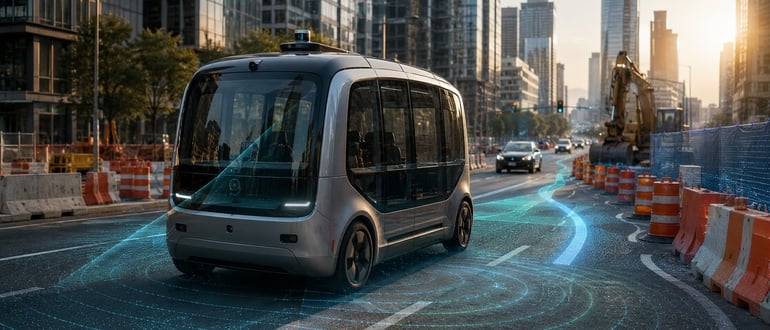
Ten years ago, we were told that by now we would be a nation of passengers, not drivers. Autonomous vehicles would rule the road by 2021, said virtually everyone. Obviously, that hasn’t happened. But far from being discouraged, autonomous vehicle proponents are optimistic.
On the face of it, incidents like the recent high-speed crash into a Texas house involving a Tesla vehicle allegedly in “full self-driving” (FSD) mode point to a technology that isn’t quite ready. Tesla says its Autopilot and FSD modes “are intended for use with a fully attentive driver, who has their hands on the wheel and is prepared to take over at any moment.” That hardly sounds relaxing or trustworthy. Sweden, for example, views Tesla’s FSD with skepticism, recommending that the European Union ban its use due to a “speed offset” feature that allows the driver to set a speed above posted road limits by any margin the driver chooses.
Similarly, Waymo recently recalled nearly 4,000 of its robotaxis after its vehicles repeatedly failed to recognize freeway construction zones, in some instances even driving past closure signs and skillfully navigating between cones marking closed lanes. That’s not the driving skills anyone is looking for. EV maker Rivian, meanwhile, is now faced with a class-action suit that claims the company has not delivered on self-driving promises on certain truck and SUV models.
While that might seem very discouraging, the auto industry is actually doubling down on autonomous driving and AI may be the cause of its optimism. Major automaker Stellantis, ride-hailing giant Uber, and AI company Wayve say they plan to jointly explore the development and deployment of Level 4 driverless cabs in cities around the world. Level 4 means an autonomous vehicle can independently handle all driving tasks like steering and braking without human intervention. Stellantis offers vehicles under the Jeep, Dodge, Chrysler, Peugeot, Citroën and Fiat marques. The new driverless taxis, likely some variant on a minivan, reportedly will be built on the automaker’s L4-Ready platform that has an embedded sensor suite and built-in redundancy for self-driving. Uber, of course, would be instrumental in developing a ride-hailing network. The AI element of this three-legged stool comes from Wayve, which says its AI software is designed to allow vehicles to negotiate complex real-world environments fully autonomously. Wayve says its AI models are trained on large amounts of data and video so that the rigorous city-by-city street mapping used by other robotaxi firms isn’t necessary. There is no reported specific timeline for this project although Wayve and Uber are already working jointly to offer an autonomous vehicle service in London using Ford Mustang Mach-E vehicles later this year.
AI’s role represents a new phase in the evolution of autonomous vehicle development, contends the consulting firm McKinsey & Company. Generative AI is accelerating a shift toward AI-native, end-to-end (E2E) architecture capable of learning driving behavior from massive data sets. E2E’s advantage is that these systems can adapt more effectively to unfamiliar environments, handle greater driving complexity and improve more quickly as they process more data, says McKinsey.
A side benefit that’s likely to grow in importance is that AI systems designed for automotive use may extend into other physical AI realms. NVIDIA, for example, says its new full-stack safety system for humanoid robots draws on technologies originally developed for autonomous vehicles. NVIDIA Halos for Robotics combines AI computing hardware, software, sensors and certification tools into a unified framework that helps robots understand their surroundings and respond immediately to potential hazards.
Meanwhile, autonomous vehicles are getting helpful nudges to get on track. The United Nations has issued a new set of rules meant to establish common safety requirements for autonomous vehicles that are meant to forestall a fragmented approach amongst different countries. One key measure meant to instill public confidence is the requirement that autonomous vehicles be equipped with data storage devices to record safety-relevant information for oversight use.
Another nudge is coming from the Trump administration, which is proposing brake pedals need not be installed in vehicles like robotaxis that are designed to be solely used autonomously. Proponents say the elimination of the brake pedal requirement would speed deployment of autonomous vehicles. The Biden administration previously eliminated a steering wheel requirement.
Undoubtedly, robotaxis like Amazon’s new Zoox robotaxi service working the Las Vegas Strip will raise the profile of autonomous vehicles. But how long will it be before autonomous vehicles, even those with AI brains, come into widespread use? McKinsey expects Level 2 capabilities, similar in scope to current Tesla FSD systems, to be widespread by 2035. Call it ten years for consistency’s sake. Level 4 remains way down the road and around some bends somewhere. Given NVIDIA’s interest, there is probably a good chance of meeting a humanoid chauffeur along the way. Dibs on the name “Kato,” the crime-fighting chauffeur from the 1960s Green Hornet TV series.