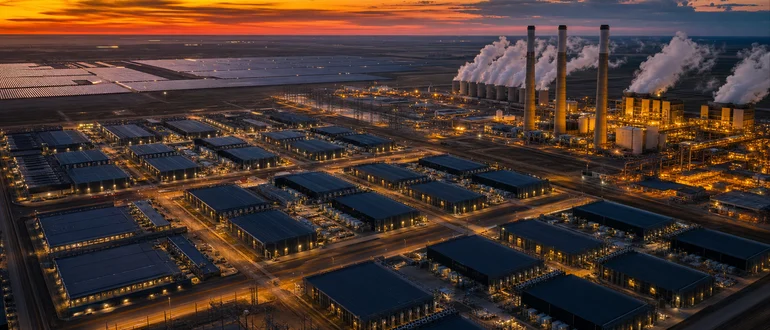
For years, the largest technology companies presented themselves as a new kind of climate leader. Amazon co-founded the Climate Pledge and promised net-zero by 2040. Microsoft pledged to become carbon negative by 2030. Google set out to run on 24/7 carbon-free energy. Meta promised net-zero across its value chain. Then artificial intelligence asked for more power — not a little more, but city-scale loads delivered continuously and on a schedule set by a corporate race rather than a public utility plan. The result is a profound stress test for voluntary corporate climate action. Amazon has acquired the site of the proposed GW Ranch campus in West Texas, where developer Pacifico Energy holds an air permit for as much as 7.65 gigawatts of gas-fired generation. Microsoft signed a 20-year deal with Chevron for a large gas project in the same region. Meta is backing a large gas expansion for its Louisiana Hyperion campus, and Crusoe has filed for a 933-megawatt gas plant at the Google-anchored Goodnight site in the Texas Panhandle.
The magic word is “matched.” Corporate carbon-free energy accounting lets a company sign a contract for renewable megawatt-hours generated somewhere on the grid at some hour of the day, and count those against the fossil-powered electrons its data center actually consumed at 3 a.m. It is legally defensible. It is not what physics is doing. Google’s own recent analysis makes the mismatch explicit — hourly matched clean energy is not the same as clean energy.
Regulation is starting to catch up. Ireland now publishes data-center electricity as its own line item and has imposed a tightened connection policy. Germany’s Energy Efficiency Act sets minimum PUE and heat-reuse standards. Texas Governor Greg Abbott has d new large-load approvals pending an audit that BNEF estimates could delay 49.8 GW of load. The IEA’s Energy and AI report frames the choice bluntly: AI can be a catalyst for a cleaner grid, or an accelerant on a dirtier one, depending on the rules we write in the next 24 months.
This special report walks through the numbers behind the AI infrastructure boom, the community-scale costs already showing up in Texas, Louisiana and Virginia, what Europe and China are doing differently, and a six-rule regulatory framework designed for a world where the buyer of power has become the builder of power. It closes with the case for AI as its own saving grace — and the honest limits of that argument.