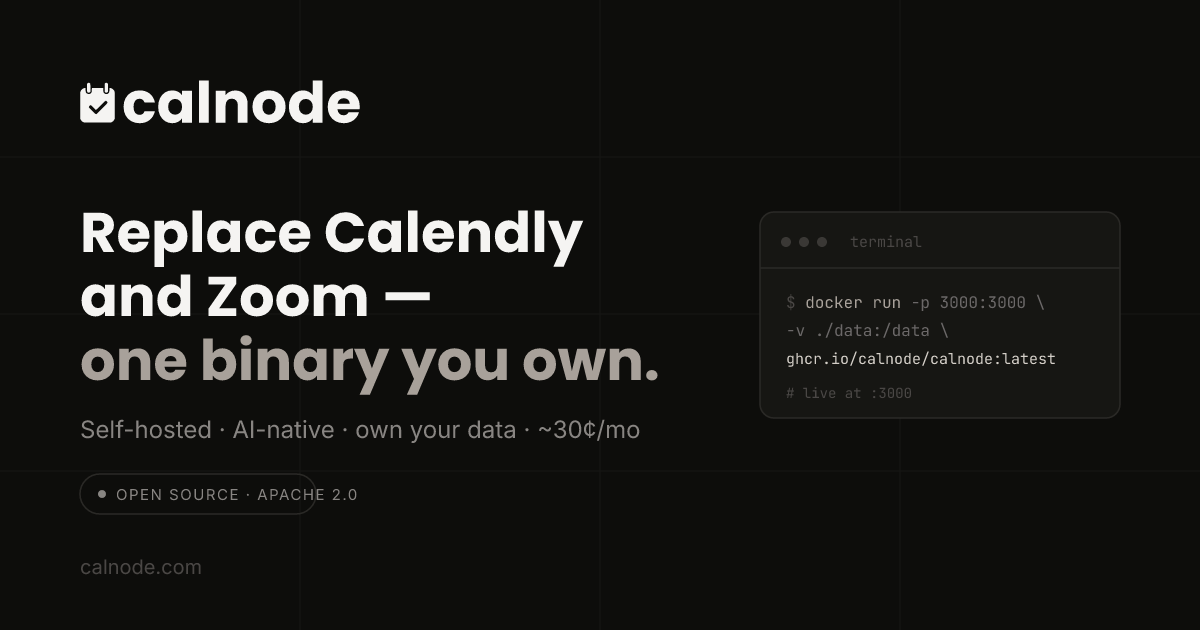
Calnode self-hosts the whole meeting — the booking, the video call, and the recording — on your own infrastructure. AI-native, ~30¢/month, and small enough to audit yourself.
No signup — you land straight in the admin. Or have us set it up for you.
Calnode is an open-source scheduling app you run yourself — a single static Go binary plus a SQLite file that deploys on a tiny VPS for pennies.
It does everything a modern scheduler does — and goes further with AI that books in natural language and a native MCP server so your agents can schedule on behalf of anyone.
Your data stays on your infrastructure. Nothing is paywalled.
Why Calnode
A single static Go binary with zero dependencies. No Node, no Python, no Redis. Boots in under a second and stays tiny.
Conversational booking lives in the booking page itself. Visitors type in plain English; Calnode understands and confirms. No separate AI layer to stitch together.
Envelope encryption at rest. Instance-per-tenant isolation. No cross-contamination by architecture, not policy.
Point Calnode at any OpenAI-compatible endpoint — local Ollama, your own GPU cluster, or a private Azure OpenAI deployment. Your booking conversations never hit a third-party model.
Apache 2.0 — read it, fork it, audit it. A ~25k-line Go backend (well-tested) plus a lean SvelteKit admin — small enough that one engineer can review the whole thing. No premium tier, no feature flags, nothing paywalled.
AI-native scheduling
Visitors describe what they need in plain English. Calnode parses intent, checks availability, and confirms — no back-and-forth, no scheduling links buried in email.
Visitors describe what they need the way they'd say it to a person. Calnode handles the rest — no dropdowns, no time-zone math, no "click a slot" friction.
Every Calnode instance exposes an MCP server. Your AI agents can check availability, create bookings, and reschedule — without leaving the tool context.
Any OpenAI-compatible endpoint works — Ollama on localhost, your org's private Azure OpenAI, or any hosted model. Booking conversations stay on your infrastructure.
Self-host footprint
Most self-hosted schedulers need a database server, a cache, a job queue, and a reverse proxy to even boot. Calnode is a single executable that reads a SQLite file. Copy it to a server and run it.
What most instances run on a Railway box — you pay for compute, not per seat.
Footprint comparison (approximate) Bar sizes are illustrative; Calendly is SaaS and has no self-hosted footprint.
Calnode Rooms · built-in video
Zoom, Calendly, and the rest send your meetings — and their recordings — to someone else's cloud. Calnode Rooms runs the call on infrastructure you control, and recordings land in your own bucket.
Connect your own LiveKit, or self-host it for total control. The media stream never touches our servers — it is your infrastructure end to end.
Every recording lands in your own S3-compatible storage. Your data, your retention policy, your encryption keys — not a third party’s cloud.
Camera, mic, screen share, and chat — with one active host who runs the room. Screen share is host-gated server-side, not just hidden. Hand off host, or end the meeting for everyone.
Every recorded meeting is consumable by your agents — pull the transcript and notes over MCP, or react to recording, transcript, and notes webhooks as each one lands.
Recording is consent-aware: when it starts, everyone is notified and can continue or leave, and acknowledgements are logged.
One carve-out, stated plainly: the optional AI notetaker sends recording audio to Deepgram for transcription. Everything else — video, recordings, and summaries via your own model — stays on your infrastructure.
How it stacks up
Comparison is based on publicly available information and is approximate.
| Feature | Calnode← you are here | cal.com | Calendly |
|---|---|---|---|
| Deployment | Single binary | Docker Compose (Postgres + Redis) | SaaS only |
| Database | SQLite | PostgreSQL + Redis | SaaS only |
| License | Apache 2.0 | AGPL | Proprietary |
| Self-hostable | |||
| Open source | |||
| AI in the booking page | |||
| Native MCP server | |||
| BYO LLM endpoint | |||
| Envelope encryption at rest | — | — | |
| Calendar sync | Google, M365, CalDAV | Google + M365 | Google + M365 |
| Video conferencing links | Zoom, Meet, Teams | Zoom, Meet, Teams | Zoom, Meet, Teams |
| Native video + recording | Your LiveKit + S3 | Hosted only | |
| Embeddable widget | |||
| REST API |
Information is approximate and based on public sources. Some cal.com features vary between cloud and self-hosted editions.
Everything included
Every feature ships in the same open-source binary.
Shareable links per event type. Guests can reschedule and cancel without creating an account.
Visitors describe their need in plain English and the AI confirms a slot — all on the booking page.
AI agents can check availability, create bookings, and reschedule via a built-in MCP endpoint.
Confirmation, reminder, cancellation, and rescheduled emails — fully branded, no "Powered by" footer.
Two-way sync with Google, Microsoft 365, and any CalDAV calendar (Fastmail, Nextcloud, and more). Conflict checks across multiple connected calendars so you are never double-booked.
Auto-generate Zoom, Google Meet, or Microsoft Teams links at booking time.
Native video on your own self-hosted LiveKit — screen share, chat, host controls, and recording to your S3 bucket. No Zoom account needed.
After a recorded meeting, Calnode transcribes it and writes an LLM summary on the booking view — pull both over MCP or catch the transcript/notes webhooks. Transcription runs via Deepgram; the summary uses your own model.
Round-robin, collective, and fixed-host routing for teams. Built-in member roles (owner, admin, member).
Google & Microsoft SSO, email and password, or passwordless magic-link login.
Drop a booking widget into any website with a single script tag. Works with any stack.
Every resource — event types, bookings, users, teams — is accessible via a REST API with API-key auth.
Fire verified events to your endpoints on booking, reschedule, or cancellation.
Paste your GA4 or GTM ID — no script embedding, and it is consent-gated: nothing loads until visitors accept. Measure your booking funnel without the compliance headache.
A built-in cookie consent banner with configurable Privacy Policy and Terms links — the basics for a GDPR-style privacy posture on your booking pages, out of the box.
OAuth tokens, API credentials, and other secrets are encrypted at rest with per-secret keys wrapped by your root key — not flat single-key AES.
Built-in per-IP rate limiting helps keep your booking pages clean.
SQLite replication to S3, Backblaze, or any compatible store. Continuous streaming, not cron jobs.
Building blocks for your AI‑OS
The interesting layer right now isn't any single app — it's how systems wire together around an LLM. Calnode is built for that world: a self-contained scheduling node that exposes exactly what an agent needs to book time, and nothing it doesn't.
Your agents call Calnode like any other tool — check availability, book, reschedule. No adapter, no glue code.
Point it at your own LLM. Calnode supplies scheduling; your stack supplies the intelligence.
One binary you can reason about, audit, and compose. Just enough, and no more.
one capability · cleanly connected
For developers The admin UI is just a client of the same API every endpoint exposes. Provision event types, manage availability, and run bookings entirely over REST — or hand the booking surface to agents via MCP. Calnode runs with or without a face.
For regulated organisations SaaS schedulers store your meeting data, attendee information, and calendar context on their infrastructure. When regulators ask where your data lives, "in a third-party SaaS" isn't a satisfying answer.
Calnode runs in your environment. Your booking data, calendars, and recordings stay in your environment. The AI inference can run on your own GPU cluster or a private model endpoint. That enables a compliant posture without asking you to trust our security posture.
Implementation & integration
We deploy and configure Calnode for organisations with hundreds or thousands of staff. SSO, CRM integration, calendar provisioning, user import — all done for you.
Security & trust
A SaaS vendor asks you to trust an annual audit report. Because Calnode is small and self-hosted, you can do better: point your own security engineer — or their LLM — at the repo and verify every security and privacy claim in minutes, not weeks.
Every claim we make is published as a claim → verify-it-yourselfmanifest, alongside the audit process itself. Nothing to take on faith — each line points at the code that proves it.
Two rounds of review: deterministic scanners (govulncheck · gosec · gitleaks · semgrep) plus an LLM red-team across six domains — egress tracing, tenant isolation, the auth model, encryption & secrets, injection/SSRF, and booking-flow authorization.
A self-serve audit kit — open and falsifiable, run it against the repo yourself. It is not a third-party attestation (no SOC 2, no external pen-test); it is something you can check directly instead of trusting a certificate.
Self-hosted by design — customer data never leaves your environment except through explicit, named, opt-in integrations. There are no hidden calls home. The complete list of third parties, and only when each applies:
Calnode is free and open source. Self-host it in minutes, or talk to us about a managed deployment for your organisation.
Don't want to host it at all? Join the managed-hosting waitlist — we'll email you when it opens.