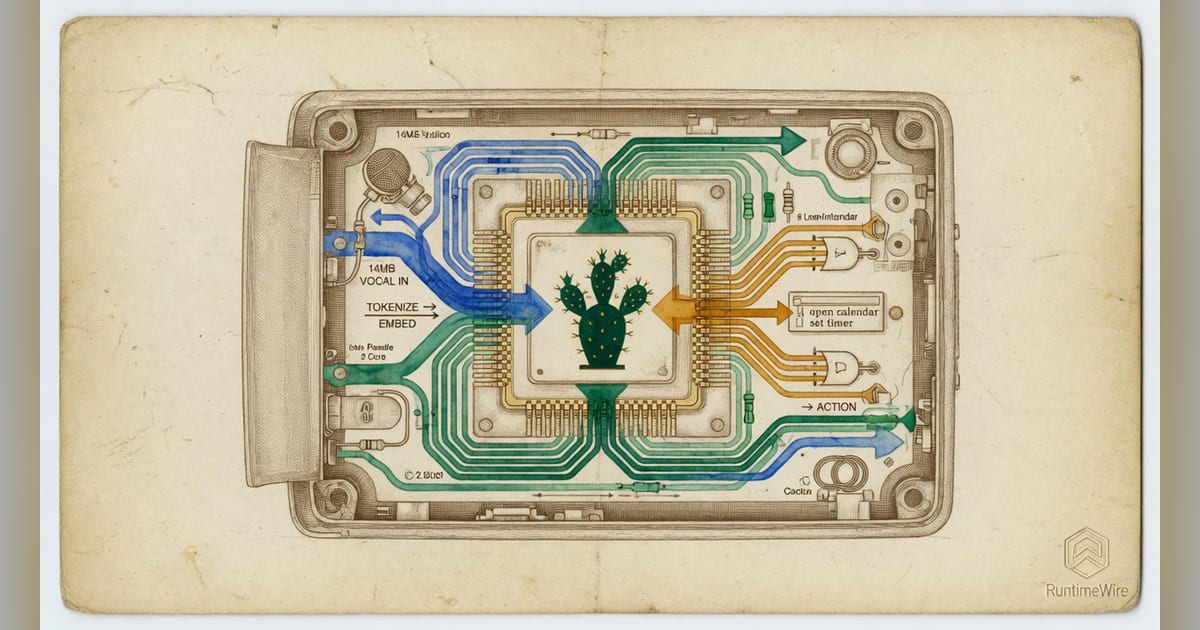
Cactus Compute founders Henry Ndubuaku (@Henry_Ndubuaku) and Roman Shemet (@RomanShemet) introduced Needle 2, a 14MB language model for tool calling on low-memory devices. The supplied product page does not display a separate launch date. Cactus Compute says the model can run on phones, wearables, home devices, robots and newer microcontrollers without a GPU or NPU.
The founders are pursuing a different definition of edge AI. Ndubuaku, who passed on an AI and machine-learning role at Nvidia to build Cactus Compute, and Shemet, a former quantitative analyst and economist, began working together before founding the company in 2025. Cactus Compute joined Y Combinator's Summer 2025 batch with a thesis centered on the cheap hardware that sits below flagship phones and laptop-class computers.
Needle 2 is the clearest expression of that thesis. The 45-million-parameter model cannot serve as a general chat assistant. It reads a user's request, chooses from a declared set of functions and fills the required arguments. A request to dim a living room light, for example, becomes a structured call containing a room, state and brightness rather than a prose response.
That narrower job gives Cactus Compute room to chase file size, memory use and speed instead of broad knowledge. The Needle repository describes Needle 2 as using about 28MB of RAM. Cactus Compute's public launch description reports 500 tokens per second on a Raspberry Pi 5 and 300 to 700 tokens per second on sub-$200 phones. Those performance figures come from Cactus Compute's own testing and have not been independently reproduced.
A smaller definition of an agent
Needle 2 treats a device's capabilities as typed tools. Developers describe functions and parameters with schemas, then the model maps natural-language requests onto those schemas. The open-source repository includes examples for controlling lights, changing a thermostat, extracting invoice fields, routing among tools and chaining actions whose later arguments depend on earlier results.
Cactus Compute constrains each output with a byte-level grammar compiled from the declared schemas. That design prevents malformed calls and limits the model to valid values where developers specify ranges, formats or enumerated choices. Requests that do not match an available tool return an empty call.
Needle 2 also attaches a confidence score to its output. A product can execute calls above a chosen threshold, ask the user to clarify an uncertain instruction or send the request to a larger cloud model. That escalation path connects Needle 2 to Cactus Compute's broader on-device AI platform, which is built around handling routine work locally and reserving remote inference for harder requests.
Cactus Compute provides local fine-tuning code so manufacturers can adapt Needle 2 to a product's own function names and language. The publicly listed model and weights are available under the MIT license through Hugging Face.
For Ndubuaku and Shemet, specialization is the point. A thermostat, watch or robot already has code that performs its available actions. Needle 2 handles the messy layer between a person's words and those functions, without carrying the parameters needed to write essays, answer broad questions or imitate a general-purpose assistant.
Pebble puts Needle inside a real product
Pebble offers Cactus Compute an early production test through its Index 01 smart ring. The screenless wearable sends recordings to Pebble's phone app, where requests can become reminders, notes, alarms or other actions.
Pebble founder Eric Migicovsky wrote that the Index 01 app runs Cactus Needle locally for spoken actions such as reminders, notes, alarms and timers. Pebble exposes those actions as MCP tools, while cloud processing remains available for higher-quality results.
The deployment matches the constraint that Ndubuaku and Shemet designed around. A screenless ring needs spoken instructions to produce the correct action quickly and consistently, including when connectivity is poor. Pebble's production update describes Index 01 as a $75 device designed to work offline without a paid subscription, although a free Pebble account is required and cloud options remain available.
Pebble gives Needle 2 a stronger proof point than a browser demonstration. It shows how a small action model can sit between local speech recognition and deterministic application code inside a consumer product. It does not establish the model's reliability across the wider set of phones, robots and smart-home hardware Cactus Compute targets.
Cactus Compute is betting against model sprawl
Large platform vendors are also moving function calling onto devices. Google's AI Edge software combines supported small models with on-device function calling, retrieval and multimodal inputs. Apple's Foundation Models framework gives developers access to a much larger on-device model with guided generation and tool support.
Cactus Compute is competing below those systems on memory and hardware requirements. Needle 2's architecture draws on a July 2026 research paper led by Ndubuaku. Under the paper's controlled, matched-parameter experiments, reallocating parameters freed from feed-forward layers into additional attention depth reduced the reported loss difference to 0.006 nats. Cactus Compute paired that work with its own quantization and inference engine, training Needle 2 for the two-bit format in which it ships rather than compressing a finished full-precision checkpoint afterward.
Cactus Compute's benchmarks and speed claims remain Cactus Compute's measurements. The commercial test will come from manufacturers willing to place a 14MB model in the path between a user's words and a physical action. A mistaken chat response is inconvenient; a mistaken device command can change a thermostat, send a message or move a robot.
Ndubuaku and Shemet have chosen a tractable place to start. Needle 2 gives up conversational breadth to fit inside hardware that larger models cannot economically serve. If its confidence scoring and schema constraints hold up outside Cactus Compute's tests, the founders will have built a practical control layer for a class of devices that has largely been left out of the on-device AI push.