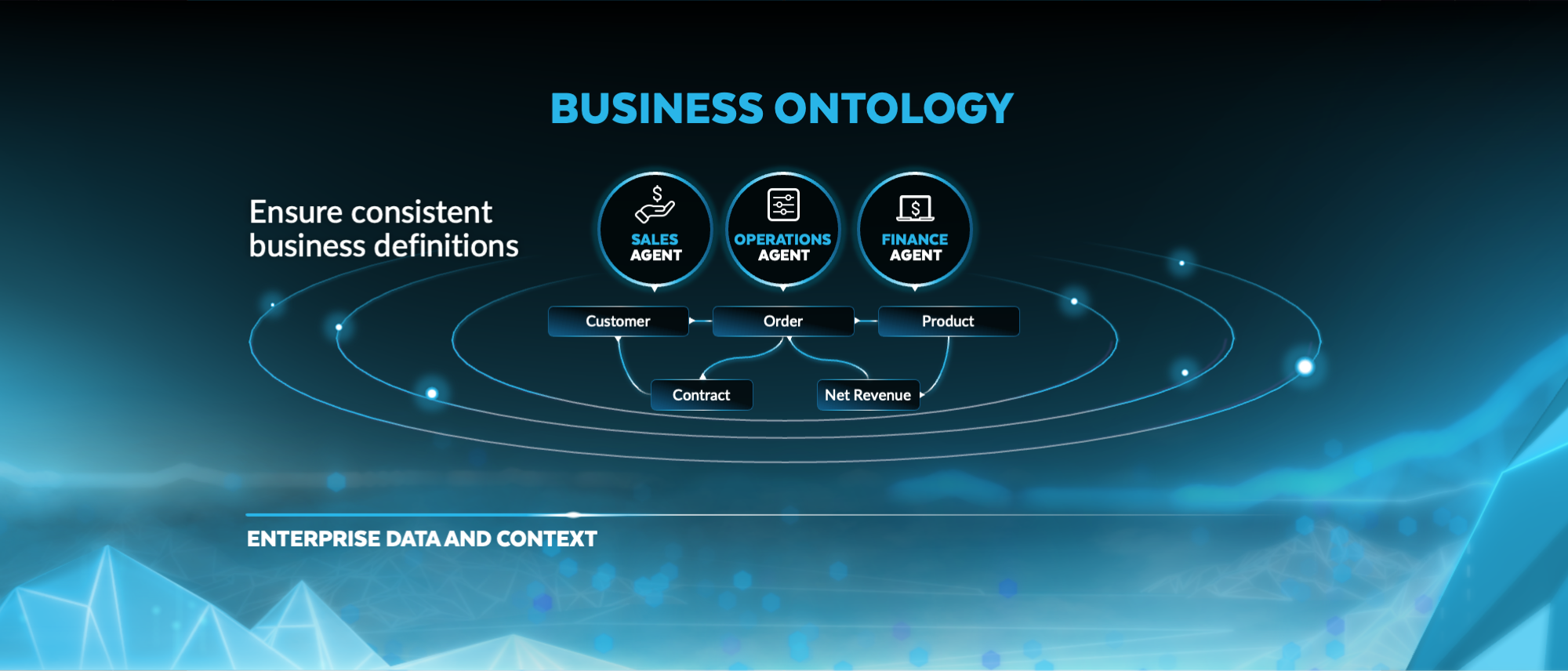
Today we’re announcing Business Ontology (public preview soon), a governed way for teams to define, own and approve shared business terms, entities, relationships and metrics and to connect them to the data and models that implement them. Part of Snowflake Horizon Context**,** the governed context layer in Horizon Catalog, Business Ontology gives people and AI agents the same approved definitions, so agents can interpret enterprise data the way the business does. Teams can reuse that knowledge across agents and applications without redefining it for each tool, while preserving differences across domains such as sales, finance and marketing.
For example, an agent answering a revenue question needs to know how finance defines "revenue" and how it relates to orders and customers. That knowledge usually lives across BI models, dbt projects and the experience of long-tenured employees, and teams often rebuild it for each new agent. If an agent gets it wrong, people make decisions based on the wrong number and lose trust in AI answers. Business Ontology gives teams one official place to record that knowledge. Horizon Context brings together knowledge from the tools teams already use. Its out-of-the-box metadata connectors collect schemas, query logs, dashboard definitions and usage signals from sources such as Tableau, Power BI, dbt, SQL Server, Sigma, Omni and PostgreSQL. Cross-platform lineage then traces data from a source database through transformations to the dashboard that displays it. The result is a connected view of your data estate, giving teams a better understanding of where data comes from and how it is used, both inside and outside Snowflake.
To make it something agents can rely on, Snowflake offers three layers of context, each with a distinct role: Snowflake Cortex Sense (public preview soon) infers context automatically, Business Ontology governs business meaning, and Snowflake Semantic Views execute metrics.
Why three layers instead of one? Because each addresses a different problem, and no single layer can do all three well. Cortex Sense gives agents broad coverage of data estates right away, without your team having to first define every table and metric by hand. Business Ontology adds authority where it matters most, so people and agents work from approved business meaning. Semantic Views add precision, so each metric is calculated the same way every time.
The layers are not sequential: Customers can start with whichever layer solves their most pressing problem and add the others as they grow. Some teams may start with glossary needs; others may begin with executable metrics. Regardless of entry point, the three layers give every agent, app and person one consistent, authoritative business context.
Let’s dig into each.
Automate context with Cortex Sense #
For many teams, Cortex Sense is the natural place to start because it handles much of the background work. It gathers context as people query data, build dashboards and run pipelines, turning everyday work into business understanding with less time spent defining what each table and metric means and how they connect. Cortex Sense does this by building context from the metadata and usage patterns teams already produce, including query history, dashboards and dbt models. As the business changes, that understanding keeps pace, as Cortex Sense automatically updates its knowledge at your chosen cadence. Teams scope a business use case, connect the relevant existing context and refine it through feedback and evaluations, reducing the need to model every table manually. Cortex Sense intelligently identifies conflicting knowledge and asks teams which source to trust.
When teams are ready to govern their most important terms, Cortex Sense can create an initial draft in Business Ontology with proposed definitions, relationships and links to data, so no one starts from a blank page. Teams can scope a business use case, connect the relevant existing context and refine it through feedback and evaluations, reducing the need to model every table manually. Cortex Sense intelligently identifies conflicting knowledge and asks teams which source to trust.
Define business context with Business Ontology #
Business Ontology is where teams record what their most important business terms mean, who owns them and how they relate. Take "net revenue." Instead of every semantic view, dashboard and agent carrying its own version, an analyst defines it once (or imports it from an existing glossary), sets its scope to “finance,” names an owner, gets it approved and links it to the semantic view metric that calculates it (see Figure 2). From then on, agents and other teams work from that approved definition. Teams can:
- Ground agents in business concepts: Domain experts define concepts such as customers, orders and revenue — and how they relate — and engineers connect those definitions to data. Agents then interpret data through the business's own knowledge.
- Align metrics across semantic views: Teams link equivalent metrics in their own semantic views to one shared business definition, aligning meaning without forcing every team onto one implementation. Intentional differences are kept, too: A restaurant company might define same-store sales differently for each brand, with each version approved separately, labeled with its own brand and linked to the semantic view that calculates it.
- Help everyone find the right definition: Anyone can look up a term, see who owns it and whether it's approved, and follow it to where it's calculated. Brand and regional variants keep their scope.
Because these definitions shape decisions, organizations control who can create, edit and approve them with Horizon Catalog’s governance controls. AI suggestions and imported definitions are a starting point for review, and accountable owners decide what becomes official. When an approved definition conflicts with something Cortex Sense inferred, agents use the approved definition and Cortex Sense learns from it.
"Business Ontology gives every definition an accountable owner, links it to the data that implements it, and makes it the answer every agent returns. As early product adopters, this is what lets us put agents in front of our data with confidence."
Joe Tobey
Head of Data Product Engineering, dentsu
Apply definitions and logic just once with Semantic Views #
Semantic Views define how each metric is calculated, while Business Ontology governs what it means and who approved it. Each view packages a domain's metrics, dimensions and joins into a Snowflake object that agents, BI tools and SQL can query directly, so agents generate SQL from governed logic instead of guessing at it. Business Ontology links approved definitions to the semantic views that calculate them, but it doesn't change the calculation. That stays with each view's owners.
Quality context requires a platform that is open by design #
Business knowledge only pays off if it can move with the business. That's why Snowflake helped found Apache Ossie (incubating), the vendor-neutral open standard for semantic models, now backed by dozens of organizations, including Microsoft, Salesforce, dbt Labs, Qlik and ThoughtSpot. Semantic Views can import and export Ossie definitions, so metrics can travel between Snowflake and other Ossie-compatible tools instead of being rebuilt in each one. Agents outside Snowflake can also query Semantic Views through Model Context Protocol, with Horizon Catalog governing access.
"Semantic drift is one of the most underestimated risks in multi-partner data environments — and at Merkle, dentsu's data and technology agency, we operate inside some of the most complex ones in the industry. Snowflake's Business Ontology closes that gap at the infrastructure level, giving every definition an owner and every downstream system a single governed answer.”
Morten Lileng
Global Head of Engineering, dentsu
What analytics companies are saying about Snowflake Business Ontology #
Many people use BI and analytics tools to get answers to their questions, which means consistent business context is critical. Here's how Omni, Sigma and ThoughtSpot see the context challenge and the role Business Ontology plays in addressing it:
Omni
"Think of context like onboarding a new analyst; it's everything you’d teach them so they know when, why, and how to use things. Omni was built around a governed semantic model and has the only two-way integration with Snowflake Semantic Views, and now Business Ontology takes that foundation further by capturing approved business definitions. Together, we’re helping our shared customers build trusted context that can serve every user and agent.”
— Jamie Davidson, Co-founder and President of Omni
Sigma
“AI agents are only as reliable as the business context and definitions that power them. With Business Ontology, our mutual customers can define their business concepts once and seamlessly reuse them across Sigma AI to build governed applications, dashboards, and agents, and power trusted analytics in Sigma.”
— Zalak Trivedi, Director of Product Management at Sigma
ThoughtSpot
"Trusted AI depends on trusted business context. Snowflake Business Ontology gives enterprises a governed home for what their business terms mean, and ThoughtSpot continuously augments that context with captured knowledge from business users with Spotter, delivering accurate, explainable answers and actions for every user. Together, we're helping customers scale agentic analytics with confidence."
— Francois Lopitaux, Senior Vice President of Product at ThoughtSpot
Turn knowledge into a consistent enterprise asset with Business Ontology #
People change roles, tools are replaced and data models change. Too often, the knowledge behind them gets lost along the way. Business Ontology turns that knowledge into a durable company asset, with an accountable owner and a clear link to where each definition is calculated. Every new agent or application can start from what the business already knows.
If you’d like to dig deeper into Business Ontology, check out our hands-on lab and read our blog post “Meaning Before Metrics: How We Built a Governed Business Ontology for AI Agents.”
Frequently asked questions #
What is Snowflake Business Ontology?
Business Ontology (public preview soon) is a business modeling and governance layer in Snowflake Horizon Context. Organizations can use it to define business concepts, metrics and the relationships between them, independent of any single data model. Each definition records its owner and approval status and links to the semantic views, tables and views that implement it. Only approved definitions are served to AI agents in CoCo and CoWork, so agents work from the meaning that the organization stands behind instead of choosing among competing implementations.
Why do AI agents need business context?
Governed business context helps agents interpret data the way the business does so they can deliver more accurate responses. AI agents can access data, but they don’t automatically “understand” what business terms mean or how concepts relate. They need context: approved references that tell them which definition to trust, which policies to follow and what corporate knowledge to incorporate. Without that context, agents guess at meanings and relevant data sources and may give different answers to the same question.
How is Business Ontology different from Semantic Views?
Business Ontology defines what a business term means, who owns it and how it relates to other concepts. Semantic Views define how each metric is calculated, packaging metrics, dimensions and joins into objects that agents, BI tools and SQL can query directly. Business Ontology links equivalent metrics across semantic views to one shared, approved definition.
Can business definitions move between Snowflake and other tools?
Yes. Business Ontology can import and export business concepts, definitions and relationships to open formats, including Apache Ossie (incubating) and Resource Description Framework (RDF), so teams can reuse approved business knowledge in other tools instead of redefining it. Semantic Views can also import and export Ossie definitions, so metrics don't have to be rebuilt. Agents outside Snowflake can query Semantic Views through Model Context Protocol, with Horizon Catalog governing access.