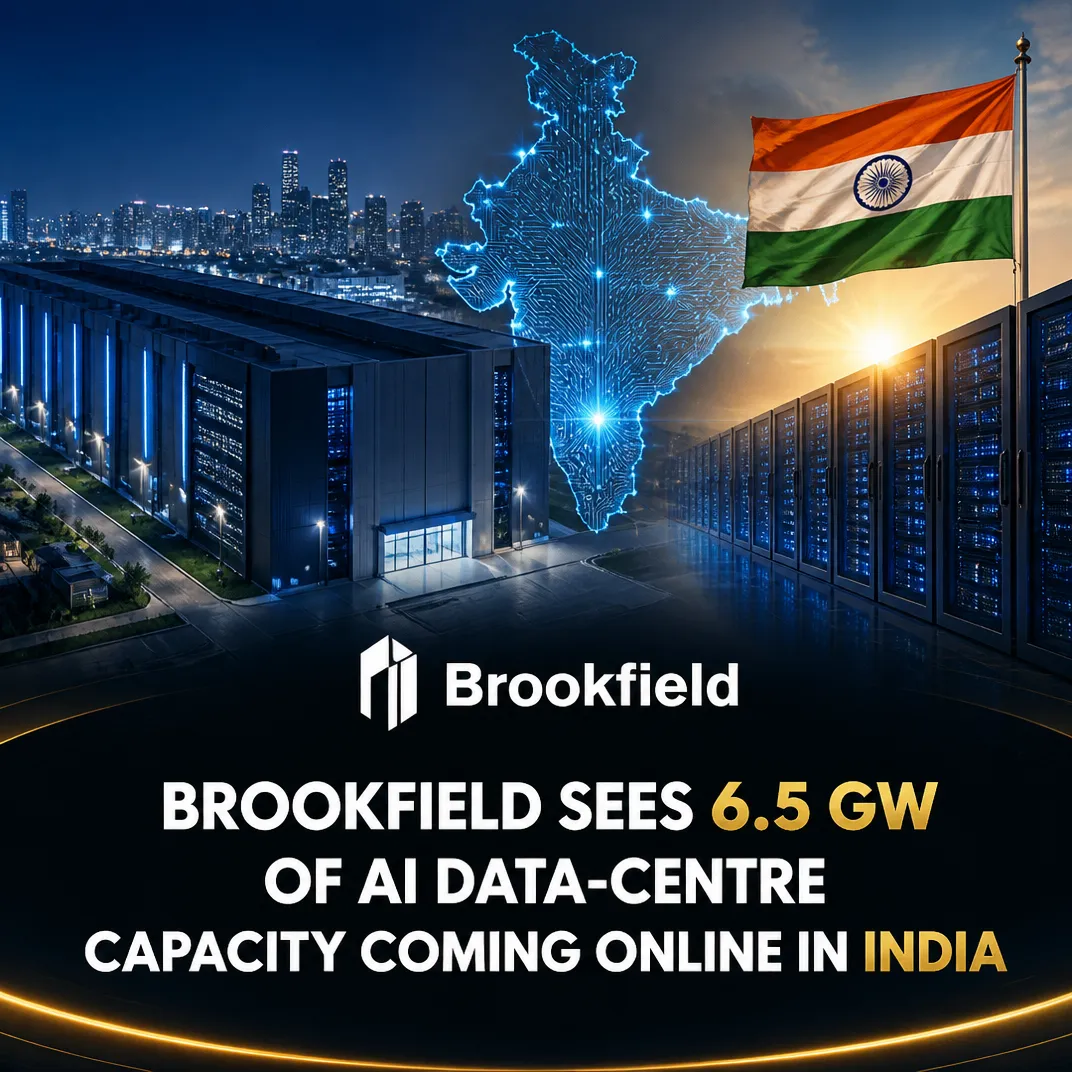
July 28, 2026, (Inside AI) — Brookfield Asset Management projects 6.5 gigawatts of AI data-centre capacity will come online in India within the next five years, a senior executive said on Tuesday. The forecast signals a massive infrastructure build-out to support the country's surging artificial intelligence demands.
The announcement was made in Singapore, highlighting India's emergence as a key node in global AI infrastructure. This capacity equals roughly the output of 6 large nuclear power plants, underscoring the energy scale required for next-generation computing.
India's AI compute needs are growing at an annual rate exceeding 40%, driven by cloud adoption, enterprise digitization, and local language model training. The nation's data-centre market is expected to attract over $20 billion in investments by 2029, according to a recent Avendus Capital report.
Brookfield, which manages over $900 billion in assets, has been expanding its digital infrastructure portfolio globally. The firm already operates data centres across North America, Europe, and Asia-Pacific. Its India push aligns with the government's National AI Strategy, which aims to position the country as a global AI hub.
The executive did not specify exact locations, but industry sources point to Mumbai, Chennai, and Hyderabad as likely hubs due to existing fibre connectivity and power availability. A single hyperscale AI cluster can consume over 100 megawatts, making energy sourcing a critical challenge in a country where peak power deficits still occur.
India's current total data-centre capacity stands at approximately 1.5 GW, meaning Brookfield's projection represents a more than fourfold increase. This growth mirrors global trends where IEA data shows data-centre electricity use could double by 2030, with AI workloads as the primary driver.
Competing firms like Adani Group and Reliance Industries have also announced multi-gigawatt data-centre plans, intensifying the race for land, renewable energy, and skilled talent. However, water scarcity for cooling and grid constraints could slow execution, as highlighted in a 2025 Indian Institute of Science study on sustainable data centres.
Energy Demands Outpace Renewable Supply #
Powering 6.5 GW of AI infrastructure requires around 57 terawatt-hours annually, equivalent to 5% of India's current electricity consumption. While Brookfield has committed to net-zero operations, sourcing firm, round-the-clock clean power remains elusive. Most Indian data centres still rely on grid mixes dominated by coal.
Innovations in liquid cooling and AI-optimized chip designs from NVIDIA and AMD could improve energy efficiency, but absolute demand will keep rising. The executive noted that Brookfield is exploring onsite solar and battery storage to mitigate reliability risks, though no contracts have been signed.
Regulatory Hurdles Loom Over Rapid Expansion #
India's data localisation policies and evolving privacy laws add complexity. The Digital Personal Data Protection Act mandates certain AI training data remain within borders, directly fuelling demand for domestic capacity. Yet, lengthy environmental clearances for large-scale construction could delay projects by 12-18 months.
Brookfield's announcement comes as global hyperscalers like Microsoft and Amazon Web Services aggressively expand in India, with combined investments exceeding $15 billion. The capacity surge may also boost local AI startups by reducing latency and compute costs, though benefits will likely accrue first to large enterprises.