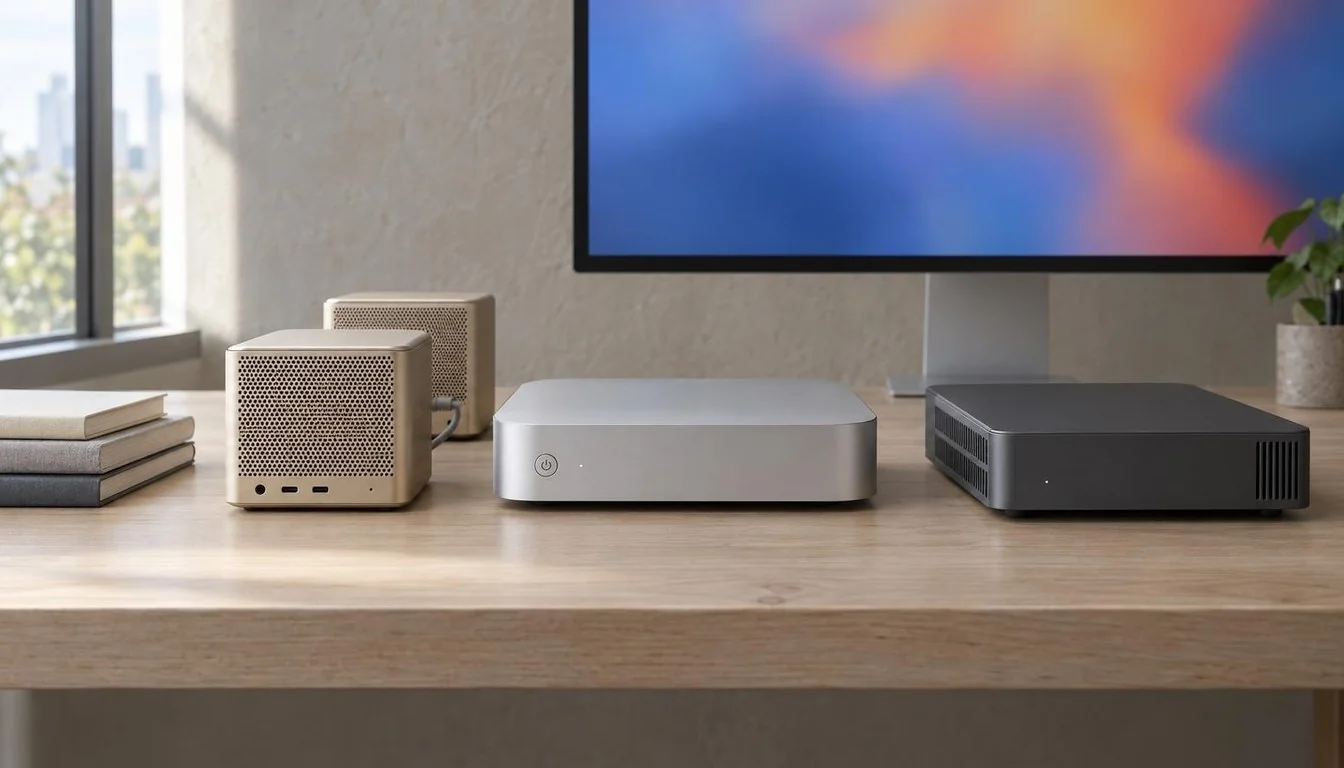
Pick a desktop for local AI in late October 2026 and the price tags have moved under your feet. NVIDIA now sells DGX Spark in two forms: the 128GB box at $6,950 on its own marketplace, and a 64GB partner model from $4,999 that The Register described at launch as half the RAM and half the storage. Apple, meanwhile, has shipped the M5 generation of Mac Studio with a chip ceiling of 512GB of unified memory. The question behind the DGX Spark vs Mac Studio search is simple: which small box runs the models you care about for the least money?
A third contender complicates the picture. AMD’s Ryzen AI Max+ 395 (the chip formerly code-named Strix Halo) now sits inside the Ryzen AI Halo developer platform, and AMD has added a newer Max+ PRO 495 variant that raises the memory ceiling to 192GB. All three machines share one idea: a big pool of memory that the CPU and GPU address together, so a model that would never fit on a 24GB graphics card can load in one piece. If you plan to run an LLM on DGX Spark, the hardware choice below decides how large that model can be.
Don't miss new tech stories on Google
Add Shattered once in the Google app and our stories show up in your news suggestions.
DGX Spark vs Mac Studio: The Short Answer #
Buy the Mac Studio if memory capacity and a quiet general-purpose desktop matter most. The M5 Max starts at $2,499 and the M5 Ultra at $5,499, and the Ultra is the only machine in this comparison with a documented path to 512GB of unified memory. Buy the DGX Spark if your work depends on CUDA, NVIDIA’s container stack, or the ability to chain several boxes together, since NVIDIA documents manual clusters of up to eight units. Consider the Ryzen AI Halo if you want an x86 system with up to 192GB of memory and are comfortable with the AMD software stack, but note that AMD has not published an official price in the material we reviewed.
No independent lab has published a same-conditions token-per-second shootout across all three current machines. Every throughput figure in this piece is therefore a vendor claim or a single-reviewer result, and we label each one that way. The decision rule that survives that gap is memory: count the gigabytes your target model needs at your chosen quantization, add room for context, and pick the cheapest machine that clears the bar.
| Verdict at a glance | Best pick | Why |
|---|---|---|
| Largest models in one box | Mac Studio M5 Ultra | Up to 512GB unified memory (Apple) |
| CUDA and NVIDIA tooling | DGX Spark | GB10 Grace Blackwell, DGX OS, NVIDIA AI stack |
| Lowest entry price | Mac Studio M5 Max | From $2,499 ($2,299 education) |
| Multi-box scaling | DGX Spark | Up to eight units, 1TB with 128GB models |
| x86 with big GPU memory | Ryzen AI Halo | Up to 192GB, up to 160GB usable as VRAM |
Full Specs Table: Four Machines, 13 Rows #
The table uses only figures published by NVIDIA, Apple and AMD on their own product pages and newsrooms. Where a maker has not published a number, the cell says so instead of guessing. The Ryzen AI Halo column covers both versions of the AMD developer platform: the Max+ 395 and the newer Max+ PRO 495.
| Spec | NVIDIA DGX Spark | Mac Studio M5 Max | Mac Studio M5 Ultra | AMD Ryzen AI Halo |
|---|---|---|---|---|
| Chip | GB10 Grace Blackwell superchip | Apple M5 Max | Apple M5 Ultra | Ryzen AI Max+ 395 or Max+ PRO 495 |
| CPU cores | See NVIDIA spec sheet | 18-core | Up to 36-core | Up to 16 Zen 5 cores |
| GPU | Blackwell GPU on the GB10 | Up to 40-core | Up to 80-core | 40 RDNA 3.5 compute units |
| Maximum memory | 128GB (64GB via OEM partners) | Up to 128GB | Up to 512GB | Up to 192GB (PRO 495) |
| Memory type | LPDDR5x, coherent unified | Unified memory | Unified memory | LPDDR5x unified |
| GPU-usable memory | Shared coherent pool | Shared pool | Shared pool | Up to 160GB as VRAM (PRO 495) |
| AI throughput claim | 1 petaFLOP of parallel throughput | No single figure published | No single figure published | 55 TOPS NPU (PRO 495), 50 TOPS and up to 60 TFLOPS (395) |
| Model-size claim | Fine-tune up to 70B parameters | Full-scale LLMs locally (no figure) | Full-scale LLMs locally (no figure) | 300B+ at 4-bit (PRO 495, AMD claim) |
| Multi-box scaling | Manual clusters of up to eight units | Not documented in sources reviewed | Not documented in sources reviewed | Not documented in sources reviewed |
| Operating system | DGX OS (Linux 7.0 kernel support) | macOS 27.2 | macOS 27.2 | Windows systems, AMD ROCm software |
| Footprint | 150 x 150 x 50.5 mm | Not covered in sources reviewed | Not covered in sources reviewed | 150 x 150 x 45.4 mm |
| Starting price | $4,999 (64GB), $6,950 (128GB) | $2,499 | $5,499 | No confirmed official price |
| Availability | 64GB shipped Oct. 23, 2026 | On sale since Sept. 22, 2026 | On sale since Sept. 22, 2026 (512GB option due late October) | Orderable through Micro Center since Oct. 12, 2026 |
Two rows deserve a second look. First, the “GPU-usable memory” row: AMD states that up to 160GB of the PRO 495’s pool can serve as VRAM, which is a hard allocation rule, while Apple and NVIDIA describe a single shared pool without a published split. Second, the 512GB option for the M5 Ultra appears on Apple’s page as “coming late October,” and the price for that configuration had not been confirmed as of October 27.
What Changed in October 2026 #
Three launches in five weeks reshaped this category. Apple announced the Mac Studio with M5 Max and M5 Ultra on August 25, and most configurations reached customers on September 22. NVIDIA announced the 64GB DGX Spark on October 2, raised the 128GB model to $6,950 from the $3,999 launch price of October 2025, and started 64GB shipments through partners on October 23. AMD introduced the Ryzen AI Halo developer platform around the Max+ PRO 495 on October 12 and said buyers could order it through Micro Center.
The DGX Spark price move is the one that surprised buyers. The 128GB unit now lists at $6,950, up from its reported $3,999 launch price in October 2025, and reports tied the change to memory-supply pressure. The 64GB model exists partly to give shoppers a cheaper door into the same silicon. Sipeed’s MaixStation, pitched as a DGX Spark rival that undercuts it, shows how fast challengers moved once the $6,950 figure landed.
Predecessors and what is not on sale yet
The M5 Mac Studio succeeds the earlier M4 Max and M3 Ultra models, and Apple now sells the M5 Max and M5 Ultra as the current lineup. NVIDIA also previewed a separate product on October 21, DGX Station for Windows, built on the GB300 Grace Blackwell Ultra Desktop Superchip. It is announced, not yet available, and no price or ship date has been published. NVIDIA’s RTX Spark Windows laptops are a different platform again and do not replace the GB10-based DGX Spark.
Pricing Compared: What Each Box Costs on October 27, 2026 #
Sticker prices tell a clear story at the entry level and a murky one at the top. Apple’s own Mac Studio announcement lists the M5 Max from $2,499 and the M5 Ultra from $5,499, with education prices of $2,299 and $5,099. NVIDIA lists the 128GB DGX Spark at $6,950 and the 64GB partner version from $4,999. AMD has said Ryzen AI Halo can be ordered through Micro Center but has not published a price that we could confirm.
| Configuration | Starting price (USD) | Memory | Status |
|---|---|---|---|
| DGX Spark 64GB (OEM partners) | $4,999 | 64GB | Shipping since Oct. 23, 2026 |
| DGX Spark 128GB (NVIDIA marketplace) | $6,950 | 128GB | On sale, price raised Oct. 2026 |
| DGX Spark 128GB at launch (Oct. 2025) | $3,999 | 128GB | Historical price |
| Mac Studio M5 Max | From $2,499 ($2,299 education) | Up to 128GB | On sale since Sept. 22, 2026 |
| Mac Studio M5 Ultra | From $5,499 ($5,099 education) | Up to 512GB | On sale, 512GB option due late October |
| Mac Studio M5 Ultra 512GB | Not confirmed | 512GB | Announced, price pending |
| Ryzen AI Halo (Max+ 395 or PRO 495) | No confirmed official price | Up to 192GB | Orderable via Micro Center |
Run the numbers and the DGX Spark pricing logic gets awkward. The 64GB unit starts at $4,999 and the 128GB unit lists at $6,950, so the smaller box costs less up front but more per gigabyte of memory. A cluster shows the same pattern: eight 64GB units reach 512GB, while eight 128GB units reach 1TB, and the 128GB build costs more in total but less per gigabyte. The Mac Studio side has no equivalent table, because Apple prices memory upgrades by configuration and we did not find a confirmed price for the 128GB M5 Max or the 512GB M5 Ultra.
One more price signal: a reported Amazon deal put the M5 Max Mac Studio at $2,299 on October 10, but that figure came from a single listing and Apple’s official price remains $2,499. Treat discounts as a bonus, not a planning number.
Memory: The Spec That Decides Which Models Run #
Local inference lives or dies on whether the weights fit. A model’s weight footprint is roughly its parameter count multiplied by the bytes per parameter, so a 70B model at 4-bit needs about 35GB, a 120B model about 60GB, and a 300B model about 150GB. Those are back-of-envelope estimates that ignore the context cache, which can add tens of gigabytes at long context lengths. They still explain why vendors quote parameter counts at 4-bit.
| Model class | Approx. weights at 4-bit | DGX Spark 64GB | DGX Spark 128GB | Mac Studio M5 Max (128GB) | Mac Studio M5 Ultra (512GB) | Halo PRO 495 (192GB) |
|---|---|---|---|---|---|---|
| 70B dense | ~35GB | Fits | Fits | Fits | Fits | Fits |
| 120B (e.g. Nemotron 3.5 Super VL) | ~60GB | Tight, little context room | Fits | Fits | Fits | Fits |
| 200B class | ~100GB | No | Fits, short context | Fits, short context | Fits | Fits |
| 300B class | ~150GB | No | No | No | Fits | Fits (AMD claim, 160GB as VRAM) |
| Frontier-scale 500B+ | ~250GB+ | No | No (cluster needed) | No | Fits | No |
The table is our arithmetic, not a vendor benchmark, and the “fits” verdicts assume a 4-bit quantization and a moderate context window. The pattern holds regardless: the 64GB DGX Spark is a starter machine for models up to roughly the 100B class. NVIDIA’s own Nemotron 3.5 Bolt 74B-A9B uses native 2-bit quantization to fit in 24GB, which shows where vendor engineering is heading. When labs shrink models to fit small memory pools, a 64GB box stretches further than the raw gigabytes suggest.
The 512GB M5 Ultra changes the shape of the market. It is the only single box here that holds a 300B-class model with generous context, and the same logic explains the interest in Apple and Meta running a Muse Spark open model across two Macs. Apple has also said the 512GB option arrives in late October, which means buyers who need it should watch the Apple Store for the order date and the final price before committing to anything else. TechRepublic has a buyer-oriented rundown of that launch.
Performance and Benchmarks: What Is Actually Published #
Honesty first: none of the three makers has published a benchmark that pits its machine against the other two under matched conditions. What exists are peak-throughput claims on product pages and a handful of hands-on reviews. The table lists what each source says and what it does not.
| Source | Type | Published figure | Limit on use |
|---|---|---|---|
| NVIDIA DGX Spark product page | Vendor spec | 1 petaFLOP of parallel throughput, fine-tune up to 70B parameters | Peak low-precision figure, not tokens per second |
| AMD Ryzen AI Halo page | Vendor spec | Up to 60 TFLOPS and 50 TOPS (395), 55 TOPS (PRO 495), 300B+ at 4-bit with 160GB VRAM | Capacity claim, no latency data |
| Apple Mac Studio announcement | Vendor spec | M5 Max up to 40-core GPU, M5 Ultra up to 80-core GPU, up to 512GB | No tokens-per-second figure for LLMs |
| PCMag M5 Ultra review | Independent hands-on | Tested the M5 Ultra for heavy AI use | Covers one machine, not a three-way test |
Apple has claimed the new Mac Studio delivers up to 4.3x faster local AI performance than its prior comparison point, according to Apple material dated September 11. That figure compares Apple to Apple and says nothing about DGX Spark. NVIDIA’s 1 petaFLOP number comes from low-precision math that rarely maps cleanly to the decode speed you feel in a chat window. Decode speed depends mostly on how fast the chip can stream weights from memory, which is why memory bandwidth, not teraflops, tends to predict tokens per second on these unified-memory boxes.
Prefill speed, the time to digest a long prompt, leans on raw compute instead. That is where Blackwell tensor hardware and mature CUDA kernels give the DGX Spark a structural edge on long-context and batch workloads, while the Mac Studio’s wide memory system helps most with generation on very large models. For wider context on how Apple’s silicon stacks up against x86 on AI tasks, see the ARM vs x86 comparison of the M5 Ultra Mac Studio. Verify any bandwidth number against the maker’s spec sheet before you trust a blog table, including ours.
A thermal flag on the DGX Spark
One developer-forum post on October 17 reported temperatures near 95°C and abrupt shutdowns during a heavy 122B-parameter inference run on a DGX Spark, with the poster wondering whether cooling or USB-C power delivery played a part. It is a single report, not an NVIDIA acknowledgement, and no recall or advisory has been issued. It does suggest that sustained, maximum-load jobs deserve a thermal test on your own unit before you build a production workflow around the box.
Software Stack: CUDA, MLX and ROCm #
Hardware gets the headlines, but the software stack decides how many hours you lose to setup. NVIDIA ships the DGX Spark with DGX OS and its AI software stack, and the October 2026 update added a Wi-Fi Assistant for appliance mode, dynamic display-reserved memory, native Cloud-init support and Linux 7.0 kernel support. NVIDIA also says the box received day-one support for new Nemotron, GLM, DeepSeek, Qwen, MiniMax and FLUX.3 models, which matters because open-weight releases land fast and CUDA is where they land first.
Apple’s path runs through macOS 27.2 and its own frameworks. Apple announced Core AI on August 25 as a framework for building, running and deploying models on Apple silicon, and its press material says the unified memory, CPU, GPU and Neural Engine support local deployment of full-scale LLMs and custom models. Most Mac users today reach for MLX or llama.cpp builds with Metal support, and both handle large quantized models well. The gap shows up in training and fine-tuning tools that assume CUDA, where Mac users often have to wait for ports.
AMD’s answer is ROCm. The company announced ROCm 10 on August 27 as an AI-native developer experience and launched AMD AI Playbooks on April 27 with step-by-step guides for local workflows on Ryzen AI PCs. It also documented day-one MiniCPM-V 4.7 support on Ryzen AI Max integrated graphics, validated on the Max 395 with Radeon 8060S graphics. ROCm has closed much of the gap with CUDA, but expect to meet more rough edges on new model architectures than you would on NVIDIA. NVIDIA is also pushing a bridge between boxes through its PAIR router beta that pools RTX, DGX Spark and Mac hardware, a reminder that mixed fleets are becoming normal.
Clustering and Scaling Beyond One Box #
NVIDIA built the DGX Spark to be stacked. On October 21 the company said it supports manually configured clusters of up to eight units, which gives 1TB of unified memory when all eight carry 128GB. It also introduced the NVIDIA Sync Cluster Assistant for pairing systems and announced a Sync Model Launcher for later in October, which NVIDIA says will download a suitable model or container, connect it to OpenCode and load DGX Spark Skills automatically. A SFFGeek report on the 64GB launch ties the cheaper model directly to that clustering story.
Clustering is a real differentiator, with limits. Splitting one model across boxes means every token crosses a network link that is far slower than local memory, so decode speed falls as you add nodes. The value is capacity and concurrency: larger models, longer contexts, more simultaneous agents. NVIDIA’s technical team published a write-up on October 22 about running frontier-class models across eight DGX Spark nodes, which signals the intended use. Treat it as a way to reach models that no single small box holds, not as a way to go faster.
The material we reviewed does not confirm a comparable first-party cluster workflow from Apple or AMD. Mac owners can still link machines through community tools, but you are on your own for setup and support. For most buyers the cleaner move is the one-box route: if a single 512GB M5 Ultra holds your model, you skip the networking tax entirely. Price that against a cluster of eight 64GB Sparks before you decide that clustering is the cheaper path.
Ryzen AI Halo: The Third Option #
AMD’s pitch is an x86 mini PC with a very large memory pool and a familiar Windows workflow. The Ryzen AI Max+ 395 carries 16 Zen 5 cores, Radeon 8060S graphics with 40 compute units, a boost clock up to 5.1 GHz and a 120 W power target, according to AMD’s Halo page, which also lists up to 60 TFLOPS and 50 TOPS for that configuration. The same page lists a Ryzen AI Max+ PRO 495 platform alongside it. Partner designs built on the chip include Ryzen AI Halo PCs and laptops such as the ASUS ROG Flow Z13 and TUF A14.
Max+ 395 vs Max+ PRO 495
On October 12 AMD introduced the Ryzen AI Halo Developer Platform built around the Ryzen AI Max+ PRO 495. It keeps 16 Zen 5 cores and 40 RDNA 3.5 compute units but lifts the NPU to 55 TOPS and the unified-memory ceiling to 192GB of LPDDR5x. AMD says up to 160GB can be allocated to the GPU as VRAM and that the PRO 495 can run 300-billion-parameter and larger models at 4-bit quantization. The Halo page lists both the PRO 495 and the 395 platforms, so the 395 stays a current product and the 495 is the newer, larger option.
Pricing remains the sore spot. AMD says the Halo can be ordered from Micro Center, but the pages we fetched give no confirmed price, and AMD’s own cloud-versus-local cost calculation cites a 128GB Halo Box with pricing as of May 2026 rather than a current figure. Retail machines are appearing, as in this look at Gorgon Halo PC pricing, but verify the final price at checkout.
Where AMD fits
The Halo wins on x86 compatibility, a compact footprint (150 x 150 x 45.4 mm, about 5 mm lower than the DGX Spark) and a large GPU-addressable pool. It loses on ecosystem depth, since fewer local-AI tools ship with first-class ROCm builds, and on clustering. AMD has also been widening the pitch. On October 5 it described Ryzen AI Max+ systems with 128GB of unified memory as able to run models up to 200 billion parameters locally, and on September 24 it said Max systems could run Perplexity’s Portable Computer on Windows for subscribers. Those are AMD claims, not independent tests, so test your model before you buy.
Early head-to-head numbers between AMD’s newest chips and NVIDIA’s local-AI parts are circulating, such as the Gorgon Halo benchmarks aimed at RTX Spark. Read them with the same caution as any vendor-adjacent data, and note that RTX Spark is NVIDIA’s Windows-PC platform, a different product from the GB10-based DGX Spark.
Real-World Examples: Who Runs What #
Spec sheets only go so far, so here are six documented deployments and what each tells you about fit.
- Robotics demo on DGX Spark. NVIDIA showed a DGX Spark powering the Reachy Mini robot in an interactive photo booth with Pollen Robotics (Hugging Face) at CES 2026. The lesson: a compact box can drive a live, latency-sensitive model next to a robot, and CUDA tooling makes that integration routine.
- Eight-node frontier models. NVIDIA’s October 22 technical blog describes running frontier-class models across eight DGX Spark nodes. It shows the clustering path working at the top of the range, at the cost of buying eight boxes.
- Vision-language-action on a Ryzen mini PC. AMD published a September 29 tutorial for running the MolmoAct2 vision-language-action model on a Ryzen AI Max+ 395 mini PC. It suggests the 395 suits robotics research where x86 and Windows tooling are already in place.
- University edge AI. AMD described a Beihua University deployment on August 14 that reportedly uses Ryzen AI Max+ 395 systems for real-time sports analysis and edge-AI training. Treat it as a vendor case study, since it comes from AMD’s own material.
- Two Macs, one open model. Apple and Meta paired two Macs to run Muse Spark Open, a case where a model too big for one machine ran across two on Apple silicon.
- Serviceable hardware. Apple added Mac Studio parts and tools to its Self Service Repair program on October 20, which matters if your Studio sits in a production rack and downtime costs money.
The common thread is that every deployment above was built around one vendor’s software, and none was a cross-vendor bake-off. The forum thermal report from earlier is a reminder that even the best-supported box needs a burn-in test. Run your own workload for a full day on any machine you buy, because vendor demos rarely match your prompt mix.
Use-Case Recommendations: Six Buyer Profiles #
1. Solo developer building agents. Choose the DGX Spark 64GB at $4,999 if your stack is Python, containers and CUDA, or the Mac Studio M5 Max at $2,499 if you also want a daily-driver desktop. Both run 70B-class models. The Mac costs half as much, and the Spark gives you NVIDIA’s agent tooling, including OpenShell and the Sync workflow.
2. Researcher fine-tuning models. Choose the DGX Spark 128GB at $6,950. NVIDIA positions it for fine-tuning models up to 70B parameters, and the training ecosystem assumes CUDA. Apple silicon handles inference well, but fine-tuning libraries still land on NVIDIA first.
3. Team that needs the largest models locally. Choose the Mac Studio M5 Ultra, and wait for the 512GB option if your model is 300B-class. Nothing else here holds that much in one chassis. Budget at least $5,499 and expect the 512GB configuration to cost more.
4. Privacy-bound office (legal, health, finance). Any of the three keeps data on the premises. Pick the Mac Studio when IT already manages Macs and wants minimal new tooling, and the DGX Spark when you need NVIDIA’s enterprise manageability features, which NVIDIA says apply to both the 64GB and 128GB models.
5. Windows-first shop or x86 hobbyist. Choose Ryzen AI Halo, accept the ROCm learning curve, and confirm the price before ordering. The 192GB ceiling on the PRO 495 beats every machine here except the 512GB Ultra.
6. Budget-capped student or tinkerer. Choose the cheapest box that fits your model, which today is the M5 Max at $2,299 with the education price. If a 24GB-class model such as Nemotron 3.5 Bolt 74B-A9B at 2-bit meets your needs, even a far cheaper machine works, and the hardware section tracks lower-cost options.
The Memory Crunch Behind These Prices #
All three platforms sell the same scarce thing: fast memory soldered next to the processor. That explains why the headline price moves of fall 2026 cluster around capacity. The Register framed the 64GB DGX Spark launch as a response to a memory crunch, and Santage and other outlets tied the jump from $3,999 to $6,950 on the 128GB unit to reported supply pressure. NVIDIA’s answer was to split the product line, offering half the memory at a lower entry price through partners while keeping the full-memory model on its own marketplace.
Apple handled the same pressure differently. It kept entry prices at $2,499 and $5,499 for the M5 Max and M5 Ultra Mac Studio, and it has not yet confirmed what the 512GB step-up will cost. A non-official report said Apple raised the starting price of the Mac Studio from $1,999 to $2,499 earlier in 2026, but we could not confirm that move from Apple itself, so treat it as unverified. What is firm is that the $2,499 entry point is the number on Apple’s page today.
For buyers the practical lesson is timing. Memory-heavy configurations are the ones most exposed to further price changes, and the cheapest machine per gigabyte today may not be the cheapest next quarter. If a local-AI project has a firm start date, locking in a configuration now beats waiting for a price drop that supply conditions do not obviously support. If the project can wait, the open questions in the next sections may resolve in your favor within weeks.
Why unified memory changed the buying rules
A desktop graphics card ties model size to its VRAM, and the best consumer cards top out far below the 128GB class. Unified-memory machines break that limit by letting the GPU address most of the system pool. The trade is bandwidth: a discrete card moves data faster per dollar, but it cannot hold the model at all if the weights exceed its VRAM. That is why a $2,499 Mac or a $4,999 Spark can run a model that a far more expensive gaming PC cannot load in one piece.
Cost Per Gigabyte and Cluster Math #
Because memory capacity gates which models run, price per gigabyte is the fairest single yardstick. It ignores speed, so read it as a floor on what you pay to hold a model, not as a measure of how fast the model answers. The table uses only list prices confirmed in this piece and marks any configuration whose price is not confirmed yet.
| Build | Total memory | List price | Cost per GB | Notes |
|---|---|---|---|---|
| 1x DGX Spark 64GB | 64GB | $4,999 | about $78 | OEM partners only |
| 1x DGX Spark 128GB | 128GB | $6,950 | about $54 | NVIDIA marketplace |
| 2x DGX Spark 128GB | 256GB | Not listed | about $54 | Manual cluster, network-bound |
| 8x DGX Spark 64GB | 512GB | Not listed | Not listed | Top of NVIDIA’s documented cluster size |
| 8x DGX Spark 128GB | 1TB | Not listed | Not listed | NVIDIA’s stated maximum cluster |
| 1x Mac Studio M5 Max (entry) | Entry config, up to 128GB | $2,499 | Depends on config | Memory upgrade prices not confirmed |
| 1x Mac Studio M5 Ultra (entry) | Entry config, up to 512GB | $5,499 | Depends on config | 512GB price pending |
Two conclusions fall out of the table. First, reaching 512GB with Sparks takes eight 64GB units, each starting at $4,999, so a single 512GB Mac Studio M5 Ultra would need to cost far more than the $5,499 entry price before clustering became the cheaper route. Second, doubling a 128GB Spark to two units doubles the bill without lifting the per-gigabyte rate, which means the second box buys capacity, not savings. Check Apple’s configurator for the memory step-ups before you finalize any budget.
Migration Guide: Moving a Local AI Workload Between Boxes #
Most readers already run something: a cloud API, a gaming GPU, or an older workstation. The steps below move that workload onto a DGX Spark, a Mac Studio or a Ryzen AI Halo with the least rework.
Step 1: Inventory models and measure memory
List every model you call, its parameter count, the quantization you can accept and the longest context you need. Multiply parameters by bytes per weight, then add 15 to 30 percent for the context cache and runtime overhead. That number, not a spec sheet headline, tells you whether you need 64GB, 128GB or something larger.
Step 2: Choose a portable format and runtime
GGUF files served by llama.cpp run on all three platforms, which makes them the safest first target. On the DGX Spark you can step up to vLLM or NVIDIA’s containers for throughput. On the Mac, MLX builds usually beat generic runtimes. On the Ryzen Halo, use the ROCm or Vulkan paths documented in AMD’s AI Playbooks. Keep one portable build around as a fallback.
llama-server -m ./models/your-model-q4.gguf --host 0.0.0.0 --port 8080 -c 32768

curl http://spark.local:8080/v1/chat/completions \
  -H "Content-Type: application/json" \
  -d '{"model":"local","messages":[{"role":"user","content":"Say hello in five words."}]}'
Step 3: Point your application at a local endpoint
Both llama.cpp and vLLM expose OpenAI-style endpoints, so most apps need only a new base URL and a placeholder key. Change that one setting, keep your prompts identical and log both outputs side by side for a week. Differences in chat templates and sampling defaults cause more regressions than the hardware does.
Step 4: Benchmark your own workload
Because no neutral three-way benchmark exists, build your own. Record time to first token, decode tokens per second and peak memory for five representative prompts at your real context length. Run each test three times, discard the first, and watch temperatures on sustained runs. A box that wins a one-minute test may throttle in hour two.
Step 5: Cut over with a rollback path
Route a small share of traffic to the new box first, keep the old path warm for two weeks, and only then retire it. If you move from Mac to DGX Spark or the reverse, re-quantize from the original weights instead of converting a quantized file, since repeated quantization degrades quality.
Pros and Cons of Each Platform #
| Platform | Pros | Cons |
|---|---|---|
| NVIDIA DGX Spark | CUDA and NVIDIA AI stack, day-one support for new open models, official clusters of up to eight units, 64GB entry option at $4,999, enterprise manageability features | 128GB price rose to $6,950, 128GB ceiling per box, one forum report of thermal trouble under heavy load, CPU and thermal details to verify |
| Mac Studio M5 Max / M5 Ultra | Lowest entry price at $2,499, up to 512GB on the Ultra, full general-purpose desktop, macOS and Core AI, Self Service Repair parts available | CUDA-first tools lag on macOS, no first-party clustering workflow in sources reviewed, 512GB price not yet confirmed, Apple publishes no LLM token-rate figures |
| AMD Ryzen AI Halo | Up to 192GB with up to 160GB as VRAM, x86 compatibility, compact 45.4 mm height, strong vendor support through AI Playbooks and ROCm | No confirmed official price, smaller local-AI ecosystem than CUDA, no documented clustering, claims await independent tests |
What to Watch Before You Buy #
Five open items could change the ranking in the next few weeks. Check each one before you pay for a configuration that depends on it.
- Apple’s 512GB M5 Ultra. The order date and price are the biggest unknowns. If the premium over the $5,499 entry price is modest, the Ultra becomes the default choice for large models. If it is steep, the 128GB DGX Spark and the Halo PRO 495 look better.
- NVIDIA Sync Model Launcher. NVIDIA said it arrives later in October. If it works as described, with automatic model download and OpenCode setup, it shortens the DGX Spark’s setup time and narrows the usability gap with the Mac.
- DGX Station for Windows. NVIDIA previewed it on October 21 with the GB300 Grace Blackwell Ultra Desktop Superchip. It has no published price or ship date, so it is a reason to wait only if your budget is far above $7,000.
- AMD’s Halo price. A firm price, and a few independent tokens-per-second tests, would move the Halo from shortlist to contender.
- Independent three-way benchmarks. Until a lab runs the same models at the same quantization on all three boxes, every speed claim here stays a vendor claim. Check outlets such as PCMag, which has already tested the M5 Ultra, for follow-ups.
If none of those items affect your plans, buy now. The machines are shipping, the software is current (the October 2026 DGX Spark update, macOS 27.2, and AMD’s ROCm 10 are all announced or shipping), and a month of waiting rarely changes which box fits your model.
Software versions to confirm on delivery
New hardware often ships with older software images. On a DGX Spark, confirm the October 2026 software release is installed, since it added support for both 64GB and 128GB systems, dynamic display-reserved memory and Linux 7.0 kernel support. On a Mac Studio, update to macOS 27.2 before you install your inference stack. On a Halo system, check the ROCm release against the model runtime you plan to use, because new model architectures sometimes need the latest drivers. Ten minutes of version checks can save a day of confusing errors.
Verdict: Which One Should You Buy? #
The data points to three clear picks. For most individual buyers who want local AI and a machine they can use for everything else, the Mac Studio with M5 Max at $2,499 is the best value: it costs half the 64GB DGX Spark, runs 70B-class models, and arrives with a mature desktop OS. For builders who live in CUDA, the DGX Spark is the better tool, with the 64GB model at $4,999 for prototyping and the 128GB model at $6,950 for fine-tuning and bigger inference jobs. For anyone who needs the biggest models in one chassis, the Mac Studio M5 Ultra with 512GB has no peer in this group, though you should wait for Apple’s final price.
The Ryzen AI Halo earns a spot on the shortlist, not the podium, until AMD publishes a firm price and independent testers publish numbers. Its 192GB ceiling and x86 flexibility are real strengths. The missing price tag and thinner tooling are the reasons we would not tell a general reader to buy one today.
| If you are… | Buy | Budget |
|---|---|---|
| A generalist who wants one machine | Mac Studio M5 Max | From $2,499 |
| A CUDA developer testing agents | DGX Spark 64GB | From $4,999 |
| Fine-tuning or serving 70B+ models | DGX Spark 128GB | $6,950 |
| Running 300B-class models locally | Mac Studio M5 Ultra 512GB | Price pending, base from $5,499 |
| An x86 or Windows-first team | Ryzen AI Halo (PRO 495) | Confirm price with the reseller |
The takeaway: memory capacity picks the winner before speed does. Size your model, read the table above, and buy the cheapest box that clears the bar with room for context. Revisit the decision when Apple prices the 512GB option and when independent three-way benchmarks arrive.
Frequently Asked Questions #
Is the DGX Spark or the Mac Studio better for local AI?
It depends on your software and your model size. The DGX Spark suits CUDA workflows and fine-tuning, while the Mac Studio offers a lower entry price ($2,499 vs $4,999) and a path to 512GB of memory on the M5 Ultra.
Is the 64GB DGX Spark enough?
It holds models up to roughly the 100B class at 4-bit with modest context. Larger models need the 128GB version, a cluster, or a bigger machine.
Why did the DGX Spark price go up?
The 128GB model rose to $6,950 on October 2, 2026 from a $3,999 launch price in October 2025. Reports linked the increase to memory-supply pressure, and NVIDIA added a 64GB partner model at $4,999 the same day.
When does the 512GB Mac Studio arrive and what will it cost?
Apple’s page says the 512GB option for the M5 Ultra is coming in late October. As of October 27 we found no confirmed price, so check Apple’s configurator before budgeting.
Is the Ryzen AI Max+ 395 still a current chip?
Yes. AMD still lists it on its Halo page alongside the newer Max+ PRO 495, which raises the memory ceiling to 192GB. No retirement or rename has been announced.
Can I cluster Mac Studios like DGX Sparks?
NVIDIA documents manual clusters of up to eight DGX Spark units. The material we reviewed does not confirm an equivalent official cluster guide for Mac Studio or Ryzen AI Max+ 395, so check Apple’s and AMD’s own documentation before planning a multi-machine build.
Are RTX Spark and DGX Station for Windows the same as DGX Spark?
No. RTX Spark is NVIDIA’s Windows-PC platform, and DGX Station for Windows is a separate GB300-based product previewed on October 21 that is not yet on sale. The GB10-based DGX Spark remains an actively sold product.