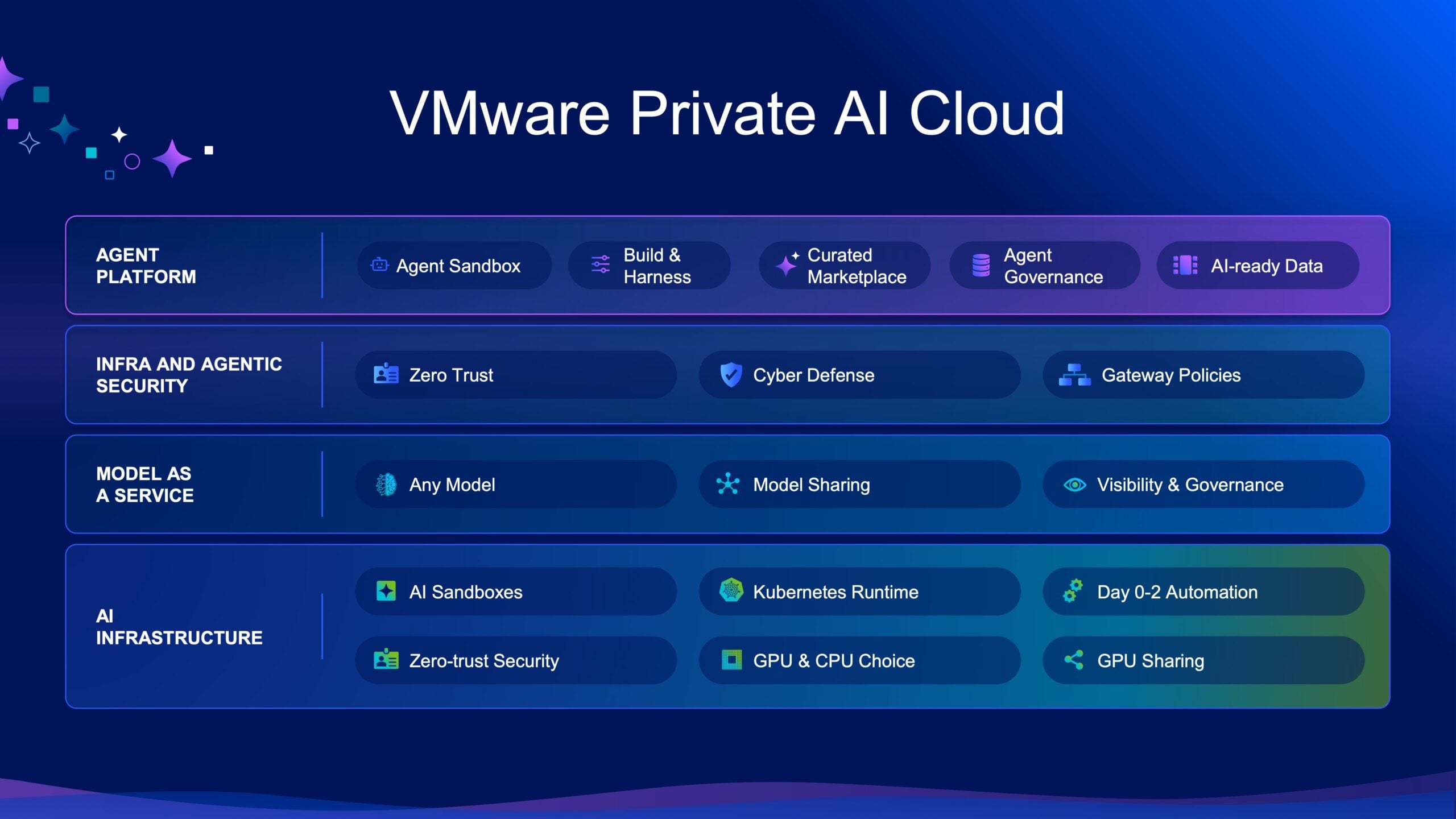
Broadcom introduced VMware Private AI Cloud at VMware Explore, a private cloud architecture designed to run AI models close to enterprise data. Rather than moving sensitive data to external model providers, the platform is intended to bring models to the data within an organization’s private infrastructure.
VMware Private AI Cloud combines VMware Cloud Foundation (VCF), VMware AI Factory, VMware Tanzu Platform, VMware vDefend, and VMware Avi Load Balancer into a unified environment for running inference workloads, agentic applications, containerized services, and traditional virtual machines. The approach gives enterprises a common infrastructure and operations model for AI and general-purpose workloads while retaining control over data location, security policies, and resource consumption.
Broadcom Infrastructure Software Group President Ram Velaga described the platform as a convergence point between private cloud and private AI infrastructure. The objective is to support production inference and agentic applications without giving up data sovereignty, compliance controls, or predictable operating costs.
VCF Targets AI Infrastructure and Token Costs #
VMware Private AI Cloud is designed to address three primary cost areas in enterprise AI deployments: hardware capital expenditure, operational complexity, and token consumption. These costs can increase as organizations move from small AI pilots to production inference workloads that require larger models, higher request volumes, and more GPU capacity.
VMware Cloud Foundation 9 introduces infrastructure capabilities intended to improve resource utilization. NVMe memory tiering can extend available memory capacity by using fast NVMe storage as an additional tier, while cluster-wide storage deduplication reduces duplicated data across the environment. These capabilities are designed to improve infrastructure efficiency for AI workloads that require substantial memory and storage resources.
VCF also supports heterogeneous infrastructure, including CPUs, GPUs, and other accelerators from multiple vendors. The platform supports server systems supplied by major OEM and ODM manufacturers, allowing organizations to select hardware based on workload requirements, availability, and cost rather than adopting a single hardware configuration.
The platform also adds management features for controlling AI resource consumption. Token monitoring provides visibility into model usage and inference activity, while multi-tenant model sharing allows multiple users or applications to access common model services. Enhanced GPU and vGPU tracking provides more detailed information about accelerator allocation and utilization. An AI metrics observability dashboard brings these measurements into a centralized operational view.
VMware AI Factory Automates the Path to Production #
Broadcom also announced VMware AI Factory, the software-defined foundation for VMware Private AI Cloud. VMware AI Factory is intended to simplify the deployment of AI-ready infrastructure and reduce the time required to move from physical hardware to a production model endpoint.
The platform is designed to cover both initial infrastructure deployment and ongoing Day 2 operations. This includes automating infrastructure provisioning, deploying model services, and managing the operational requirements of AI workloads post-deployment. Broadcom also positions VMware AI Factory as a mechanism for improving visibility into token economics and resource consumption as model usage increases.
The VCF model runtime is based on vLLM, which provides a common serving layer for supported models. Broadcom stated that VCF customers can run more than 150 open-source and commercial models through the platform. This allows organizations to select models based on language support, context requirements, multimodal capabilities, reasoning performance, and hardware compatibility.
Validated Models Enable Private Model Services #
Broadcom announced that models from Google, NVIDIA, NEC, Alibaba Cloud, and Z.ai have been tested and validated for VMware Cloud Foundation. The validation program is intended to provide enterprises with a clearer path to deploying selected models on-premises and exposing them to internal users through Model-as-a-Service offerings.
The validated models announced for VCF include:
NVIDIA Nemotron 3: The Nemotron 3 family includes open multimodal models based on a hybrid Mamba-Transformer Mixture-of-Experts architecture. The models support a context window of up to 1 million tokens and are designed for long-running agentic workflows across enterprise applications.Google DeepMind Gemma 4: Gemma 4 is an open-source, open-weight multimodal model family intended for local execution. Its availability on VCF gives organizations the option to develop and deploy autonomous agents within their own infrastructure.NEC cotomi: NEC’s cotomi model is optimized for the Japanese language and trained on curated datasets. Broadcom stated that the model delivers a 40 percent improvement in token efficiency.Alibaba Cloud Qwen 3.7-Max: A proprietary multimodal model with a 1-million-token context window. It includes multimodal reasoning capabilities and is designed for agentic workloads.Z.ai GLM 5.2: GLM 5.2 is an open-source General Language Model designed for local coding and reasoning agents. The model is intended to support multi-step autonomous workflows while keeping data within the enterprise environment.
The model validation effort aims to reduce deployment uncertainty for enterprises that want to run commercial and open-source models on private infrastructure. Broadcom stated that model providers are working with the company to make validated models available through VCF’s integrated services.
Broadcom’s Private Cloud Outlook 2026 reported that 56 percent of enterprises are already running or planning to run production AI inference on private cloud. VCF is positioned to support those deployments alongside existing virtual machines, Kubernetes workloads, and containerized services.
Independent testing using MLPerf Inference v5.1 standards confirmed that VCF delivered performance on par with bare-metal infrastructure, according to Broadcom. The testing is intended to demonstrate that virtualization and private cloud management can support production inference without requiring a separate bare-metal AI stack.
Defense-in-Depth Security for AI Workloads #
VMware Private AI Cloud uses a defense-in-depth security model aligned with the NIST Cybersecurity Framework 2.0. The platform combines infrastructure controls, network segmentation, application-layer protection, supply-chain security, and continuous compliance features.
VMware vDefend provides microsegmentation and hypervisor-level lateral security controls. Virtual patching is designed to protect workloads from known vulnerabilities without requiring immediate application changes or infrastructure downtime. Traffic-flow monitoring can also identify unexpected communication between workloads and help detect unauthorized or shadow AI deployments.
Broadcom is extending vDefend to agentic AI workloads. The updated capabilities are designed to identify agentic components through continuous traffic monitoring, detect unauthorized use of AI systems, and distribute virtual patches using AI-generated Intrusion Detection and Prevention System signatures.
VMware Avi Load Balancer adds application-layer protection through its web application firewall and API security capabilities. For agentic workloads, Avi is designed to restrict agents from accessing unauthorized tools, identify anomalous behavior that may indicate a zero-day attack, and apply data protection controls to help prevent unauthorized exfiltration.
TrueSource Extends Open-Source Supply-Chain Controls #
Broadcom also introduced TrueSource capabilities for software and data services used in private AI environments. TrueSource Trusted Artifacts applies clean-room build processes across the Java, Python, and Node.js ecosystems and the Bitnami Secure Images catalog.
Spring Enterprise releases are curated and maintained by the Spring team. Broadcom stated that the releases include patches that are scanned against frontier models and verified by humans, with fixes delivered across supported release lines.
TrueSource Data Services extends the same approach to data infrastructure components. The initial services include PostgreSQL, RabbitMQ, MySQL, and Valkey. This provides a controlled source for commonly deployed database and messaging components that may support AI applications and agentic workflows.
Tanzu Platform Adds Controls for Autonomous Agents #
Broadcom also announced new AI-ready data foundations and agent runtime capabilities for VMware Tanzu Platform. Tanzu Platform is positioned as the application and agent platform operating within VMware Private AI Cloud.
Autonomous agents introduce risks that differ from those associated with conventional applications. Agents can independently query data, invoke tools, interpret instructions, and take actions across connected systems. Without sufficient controls, an agent may exceed its assigned scope, access unauthorized resources, expose sensitive information, or generate unexpected infrastructure and cloud egress costs.
Tanzu Platform addresses these risks with a deny-by-default runtime model. Agents have no access to APIs, networks, MCP servers, or the internet unless explicitly granted. An isolated credential store keeps credentials hidden from the agents themselves, reducing the risk of credential theft, misuse, and prompt injection attacks.
The platform also includes a prebuilt developer harness with approved skills, workflow buildpacks, human-in-the-loop controls, and integrated memory services. These components are intended to provide a controlled development path for building agents while maintaining operational safeguards during execution.
AgentMinder Provides Centralized Agent Control #
Broadcom unveiled AgentMinder as a central control plane for autonomous AI agents. The system treats each agent as an enterprise identity and associates that identity with a defined mission, approved tools, and authorized resources.
Runtime policy enforcement applies least-privilege controls to tool invocation. This allows enterprises to determine which tools an agent can use and under what conditions. AgentMinder also provides audit records for agent activity, giving security and compliance teams visibility into the actions taken by autonomous systems.
The combination of agent identity, policy enforcement, and auditability is intended to provide a governance layer for organizations deploying multiple agents across departments and applications.
AI-Ready Data Foundations Keep Context in the Enterprise #
The new AI-ready data foundations in the Tanzu Platform process structured and unstructured enterprise data within the customer-controlled environment. The resulting data products are designed to provide agents with curated, context-rich information without requiring the source data to leave the private cloud.
These data products can be published to the Tanzu Platform marketplace as governed services. Developers and agents can discover and consume the services through a centralized catalog, while data owners retain control over how the information is prepared, exposed, and managed.
The approach is intended to improve the quality of context available to agents, reduce reliance on uncurated data, and lower token consumption by delivering more relevant information to the model. It also helps keep sensitive data, metadata, and compute resources within the organization’s controlled infrastructure.
Availability #
Broadcom stated that the new VMware Tanzu Platform capabilities announced at VMware Explore will be generally available in Fall 2026.