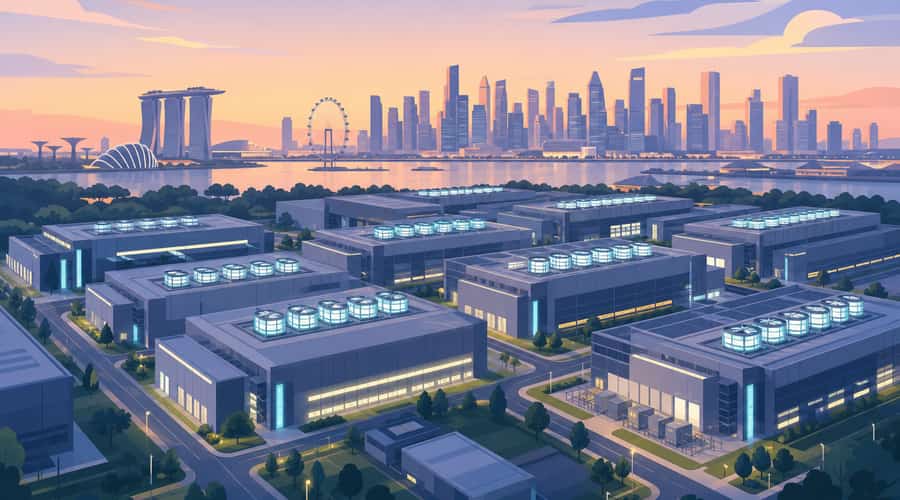
Blackstone is preparing a Singapore REIT listing for AirTrunk that could raise more than $1 billion, and the timing tells you how private capital wants to cash in on AI infrastructure without giving up the whole asset.
Blackstone bought AirTrunk for the data center boom. Now it wants public investors to pay for a slice of the income stream. The Wall Street Journal reported in June 2026 that AirTrunk has begun sounding out cornerstone investors for a Singapore real estate investment trust IPO that could raise more than US$1 billion, with a possible launch in August and listing in September.
That is a real update, not an old deal being warmed over. Bloomberg had reported in April that Blackstone had chosen Citigroup, DBS Group, and Jefferies to prepare the listing. The newer Journal report puts the deal closer to market, with a target size of up to S$1.5 billion, about US$1.2 billion. Blackstone and CPP Investments declined to comment to the Journal.
When Blackstone and the Canada Pension Plan Investment Board agreed to buy AirTrunk in 2024, the deal valued the company at more than A$24 billion, or roughly US$16 billion at the time. That was not a small wager on servers in sheds. AirTrunk was founded in 2015 by Robin Khuda and had become one of Asia-Pacific's largest hyperscale data center operators, with sites across Australia, Japan, Malaysia, Hong Kong, and Singapore.
The REIT structure isn't a detail. It's the point.
Blackstone can pull cash out of a hard asset without selling the whole platform. Investors get dividend-bearing exposure to leased data centers rather than a bet on whether Nvidia, AMD, or a hyperscaler has a clean quarter. If you want AI infrastructure exposure but don't want to buy chip stocks after a huge run, a Singapore-listed data center REIT is easier to explain to an investment committee.
That doesn't make it risk-free. Frankly, anyone pretending data centers are just steady real estate is skipping the hard part. Power supply, land constraints, tenant concentration, cooling costs, and government rules all sit inside the rent cheque. Singapore itself has had to manage data center growth carefully because the sector consumes so much electricity. The appeal here is not that the risk disappears. It is that the risk gets packaged as income.
Singapore is the obvious venue for that package. The city has spent years building one of Asia's deepest REIT markets, with 42 listed REITs and a combined market value of about US$77.6 billion, according to the Journal. Investors there already understand the structure. The exchange already has the investor base. Hong Kong can raise money for big listings, but it doesn't have the same REIT habit. Sydney has the corporate home of AirTrunk, but not the same pool of Asian REIT buyers for a deal of this kind.
The precedent Blackstone will care about is NTT DC REIT. In 2025, the NTT Data-backed vehicle raised more than US$800 million in Singapore, the Journal reported, in an oversubscribed IPO that became the city's biggest listing in more than a decade. GIC came in as a cornerstone investor, and the deal proved that public-market money would buy data center rent if the yield and sponsor were credible.
AirTrunk would be a bigger test. The Journal said the planned deal could make AirTrunk Singapore's largest listed REIT if it succeeds. That matters because Blackstone is not bringing a small proof-of-concept vehicle to market. It is trying to turn one of the biggest private data center acquisitions in the region into a public income product while AI demand is still strong enough to make buyers lean forward.
You can see the logic. Blackstone paid at the top end of the market because cloud and AI workloads needed physical capacity in places where permits, power, and land are hard to secure. A REIT listing lets it show limited partners that the AirTrunk deal is not just a long-dated infrastructure story. It can produce liquidity now.
The danger is timing. AI infrastructure is the most crowded institutional trade of 2026. Everyone wants the same exposure: data centers, power, networking, and anything attached to the buildout. Crowded trades don't fail because the story is false. They fail when the price assumes every piece of the story arrives on schedule.
Blackstone knows this. That is why the REIT route is smarter than a plain IPO of an operating company. A REIT can be sold on occupancy, leases, sponsor quality, and distributions. It does not need investors to believe every AI forecast in circulation. It only needs them to believe that hyperscale tenants will keep paying for capacity in markets where supply is difficult to add quickly.
Deliberations can still change, and the size or timing may move before any prospectus lands. But the direction is clear. Blackstone is not waiting for the AI infrastructure wave to peak before monetizing AirTrunk. It is taking the part of the story public investors already know how to buy: contracted data center income on a Singapore REIT screen.
Also read: Hexaware's Anthropic reseller deal reveals how frontier AI will actually reach enterprise clients • Washington's chip export controls handed Huawei the Chinese AI market Nvidia once dominated • SpaceX drew $89 billion in demand for its debut bond offering but the stock tells a more complicated story