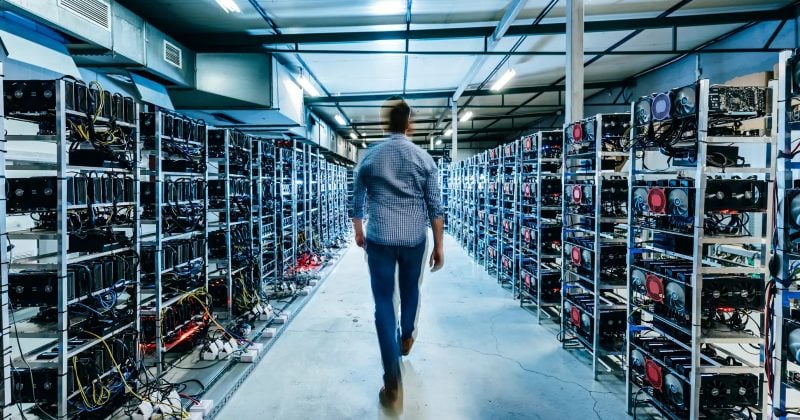
Via 21bitcoin.app
Despite post-halving economic pressure and a historic dip in hashrate, Bitcoin's price continues to trade well above what it costs to mine.
Bitcoin’s estimated mining production cost sits at roughly $54,939, and the network’s marquee asset hasn’t dipped below that floor. That’s a notable data point at a time when miners are navigating some of the toughest economics the industry has seen since the latest halving slashed block rewards in half.
Hashrate tells the real story #
Bitcoin’s hashrate peaked at approximately 995 EH/s in April 2026. That’s just a hair below the psychologically significant 1 ZH/s (zetahash) threshold. It has since settled to around 959 EH/s.
But something unusual happened in 2026. The network recorded its first quarterly drop in hashrate in six years. Not because of a price crash or regulatory crackdown, but because miners started redirecting their computational firepower toward a different target entirely: artificial intelligence.
The great AI pivot #
Public mining companies like CleanSpark, Core Scientific, and Hut 8 have begun reallocating portions of their infrastructure toward AI and high-performance computing (HPC). Bitcoin mining revenues fluctuate with price and difficulty. AI compute leases offer something miners rarely get: predictable, fixed-rate income. CoinShares and other analysts have noted this shift is accelerating. Forecasts suggest AI-related contracts could represent a majority of revenue for some public miners by the end of 2026.
Post-halving, block rewards dropped to 3.125 BTC. Hashprices, the revenue miners earn per unit of computational power, have decreased accordingly.
What the production cost floor means for price #
Bitcoin trading above its $54,939 production cost provides a kind of economic gravity for the asset. When the price approaches or dips below what it costs to produce a coin, marginal miners exit, difficulty adjusts downward, and the remaining miners become more profitable. It’s a self-correcting mechanism baked into Bitcoin’s protocol design.
Analysts at CoinShares estimate that Bitcoin’s hashrate could reach approximately 1.8 ZH/s by year-end 2026 if favorable pricing trends hold. However, the pace of that growth is likely to be slower than previous cycles precisely because of the AI reallocation trend.
Disclosure: This article was edited by Editorial Team. For more information on how we create and review content, see our