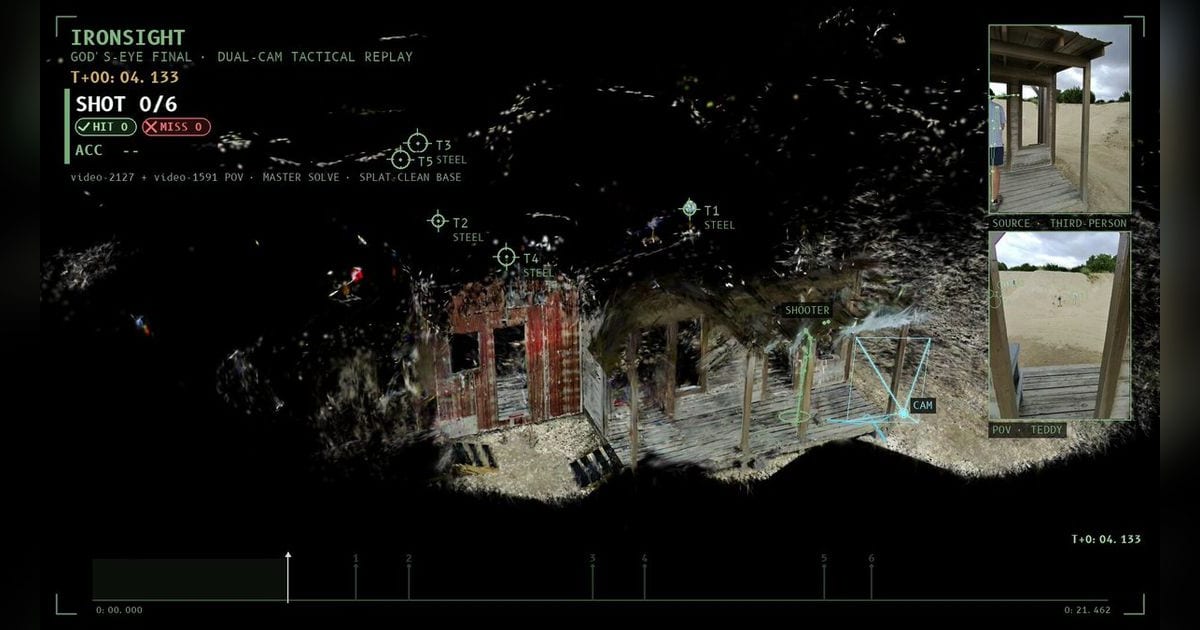
Bilawal Sidhu (@bilawalsidhu) posted IronSight on X, a 4D reconstruction built by fusing footage from two pairs of Ray-Ban Meta smart glasses and using Anthropic's Claude Fable 5 as part of the build.
https://x.com/bilawalsidhu/status/2073248618144837848 Sidhu described IronSight as a weekend prototype, not a commercial product. In the thread, he said the reconstruction came from Meta glasses footage alone, and wrote in a reply to Vaibhav Gupta (@vaibcode) that he had queued up experiments the night before, then spent "just a few hours" selecting primitives and building the result.
The claim that matters is the input stack. Sidhu did not say he used a LiDAR scanner, studio rig, drone survey, motion-capture stage, or dedicated photogrammetry shoot. He said the source footage came from two pairs of consumer camera glasses. Ray-Ban and Meta market the Ray-Ban Meta smart glasses around hands-free photo and video capture through an ultrawide 12 MP camera, which puts the device closer to a consumer wearable than a mapping instrument.
Sidhu is unusually credible on this specific kind of experiment because his background is spatial computing, not generic AI posting. His own bio lists six years at Google as a senior product manager across AR/VR and 3D Maps, including work on Immersive View, ARCore Geospatial API, VR camera systems, YouTube VR experiences, and 3D mapping from satellite, aerial, and ground-level sensors. He has also been writing and speaking for years about the merge between reality capture and generative AI; in a 2023 Metavert interview, he framed the creative opportunity as moving from capture to augmentation across photo, video, and 3D.
The prototype lands at the right moment for Fable
IronSight appeared three days after Anthropic said access to Claude Fable 5 had been restored. Anthropic's Fable page says the model is built for long-running coding and professional work, with availability for Pro, Max, Team, and Enterprise users, as well as developers through the Claude Platform, cloud marketplaces, AWS, Google Cloud, and Microsoft Foundry. Anthropic prices Claude Fable 5 at $10 per million input tokens and $50 per million output tokens, with a 90% input-token discount for prompt caching.
The timing gives Sidhu's demo a second meaning. Claude Fable 5 is being sold as an agentic coding model for multi-stage work that can plan, test, and use vision against outputs. Sidhu is using it in the frontier-prototyping pattern that has defined the past month of AI coding: give the model a hard spatial task, let it generate code and test ideas quickly, then post the artifact before it becomes a product.
That pattern is also why the demo needs a narrow reading. Sidhu has not published code, a technical note, a repo, an accuracy benchmark, camera calibration details, or a comparison against established reconstruction methods. There is no stated latency, cost, frame count, or failure analysis. IronSight shows a plausible direction for fast spatial prototyping. It does not yet establish a repeatable pipeline.
4D reconstruction is moving from papers into weekend demos
In computer vision, 4D reconstruction generally means reconstructing a scene across 3D space and time. The research frontier has been moving fast: the Shape of Motion project from UC Berkeley, Google Research, and UC San Diego presents a method for reconstructing a 4D scene from a single monocular video, with explicit 3D motion across a sequence.
Sidhu's IronSight sits in a different lane. The source footage comes from wearable first-person cameras, and the build appears to combine multiple viewpoints rather than relying on a single phone clip. That makes the practical question less about whether any one research method wins and more about how much useful spatial structure can be extracted from the messy cameras people already wear.
That is the operator takeaway. The old stack for dynamic 3D reconstruction assumed specialized capture, researcher-grade pipelines, or expensive production workflows. The emerging stack is consumer capture plus frontier coding models plus a builder who understands which graphics and vision primitives to test. Sidhu's Google background matters because choosing the primitives is the hard part. Fable can accelerate implementation, but it cannot replace judgment about calibration, geometry, temporal alignment, and failure modes.
The privacy problem follows the same line. Two pairs of camera glasses can capture a richer shared environment than one phone. That is useful for reconstruction and uncomfortable for bystanders. Sidhu's demo does not discuss consent, data retention, or where the footage was processed. Those gaps are normal for a weekend experiment, and they are exactly the issues that will determine whether wearable spatial capture becomes a product category or remains a stream of impressive clips.
IronSight is best read as an early artifact of a new prototyping loop. Sidhu used low-friction wearable capture, a newly restored frontier model, and his own spatial-computing instincts to compress a research-flavored idea into a Saturday build. The next test is whether the same approach can produce repeatable, inspectable reconstructions outside a creator demo.