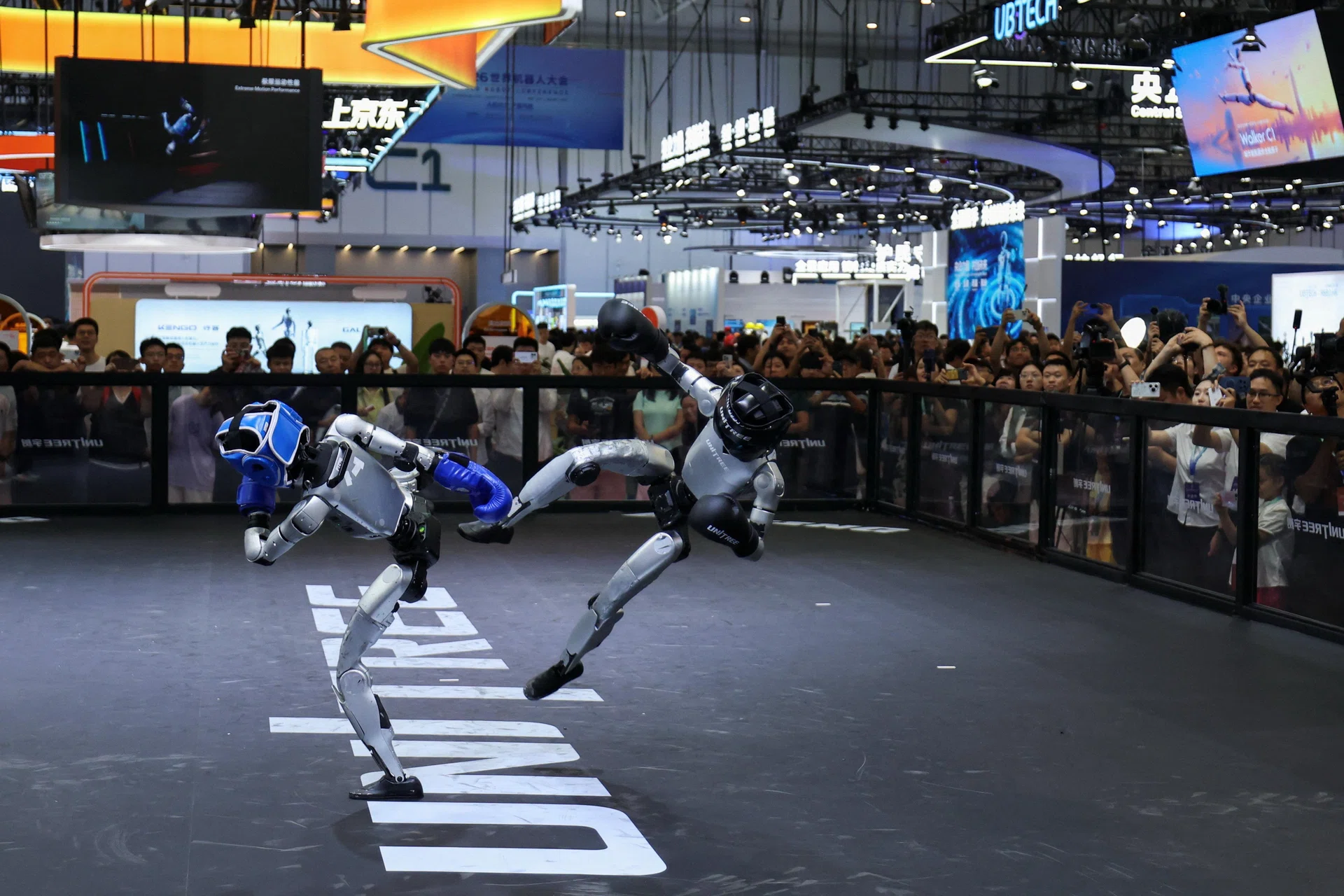
While dancing robots show off intelligence, purpose-built machines can scale far more cost effectively EVERY few months, a humanoid robot company raises a round that defies its own income statement.
Figure AI closed more than a billion dollars in September 2025, at a post-money valuation of US$39 billion.
The company has never disclosed revenue, but credible third-party estimates put its 2026 revenue in the low tens of millions, which implies a multiple north of a thousand times sales.
For context, even the most generously priced listed hardware companies trade in the low tens at steady state. Figure AI is roughly a hundred times richer, on the assumption that the promise of a humanoid with general intelligence is nearly here. However, Figure AI is no outlier. Apptronik’s valuation trebled to above US$5.5 billion in February, and Norway’s 1X has been circling a valuation near US$10 billion.
Meanwhile, in China, there are more than 10 companies with valuations of US$1 billion and above.
And Unitree, maker of the viral high-performance dancing robots, started trading publicly at more than 100 times price-to-sale multiple at US$66 billion valuation in the public market, where the stock gained 600 per cent on debut.
Here is the part I ponder. Is humanoid the best form factor across different use cases, or should robots be more optimised for its use case?
Should investors still look into humanoid startups, given the steep valuation that have gone way ahead of the fundamentals? Or should we look into use case-specific vertical robots?
Three environments, three very different problems #
The useful way to sort robotics is not by what the machine looks like, but by how much the world around it is allowed to vary.
The first is a structured environment where there is only one job, one task and the surroundings are engineered to stay identical.
This is the industrial arm welding a seam, which was solved decades ago by Fanuc, ABB and Kuka, and is precisely why it no longer generates venture returns. Let conditions drift, and it fails.
The second is an unstructured environment, which means there are many jobs and many tasks, in a world not arranged for a machine’s convenience.
Some examples include tidying a house in the morning, or working a building site in the afternoon. This is where the humanoid aims, and it is genuinely a very challenging class of problem.
In between sits the third – a semi-structured environment.
There is one job to be done, but that job contains several distinct tasks, and the environment varies meaningfully from site to site.
Self-driving is the canonical example. So is cleaning a washroom, where a single job decomposes into scrubbing urinals, cleaning bowls, vacuuming floors and wiping surfaces, with no two washrooms laid out alike.
Flexibility is the humanoid’s asset and its heaviest cost #
The appeal of humanoids is obvious. Build a machine in our shape and it inherits the world we built for ourselves. One platform, any job.
But generality is expensive in a way the valuations gloss over.
A machine that must handle an open-ended set of jobs has to be engineered for all of them, with more degrees of freedom, more sensing, more redundancy and far more robustness, because it cannot know in advance what it will be asked to do.
Every use case added widens the specification, and a wider specification means a harder build and a dearer unit. The humanoid is costly because of its generality, not despite it.
However, if you step into the shoes of the business buyer, no one has ever bought a machine because it had arms and legs. Buyers purchase the lowest cost per task at acceptable quality, and on that measure, purpose-built wins structurally.
A floor-cleaning robot carries no hardware it does not need for floors. Ask a humanoid to push a mop and you are paying for shoulders, hands and a balance system that adds nothing to the square metres cleaned.
Run the focused machine at high utilisation, on a washroom that never closes or a port that never sleeps, and capital cost amortises across enough jobs to make the payback obvious.
The semi-structured middle is where I would deploy #
So the tier worth hunting in is the third, in which a robot is designed to target a specific vertical in a semi-structured environment.
It is hard enough that it has not been commoditised, since the environment genuinely varies, yet bounded enough that a team can engineer its way to completeness.
That constraint is the whole advantage. You do not need general intelligence to clean a washroom, but you need a system that has seen every kind of washroom, and because the job is finite, that library can actually be finished.
The proof is autonomous driving technology company Waymo, which is the closest to maturity at roughly half a million paid rides a week across 11 American metros, against a target of a million by year-end.
It is also a useful reality check, with it having d expressway rides for two months this year pending a software update, with independent forecasters expecting the company to fall short of the million.
Semi-structured work is genuinely difficult, which is exactly why solving it is worth something.
The unsolved list is long and mostly unglamorous, which is rather the point:
- Hull cleaning and underwater inspection – where fouling burns fuel and divers are scarce;
- Washroom and facility cleaning – an enormous wage bill with chronic shortages;
- Facade cleaning and high-rise inspection – where the alternative is scaffolding and rope access.
Each of the above is one job with many tasks, a large market and a buyer who can compute payback by running the machines at high utilisation.
Importantly, valuations in this category have not run significantly ahead of the fundamentals, as most of the attention has been paid to humanoids.
Three tests before we wire the money #
First, view it from the buyer’s lens. Is there a chronic shortage of labour? Is there a cost advantage?
It is not about what the technology can do, but why this machine is the best answer to one customer’s job, measured in cost per task and quality against whatever they use today. If the buyer cannot articulate that, then it is a demo.
Second, difficulty. We want jobs that consist of multiple tasks and are hard to automate, because difficulty is what protects the company once the category is proven.
Each deployment teaches the system something the next one inherits, so edge cases compound into a moat.
Third, market size. A bounded job is only worth solving if it recurs in enormous quantity, since these companies earn returns through repetition across thousands of sites rather than by widening their remit.
Singapore is quietly becoming a good test bed for this category.
Demanding buyers and high labour cost make it an ideal place for testing, and we have observed vertical robots, such as Hivebotics, Neptune Robotics and BeeX, gaining traction.
Meanwhile, Menlo Robotics, which has built humanoid robots, will also focus on bimanual arms robots to solve enterprise-focused problems.
That said, building a robotics company from Singapore is never easy.
The home market is an excellent test bed, but a small one. A hundred deployments will prove a machine works, but they will never absorb enough units to pull the bill of materials down. So founders here have to export early, which dials up the complexity considerably.
Further, designing the robot is only the first act. Scaling to high-volume manufacturing at a competitive cost is a different discipline altogether, and one that has defeated many well-funded companies. But it is not new ground.
Sim Wong Hoo took electronics company Creative Technology from a small Singapore startup to a Nasdaq listing, and Tan Min-Liang built gaming hardware company Razer into a global hardware brand from the same small base.
Neither had a domestic market worth the name, but both found a way anyway.
The layer worth watching #
None of this makes the humanoid dream uninteresting. If someone builds intelligence general enough to move between jobs without re-engineering, the prize is historic.
That said, the best form factor for almost any specific job will probably never be a machine shaped like a person. Even if general robotic intelligence arrives tomorrow, a purpose-built machine running at high utilisation should still win on cost per job and reliability.
Further, estimating the timeline for general intelligence is hard. The founder of Unitree estimated that the ChatGPT moment for robotics could still be up to 10 years away.
Unlike large language models that had the Internet waiting for them, robotics has no equivalent corpus that enables scaling law yet.
Every hour of useful training data has to be earned in the physical world, one deployment at a time. That is the real reason nobody can name a date, until a significant breakthrough in algorithm.
So for now our capital goes to the semi-structured middle, where the arithmetic already works. Our attention stays on the intelligence layer, because that is where this ends.
The writer is executive director, investment at Vertex Ventures South-east Asia and India
Decoding Asia newsletter: your guide to navigating Asia in a new global order. Sign up here to get Decoding Asia newsletter. Delivered to your inbox. Free.
Share with us your feedback on BT's products and services
TRENDING NOW When every phone becomes a satellite phone, what happens to Asia’s telcos?
Singapore should anchor hedge fund leaders, nurture local managers amid regional talent war: observers
How BYD disrupted Singapore’s car market – and why the strategy is turning on itself
Too little, too late? Manila’s billion-dollar bid to ignite its sputtering EV industry