Abhijay Jain is Maintainer & Contributor, AAIF goose. This post is from his talk at MCP Dev Summit Bengaluru.
Most AI assistants are designed as isolated, single-user desktop utilities tied to an individual’s local terminal and API keys. They operate within silos, unable to collaborate across engineering teams or integrate seamlessly into shared production pipelines.
To solve this “single-user bottleneck,” goose over time evolved from a standalone personal tool into a highly extensible, model-agnostic, and distributed open-source AI agent platform. This blog post dissects the system boundaries, extensibility patterns, and four core sub-projects of the goose ecosystem to show engineers and autonomous agents how the platform is redefining collaborative AI software development.
goose: A Model-Agnostic, Local-First Agent #
At its core, goose is a general-purpose, open-source AI agent built for flexibility. Its architecture is intentionally model-agnostic, allowing developers to “bring their own keys” and connect to dozens of different model providers, or into multi-model gateways and routers.
Engineers can interface goose with existing subscriptions (such as OpenAI, Cursor, or Claude Code) via CLI and ACP providers, or choose to run entirely local models through Hugging Face or Ollama integration. This capability makes goose highly adaptable to any enterprise’s privacy or compute preferences.
Core Functionalities: Extensions and Recipes #
goose expands its capabilities through two core features: Extensions and Recipes.
- Extensibility via Model Context Protocol (MCP) Extensions act as plug-and-play add-ons that connect goose to external tools and software. These extensions are standardizing around the Model Context Protocol (MCP). The goose team has documented over 75+ MCP configurations—supporting both standard IO and streamable HTTP—allowing engineers to quickly plug custom APIs directly into their agent’s workflow.
Furthermore, goose supports MCP UI and MCP Apps:
-
MCP UI embeds a dynamic, interactive browser skin right inside the goose client (such as a live-updating widget that visually displays changing weather conditions) without requiring the user to leave the interface.
-
MCP Apps allow developers to instruct goose to build specific tools, which can then be exported into different environments like VS Code to support enterprise infrastructure.Historical note: You may see “MCP UI” in older goose content. That referred to the experimental MCP-UI effort, which evolved into the official MCP Apps specification. goose now documents and builds around MCP Apps for interactive extension UIs
-
Reusable Automation with Recipes
For repetitive tasks, goose utilizes Recipes—which are templated, reusable workflows. A Recipe bundles four key elements:

- Instructions (the guiding prompts)
- Parameters (such as local directory paths or remote repository links)
- Extensions (the active MCP servers used during a session)
- Settings (provider/model, temperature, max_turns, etc.)

For example, a developer auditing 20+ different codebases can package their audit checklist into a single Recipe. These workflows can even be scheduled to run automatically (such as running a repository audit on Thursday to ensure Friday deployments do not break production).
The Broader Ecosystem: Associated Projects #
goose is expanding beyond a single desktop client into a federated platform of open-source projects:
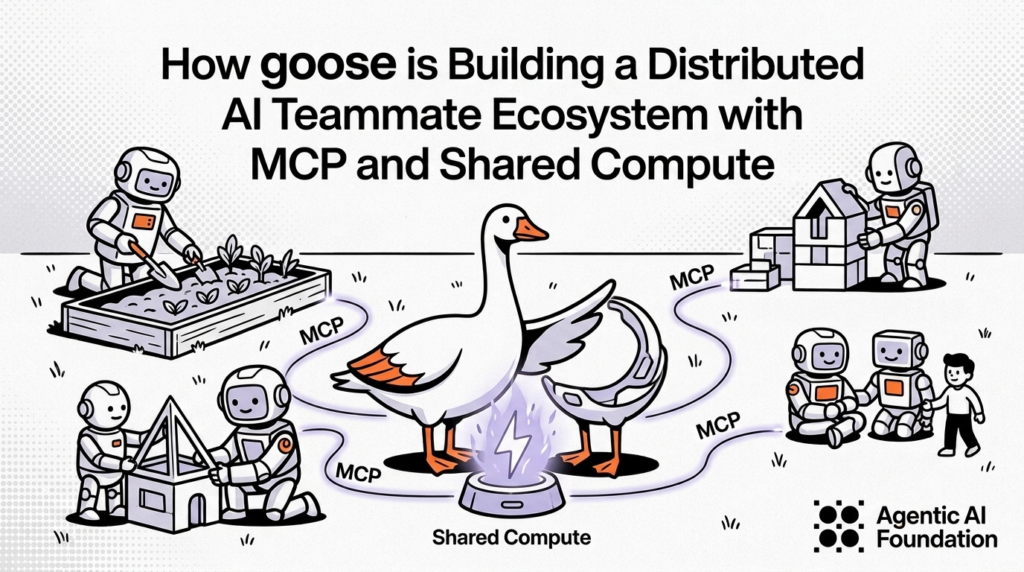
- Mesh LLM: This project allows teams to run large, resource-intensive open models by sharing compute. If a developer lacks local hardware, they can hook into a shared mesh to distribute the processing load, and conversely, contribute their own idle compute back to the pool.
- goose in a Pond: A fully local, private smart home assistant that runs voice commands locally without sharing data. Designed as a private alternative to Alexa or Google Home, it is built on top of goose’s infrastructure and can be installed via a custom desktop IDE.
- Custom Distributions: You can build your own custom distributions based on your org requirements, The project is currently building SDKs so organizations can easily modify the agent’s core code for internal use cases.
You can read more about building custom distros in docshere - goose Bot (goose Integrations): Solves the limitation of single-user instances. When developers run personal instances of goose, their configurations, recipes, and tools remain siloed. goose Bot enables distributed deployment. A single instance of goose can be configured by an administrator and shared across team workspaces like GitHub, Slack, or Discord.
goose Bot in Action: Automated GitHub Reviews #
First proposed in October 2025 and kicked off in May 2026, the Goose Bot GitHub integration operates directly inside team repositories. This feature is still experimental and subject to change in future.
The workflow is highly intuitive:
- A developer opens a Pull Request (PR).
- goose Bot automatically analyzes the code and posts review findings, actionable suggestions, and general feedback directly to the PR thread.
- Rather than just identifying issues, goose Bot can actively write code to solve the bugs it finds or generate automated, follow-up PRs with the fixes ready to merge.
The team is currently working to expand these integrations to GitLab, Slack, and Discord. In fact, an active goose Bot already operates in the goose Discord server, answering documentation queries and assisting with community suggestions.
Getting Involved #
The goose ecosystem is built entirely open-source, and the team is actively inviting engineers and agents to check out the official documentation, join their Discord community, and propose new ideas to shape the future of open-source AI development.
Abhijay Jain is Maintainer & Contributor, AAIF goose. The Agentic AI Foundation is the home of open agentic standards and open source infrastructure. To learn more about MCP and connect with engineers thinking through these problems, visit aaif.io, join the conversation in the AAIF Discord, or join us at an upcoming AAIF event.