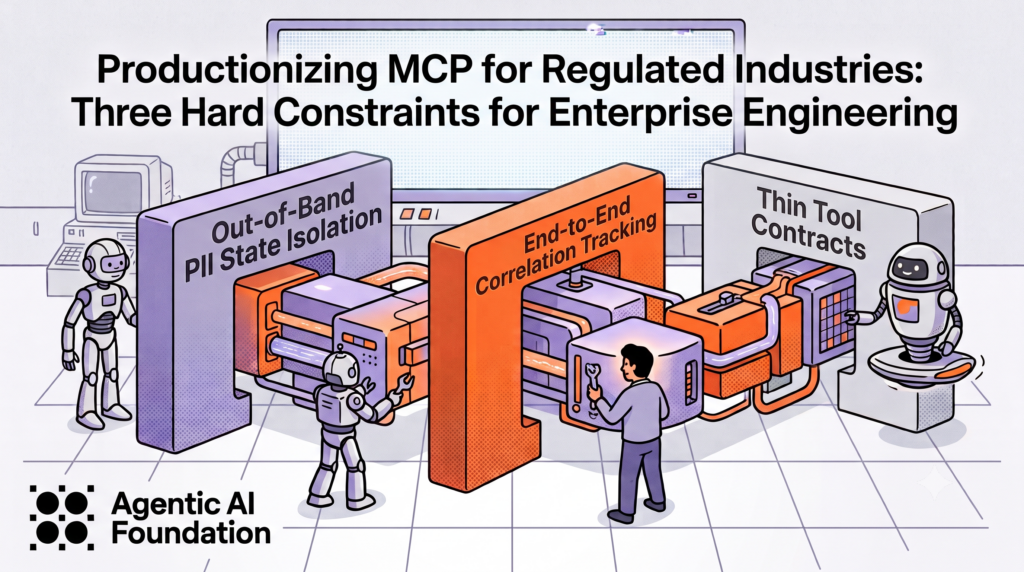
**TL;DR: **This post is a summary based on a talk Hariskumar Panakkal of Wipro presented at the MCP Dev Summit in Bengaluru. In the talk, he covers deploying Model Context Protocol architectures within enterprise banking environments that require strict security patterns like out-of-band personal data isolation, distributed tracking, and decoupled service guards. These foundational infrastructure requirements remain mandatory for production readiness despite the native session management changes introduced by the updated protocol specification.
Hariskumar Panakkal talk at MCP Dev Summit Bengaluru 2026.
The release of the Model Context Protocol (MCP) version RC-7-28 marks a turning point in how we standardise the layer connecting large language models to tools and data sources. By formalising session handles and connection initialisation handshakes directly inside the core protocol specification, the community has ironed out the biggest friction points for local development. However, running an agentic system on a local machine is not the same as deploying it across an enterprise production cluster at large scale.
When you migrate MCP off a laptop and into a multi-replica, auto-scaled container infrastructure, stateless assumptions break down. In highly regulated environments like agentic banking, healthcare, or corporate finance, these infrastructural gaps become immediate blockers. Looking at data from engineering teams moving agentic banking solutions into production, three architectural patterns remain mandatory. While RC-7-28 changes the underlying transport mechanics for sessions, these security and operational guardrails remain unchanged.
## Out-of-Band PII State Isolation

While RC-7-28 establishes how structured schema fields move between an MCP client and an MCP server, it does not handle the compliance risk of passing sensitive customer data to external foundation model providers. In a production stack, personally identifiable information (PII) like Social Security numbers, account balances, and dates of birth must be isolated from the model payload.
Production environments use an out-of-band proxy wrapper loop:
- Interception: The ingress orchestration layer intercepts the raw user payload and strips out all sensitive tracking data.
- State Caching: The raw PII is written to a short-lived, encrypted local state database and replaced in the user prompt with a deterministic reference token.
- Sanitised Reasoning: The model processes the sanitised prompt, reasoning over the structural context to determine which tool to execute without ever viewing the underlying sensitive values.
- Just-In-Time Injection: When the model emits the outbound tool call, a proxy wrapper intercepts the execution payload, retrieves the raw PII from the local state database using the token, and injects the valid data into the backend MCP server call.
Models are structurally prone to data leakage, and external prompt logging layers present severe compliance vulnerabilities. Isolating sensitive data within a secure network perimeter maintains regulatory compliance while preserving the reasoning capabilities of the model.
End-to-End Correlation Tracking #
The latest release candidate refines internal protocol error types, but it does not provide distributed log aggregation across independent network boundaries. In an auto-scaled Kubernetes environment where container pods recycle continuously, tracking a multi-turn agent workflow across isolated infrastructure layers requires deterministic tracking.
A production-grade architecture requires the initialization of an immutable tracking ID at the absolute entry point of the user request. This unique identifier must be explicitly passed within the context headers of every single downstream service component:
| Context Header | Target Layer | Propagation Invariant | | X-Correlation-ID | UI ──► Orchestrator ──► Gateway ──► MCP Server | Immutable UUIDv4. Must be forwarded across all container boundaries. | | X-MCP-Session-Handle | Orchestrator ──► Gateway ──► Local Pod Replicas | Evaluated against the RC-7-28 specification to maintain session routing. |
If an agentic execution path fails mid-transaction due to a cluster pod recycling or an external API timeout, disconnected server logs cannot pinpoint the root cause. Propagating a uniform tracking ID across the execution path allows automated monitoring agents and human site reliability engineers to instantly aggregate logs, reconstructing the exact chronological history of the failed execution.
Thin Tool Contracts and Decoupled Service Guards #
RC-7-28 simplifies the process of standing up new MCP servers and exposing tool capabilities. However, embedding business logic, authorization rules, and compliance checks directly into the tool code creates significant technical debt and high component coupling.
The correct pattern relies on thin, single-responsibility MCP server implementations. The tools exposed to your agent orchestrator must operate purely as lightweight, declarative interfaces with no hardcoded validation rules.
All complex execution guardrails—such as evaluating role-based access control (RBAC), verifying customer consent tokens, or committing account mutations—must be handled by independent internal microservices. The thin MCP server layer simply acts as a router that queries these external engines based on declarative requirements:
Baking business logic straight into individual tool scripts makes it impossible to reuse those validation pathways across legacy, non-agent digital channels. Keeping the tool definitions thin and decoupled ensures that you can modify underlying validation rules, update access policies, or transition to updated transport specifications without breaking the declarative interface required by the model.
MCP RC-7-28 Provides the Foundation. Now Build the Architecture #
The enhancements introduced in MCP RC-7-28 successfully standardise and stabilise the communication mechanics between models and tools. However, deploying this protocol within a scaled enterprise infrastructure requires separate engineering constraints around data privacy, distributed observability, and modular service boundaries. To build a resilient agentic infrastructure, focus on establishing a robust gateway and orchestration architecture that addresses production security realities, and leave the core protocol to manage the routing of intent.
Keep up to date with AAIF:
- Stay Informed: Follow the AAIF social pages ( LI,X,BlueSky) andsubscribeto the community newsletter for highly condensed, curated updates on global AI innovation. - Read the Curated Content: Dive into The Daily Agenticfor quick, highly digestible insights on current trends. - Contribute Code: Visit the AAIF siteand navigate to the repositories to check out open issues, collaborate with maintainers, and help shape open source agent projects.