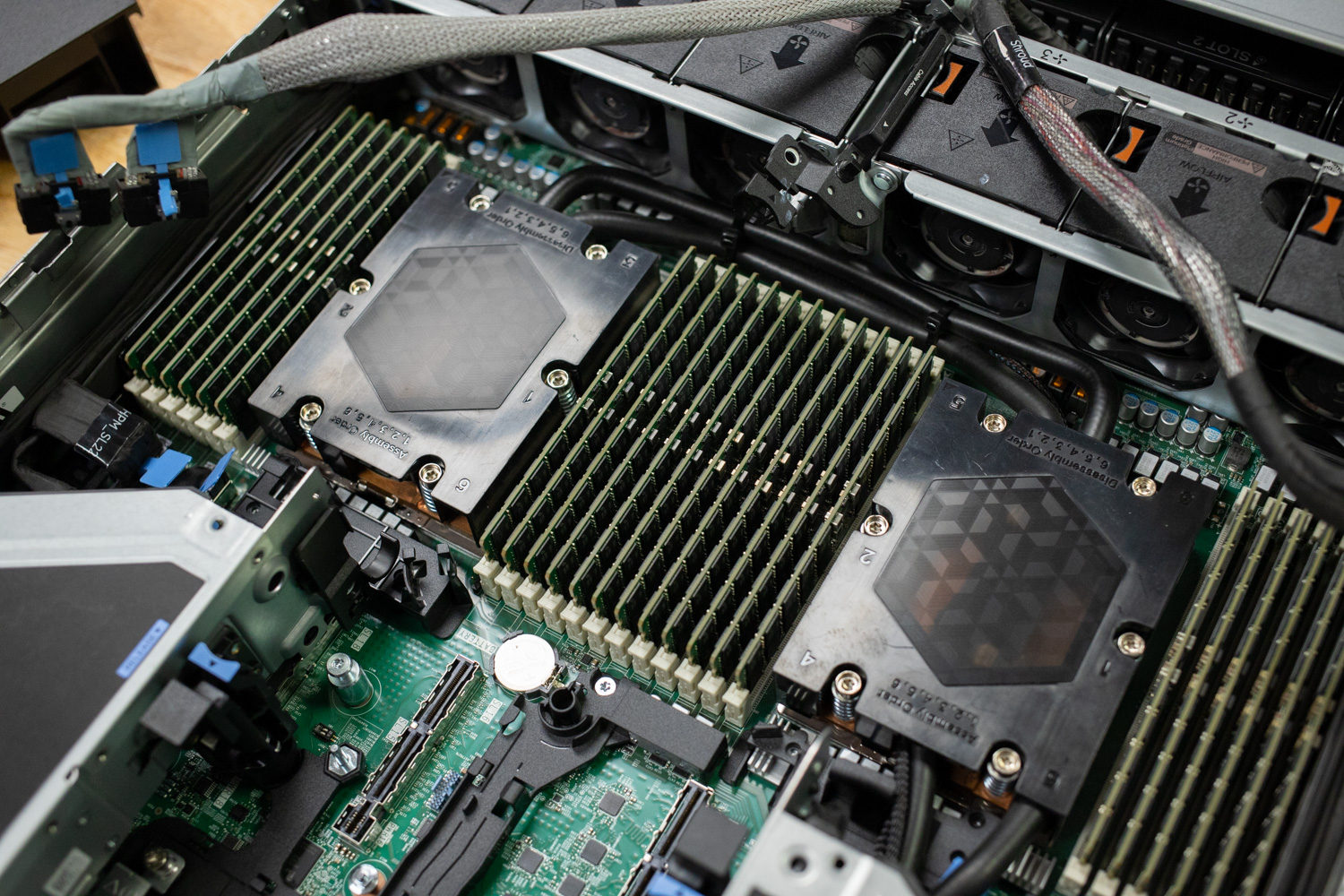
Published September 2026. Rankings reflect systems tested in the StorageReview lab; market context reflects IDC 1Q 2026 tracker data.
The server market set an all-time record in 2025 at $444 billion and opened 2026 with first-quarter revenue up another 30 percent, and almost none of that tells you which server to buy. Half of the market by revenue is ODM hardware sold directly to hyperscalers, machines an enterprise cannot order. Most of the rest of the growth is AI rack systems concentrated in a handful of neocloud and hyperscale customers. Strip both away, and the general-purpose market of 1U and 2U machines that actually populate enterprise racks looks nothing like the headline share tables.
This page ranks servers the way we rank everything else: from what has been through the StorageReview lab, with market reality stated plainly where our testing has gaps. Every pick links to the review holding the data. Where a market leader has not crossed our bench, we say so rather than pretending the category does not exist.
The Picks #
Best Overall 2U Server: Dell PowerEdge R7725
The 17G AMD flagship earns the top slot on breadth. Dual EPYC 9005 sockets, room for accelerators, and storage flexibility that carried it through our original review and then a world-record Pi computation of 314 trillion digits. If a rack has one general-purpose 2U slot to fill in 2026, this is the default answer, and our testing keeps finding new ceilings for it.
Best Intel 2U Server: Dell PowerEdge R770
The Intel side of 17G, with Xeon 6 P-cores and the modular design language Dell brought to this generation. Our R770 review called it modular, powerful, and AI-ready, and for shops standardized on Intel it is the direct counterpart to the R7725. The R770AP variant extends the platform for higher-power configurations.
Best 2U Storage Server: Dell PowerEdge R7725xd
The storage-dense 17G variant reset our expectations by sustaining 300 GB/s from a 2U chassis. If the workload is feeding data to GPUs, backup targets, or scale-out software-defined storage, this is the strongest per-rack-unit result we have measured from a general-purpose server.
2U Alternatives: Lenovo ThinkSystem SR650 V4 and Supermicro A+ AS-2126HS-TN
Lenovo’s V4 workhorse earned its versatile 2U workhorse verdict with Xeon 6 and a clean, serviceable design, and the SR630 V4 brings the same platform to 1U. With Lenovo’s infrastructure business posting record quarters, the V4 line is the strongest reason yet to bid a third vendor against Dell and HPE.
The Supermicro A+ AS-2126HS-TN puts dual EPYC 9005 Turin in a no-nonsense 2U that our review found delivers flagship compute density at a price the tier-one vendors do not match. The trade is the usual Supermicro one: hardware velocity and value against a thinner enterprise support and management story, and our review says so plainly.
Best 1U Server: Dell PowerEdge R4715
Our tested 1U pick. The R4715 puts a single EPYC 9005 socket in a 1U chassis, and our R4715 review found it covering virtualization, database, and backup duty that recently required a 2U dual-socket box. It also anchors the SMB pairing below alongside the R5715.
Best AI Inference Server (4U and Up): Dell PowerEdge XE7740
Our architecture deep dive walked through how the XE7740 is built for the inference era: accelerator flexibility in a package enterprises can rack without redesigning the room.
We tested the Intel Xeon 6 build; Dell also offers the platform with AMD EPYC 9005 as the XE7745, which some shops will prefer for EPYC core density and memory bandwidth, though we have not tested that variant directly.
Also tested in this class: the HPE ProLiant Compute DL380a Gen12, a dense air-cooled 4U GPU chassis that held up well in our review and brings iLO 7 with a secure enclave HPE positions as the first quantum-resistant root of trust in a server BMC. It does not take the inference slot because its PCIe lane allocation is less optimized than Dell’s for keeping GPUs and network cards on the same root complex, an affinity detail that matters more as inference scales out across nodes.
Best SMB Servers: Dell PowerEdge R5715 and R4715
The quiet revolution of this generation. A single EPYC 9005 socket now carries core counts that covered an entire dual-socket cluster two generations ago, at lower cost and simpler licensing. Our R5715 review covers the 2U storage-forward build, our R4715 review the 1U midmarket version, and our follow-up put both through database, virtualization, and backup workloads that mirror how SMBs actually deploy them.
Best Edge Servers: Dell PowerEdge XR7620 and Supermicro SYS-E403
Dell’s XR line remains the deepest ruggedized portfolio, and our XR7620 review covered accelerated compute at the edge, with the 17G XR8720t now extending the line for telecom. For the quiet-office end of edge, the fanless-adjacent Supermicro IoT SYS-E403 proved short, quiet, and capable in our testing. HPE’s ProLiant DL145 G11 sits between them as a compact branch-office box.
Specialty Systems Worth Knowing
Two lab-tested systems sit outside the mainstream categories but earn a place in the conversation. The Comino Grando RTX PRO 6000 packs eight RTX PRO 6000 Blackwell cards and 768GB of VRAM into a liquid-cooled 4U chassis that sustains every card at full TDP around the clock, a deskside-to-rack crossover for buyers whose model does not fit anywhere else. And Hypertec’s Trident immersion server puts four GPUs in a single immersion-born 1U, holding performance stable where air-cooled designs throttle, a preview of where high-density AI deployments are heading.
Twice now we have used Supermicro’s JumpStart remote-access program to test hardware most buyers cannot yet touch: a week with an NVIDIA HGX B200 system and the H14 platform with AMD Instinct MI350X. As a way to validate a platform before committing to a deployment, nothing else from a major vendor matches it. Supermicro’s Hyper SYS-212HA with Xeon 6 rounds out its mainstream case.
The Server Market in 2026 #
Market share tables mislead server buyers more than they help, so here is how to read one. IDC’s most recent tracker, for the first quarter of 2026, puts the worldwide market at $122.6 billion, up 30 percent in a year, with the United States accounting for 65 percent of global revenue. Half the worldwide total is ODM hardware built by Foxconn, Quanta, and Wiwynn and sold directly to hyperscalers; no enterprise can buy it. GPU systems were 56 percent of all server revenue in the quarter, concentrated in a handful of AI buildouts, while plain x86 server revenue actually declined. Revenue share in 2026 is mostly a measure of who is shipping AI racks to neoclouds, not of what enterprises choose.
| Vendor | 1Q26 revenue | Share | YoY | What it means for buyers |
|---|---|---|---|---|
| ODM Direct (Foxconn, Quanta, Wiwynn et al.) | $61.5B | 50.2% | +2.1% | Hyperscaler-only; not purchasable |
| Dell | $20.3B | 16.5% | +244% | AI-rack surge; also the largest enterprise server vendor |
| Supermicro | $9.3B | 7.6% | +129% | AI systems and price-performance; $39.1B FY2026 |
| Lenovo | $5.6B | 4.6% | +37% | Record infrastructure quarters; rising #3 |
| IEIT Systems (Inspur) | $4.0B | 3.3% | -7% | China-centric; effectively absent from US enterprise |
| HPE | $3.7B | 3.0% | +17% | Repositioned toward hybrid and mission-critical over volume x86 |
| Rest of market (incl. Cisco) | $18.1B | 14.8% | +48% | Cisco does not break out UCS revenue |
Source: IDC Worldwide Quarterly Server Tracker, 1Q 2026. IDC does not publish a per-vendor US-only table; worldwide revenue is the best public proxy.
For the general-purpose racks enterprises actually buy, the practitioner consensus and our own lab experience agree: Dell first on management, channel, and parts availability; HPE second with a loyal iLO base and strength in specific verticals; Lenovo a rising value and quality pick; Supermicro for price-performance and early silicon access with a thinner support bench; Cisco holding its installed base in converged and blade environments.
Current Platform Generations #
What is actually shipping in September 2026, per vendor. Two dating warnings apply to everything below: AMD launched EPYC Venice in July 2026 and OEM systems have been previewed but are not yet orderable, and NVIDIA’s Rubin platform reaches volume production in the second half of 2026, which will date any Blackwell-generation AI purchase within quarters.
| Vendor | Current generation | Key platforms | Silicon |
|---|---|---|---|
| Dell | PowerEdge 17G | R470-R770, R4715-R7725xd, XE9780/XE7740, XR8720t | Xeon 6, EPYC 9005, HGX B300, GB300 NVL72 |
| HPE | ProLiant Compute Gen12 | DL320-DL380a, ML350, Synergy 480, Cray/XD | Xeon 6, EPYC 9005 (1P), GB300 racks |
| Lenovo | ThinkSystem V4 (Intel); V3 continues (AMD) | SR630/SR650 V4, Neptune SC/SD, SR685a V3 | Xeon 6, EPYC 9005, GB200/GB300 |
| Cisco | UCS M8 | C220/C240/C225/C245 M8, X210c/X215c M8, C885A M8 | Xeon 6, EPYC, HGX |
| Supermicro | X14 (Intel), H14 (AMD), DCBBS rack-scale | Hyper, BigTwin/GrandTwin, GPU SuperServers | Xeon 6 and 6+, EPYC 9005, HGX B300, GB300 NVL72 |
One buying note that cuts across all five: IDC expects DRAM and NAND price increases to push server configuration prices up through 2026, so identical configs will quote higher as the year goes on. Budget accordingly.
How This Page Works #
Every ranked pick has been through the StorageReview lab, and every pick links to the review holding the data. Where the market includes a significant vendor our lab has not tested, we cover it in context sections with that gap stated plainly rather than ranking it on reputation. Market figures come from IDC’s quarterly tracker and are labeled with their quarter, because AI-era share numbers move violently. We update this page as new servers complete testing and when new tracker data publishes.
Server FAQ #
Which server brand is best in 2026?
For most enterprise buyers the practical answer is Dell for the broadest current-generation portfolio, deepest management tooling, and parts availability, with HPE and Lenovo as fully credible alternatives that frequently win on price or vertical fit. Supermicro wins when price-performance or early access to new silicon matters more than white-glove support. The better question is which server fits the workload, which is why this page ranks by category rather than crowning one vendor.
Is Cisco UCS still worth considering?
If your organization is standardized on Cisco networking or runs converged infrastructure, yes: UCS X-Series is the most actively developed modular platform left, and Intersight gives it a genuine cloud management story. Two things to weigh: Intersight is a recurring subscription rather than the perpetual licensing most competitors offer, and independent test data on current UCS hardware is scarce, ours included. Shops leaving UCS in recent years most often cite lead times, pricing, and the subscription requirement.
Are blade servers dead?
Dying as a default, surviving as a niche. Dell’s blade chassis has no current-generation compute sled, HPE Synergy is down to a single refreshed module, and only Cisco’s UCS X-Series shows a full roadmap. The density and management arguments that sold blades now belong to dense 1U and 2U racks and to single-socket designs with 128-plus cores. Choose blades in 2026 to extend an installed base, not to start one.
Should I buy single-socket or dual-socket?
Run the math before defaulting to two sockets. A single EPYC 9005 socket reaches 128 to 192 cores with full memory bandwidth, which covers most virtualization clusters that would have needed two sockets a few generations ago, with lower power, simpler licensing, and one less CPU to buy. Our testing of the Dell R5715 and R4715 found the single-socket 17G machines handle database, virtualization, and backup duty for the midmarket without strain. Dual-socket still wins for maximum memory capacity, accelerator-heavy configs, and consolidation ceilings.
Intel or AMD for a server in 2026?
Both platforms are current, and the right answer is workload-shaped. In our lab, EPYC 9005 systems like the R7725 lead on core density and memory bandwidth per socket, which is why a single AMD socket now covers work that took two sockets a couple of generations ago; consolidation and per-core licensing math tend to favor AMD. Intel Xeon 6 counters with AMX acceleration for CPU-side AI inference and the strong memory configurations in the R770 and R770AP. If the deciding factor is virtualization density or licensing cost, start with EPYC; if the workload leans on CPU inference or an Intel-validated software stack, the Xeon 6 machines earn their place.
Do I need an AI server or a regular server for AI workloads?
Depends entirely on the model size and duty cycle. Inference on small and mid-size models runs happily on a general-purpose 2U with one or two accelerators, which is exactly what platforms like the XE7740 and DL380a Gen12 are shaped for. Dedicated eight-GPU HGX systems and rack-scale NVL72 machines earn their cost when training or high-volume inference is the primary workload. The honest warning for 2026: NVIDIA’s Rubin generation reaches volume production late this year, so Blackwell-class purchases should be justified by near-term need, not future-proofing.
Why is the server market growing so fast if enterprise buying is flat?
Because the growth is not enterprise buying. GPU systems were 56 percent of first-quarter 2026 server revenue, half the market is ODM hardware sold directly to hyperscalers, and traditional x86 revenue declined year over year. The record numbers describe an AI infrastructure buildout concentrated in a small set of customers. Enterprise buyers should read them as context for component pricing and lead times, not as a signal about what to purchase.