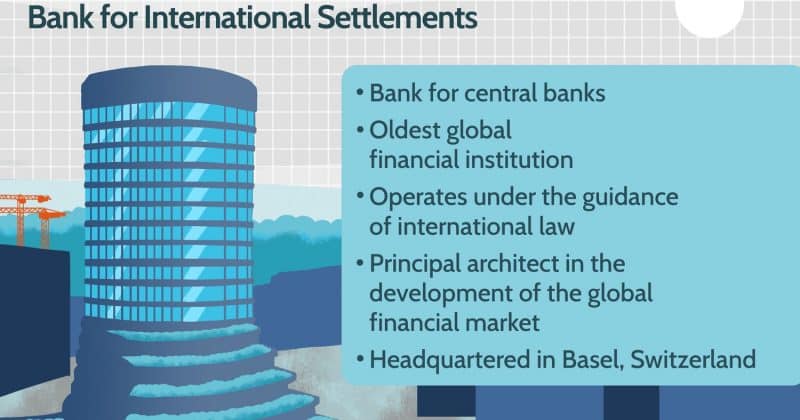
The central bank of central banks flags hidden debt structures and shadow borrowing as hyperscalers pour over $100 billion into AI infrastructure
The Bank for International Settlements, the institution that serves as the central bank for the world’s central banks, is sounding an alarm about the AI gold rush. In its March 2026 Quarterly Review, the BIS laid out a case that the frenzy to build AI infrastructure is creating financial risks that most investors can’t fully see.
The core concern: the biggest tech companies on earth are taking on enormous amounts of debt to fund data centers, and a growing chunk of that borrowing is happening through opaque structures that don’t show up on traditional balance sheets. If AI doesn’t deliver the returns everyone’s banking on, the fallout could ripple well beyond Silicon Valley.
The debt machine behind the AI buildout #
The numbers are striking. Hyperscalers, the industry term for the mega-cap tech firms driving AI infrastructure, including Amazon, Alphabet, Microsoft, Meta, and Oracle, issued more than $100 billion in corporate bonds in 2025. Much of that debt carries maturities beyond five years, signaling these companies are making long-duration bets on AI’s commercial future.
But the BIS flagged something more concerning: the growing use of off-balance-sheet financing structures that obscure the true scale of leverage. These include special purpose vehicles, joint ventures, and private credit arrangements that the BIS describes as “shadow borrowing.” These companies are finding ways to fund massive capital expenditures without the debt appearing on their corporate balance sheets in a straightforward way.
These arrangements create new webs of financial interconnection between tech companies, banks, and private credit markets. If a downturn hits, those connections could transmit stress in unexpected directions.
Contained for now, but the BIS has seen this movie before #
The BIS was careful to note that immediate risks to financial stability appear modest. That caveat comes with a significant asterisk: the situation stays contained only if the AI sector actually delivers strong financial outcomes.
The BIS pointed out that excessive market enthusiasm could lead to spillovers, including stock market corrections and stress in credit markets. The report drew implicit parallels to past investment cycles where transformative technology attracted enormous capital, only for unforeseen challenges to trigger widespread financial distress.
The Quarterly Review, published on March 16, 2026, included analysis from a team of researchers. BIS Bulletin no. 120, authored by Iñaki Aldasoro, Sebastian Doerr, and Daniel Rees, contributed key findings, while significant sections of the Quarterly Review were led by Egemen Eren, Ingomar Krohn, and Karamfil Todorov.
The BIS also flagged a specific risk trigger: guarantees embedded in some of these off-balance-sheet structures could activate unexpectedly. If private credit flows shift in a procyclical manner, meaning lenders pull back precisely when conditions deteriorate, the resulting squeeze could amplify a downturn rather than cushion it.
What this means for investors #
The BIS report highlights that the visible financial metrics for hyperscalers may not capture their full exposure. Investors evaluating these companies on traditional balance sheet ratios could be underestimating actual leverage, as the shadow borrowing structures create a gap between reported debt and economic debt.
An upcoming BIS Annual Economic Report, scheduled for late June 2026, is expected to provide additional analysis on the broader fiscal and financial stability implications of the AI investment boom. If that report strikes a more urgent tone, it could shift regulatory attention toward these financing structures, potentially increasing compliance costs or limiting certain types of off-balance-sheet arrangements.
Disclosure: This article was edited by Editorial Team. For more information on how we create and review content, see our