TL;DR — Key Takeaways
AWS is moving several AI services into maintenance mode. Amazon Q Business, Amazon Kendra, Bedrock Agents Classic and nine SageMaker AI capabilities are no longer available to new customers, although existing users will continue receiving access and support.This is portfolio pruning, not an AI retreat. AWS is redirecting investment toward newer offerings such as Bedrock AgentCore and Bedrock Knowledge Bases while continuing to invest heavily in AI infrastructure.The AI market is evolving faster than enterprise deployment cycles. Services launched around enterprise search, retrieval and first-generation agents may no longer fit a market focused on autonomous systems, orchestration, identity and governance.Enterprise buyers need to treat new AI services as potentially temporary abstractions. Portability, lifecycle transparency and control over data, prompts and orchestration should be central purchasing requirements.
Amazon Web Services is sending a select group of its AI offerings into maintenance mode, and the speed with which some of them reached this stage is bound to make enterprise customers uncomfortable.
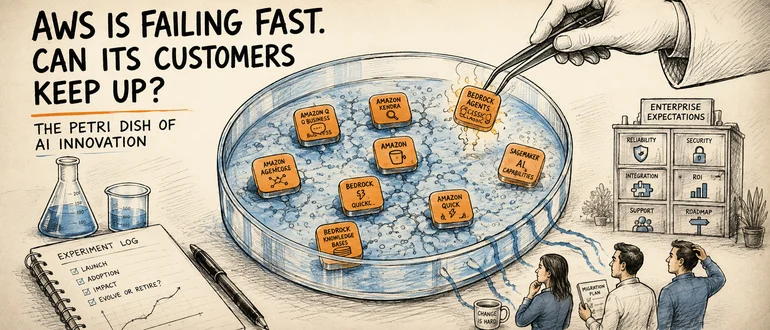
Amazon Q Business, Amazon Kendra and Amazon Bedrock Agents, now called Bedrock Agents Classic, are among the affected services. Nine Amazon SageMaker AI capabilities are receiving similar treatment. Beginning July 30, AWS stopped making them available to new customers, while promising continued access and support for existing users.
Janakiram MSV captured the drama of the moment in a Forbes article headlined “AWS Kills the AI Services It Launched Just Two Years Ago.” “Kills” may be slightly stronger than the language AWS uses, but it captures the commercial significance. These services have not been shut down, but AWS has told the market that they are no longer part of the company’s growth strategy.
Maintenance mode is not quite a funeral. It is more like a long-term care facility for technology. The service remains available to those already relying on it, but its days as an actively expanding platform are over.
That deserves attention. It does not, however, mean AWS is abandoning its entire previous generation of AI technology or retreating from enterprise AI.
AWS is selectively pruning its portfolio. Other AI products continue to receive substantial investment, and the company is directing customers toward newer alternatives, including Bedrock AgentCore, Bedrock Knowledge Bases and Amazon Quick. Amazon is also continuing to spend enormous sums on the compute, infrastructure and data center capacity required to support AI.
This is a portfolio correction, not a surrender.
The most likely explanation is also the least sensational. Some of these offerings may not have attracted enough customers. Others may overlap with newer products or no longer fit the direction in which the technology is moving. A few may have been overtaken by developments that AWS could not have reasonably anticipated when the services were conceived.
What we are seeing is the petri dish of AI innovation on full display.
Yesterday’s Good Idea
Think about what enterprise AI looked like only two or three years ago.
Retrieval-augmented generation was emerging as the bridge between general-purpose large language models and private corporate information. Enterprise search appeared poised for a renaissance. Packaged assistants promised to let employees query company data through natural language. The first generation of agents was expected to connect models to tools and allow them to perform a defined set of business tasks.
Kendra, Q Business and Bedrock Agents were not foolish products built around obviously flawed ideas. They represented reasonable assumptions about how enterprises would adopt generative AI.
The problem is that two years in this market might as well be a decade.
Models have become more capable. Context windows have expanded. Tool use has improved. Reasoning systems and coding agents have shown that AI can perform multistep work rather than simply retrieve, summarize or generate information. Enterprises are thinking more seriously about memory, identity, permissions, orchestration, observability and governance.
The market has moved from asking how an employee can chat with corporate documents to asking how an autonomous system can take action across multiple applications without creating an operational, security or compliance disaster.
A service designed for the first question may not be the right answer to the second.
AWS should be allowed to recognize that. In fact, it has an obligation to recognize it.
Keeping a poorly adopted or technologically obsolete product alive indefinitely is not a sign of commitment. It can become a form of corporate vanity, preserving yesterday’s strategy because admitting that the market moved would be uncomfortable. Engineering talent, capital and management attention are finite. Resources devoted to an offering customers do not want cannot be invested in the one they may need next.
This is the basic logic behind failing fast. Make a bet, test it in the market, learn what works and stop funding what does not.
AWS appears to be doing exactly that.
Failing Fast at Hyperscaler Scale
There is nothing malicious about this. I do not believe AWS launched these services knowing it would place them into maintenance mode a few years later. The company made product decisions based on the market it saw at the time. The market changed, adoption revealed which assumptions were wrong, and AWS is reallocating resources.
That is innovation.
The complication is that AWS is not a startup experimenting only with its own time and investors’ money. It is one of the world’s largest and most important enterprise technology providers. When AWS conducts an experiment, its customers, partners and employees often become part of it.
An AWS product team can identify a weak offering, move engineers to another project and introduce a successor within months. A large enterprise does not have that freedom.
The customer may spend months evaluating a service. Security, legal and compliance reviews follow. The service must be integrated with identity systems, internal data, logging, governance controls and existing applications. Employees must be trained. Business processes must change. Only then can the organization begin measuring whether the investment delivered a return.
Bedrock Agents became generally available in November 2023. Amazon Q Business became generally available in April 2024. That may be enough time for AWS to conclude that the products did not receive the market support it expected or no longer matched its strategy. For some enterprise customers, it was barely enough time to move beyond a pilot.
AWS can fail fast. Its customers cannot always migrate fast.
The company’s official lifecycle announcement emphasizes that existing users will continue to receive access and support. That is materially better than an immediate shutdown. Customers are not waking up to find that their applications have stopped functioning.
But maintenance mode is not a growth path.
Customers know that meaningful innovation will happen elsewhere. Partners know that demand for implementation services will decline. Developers know that the ecosystem surrounding the product will shrink. Every organization still using the service must decide whether to remain on a platform with a diminishing strategic role or begin paying for a migration to the replacement AWS now favors.
From AWS’s perspective, this is resource reallocation. From the customer’s perspective, it may be stranded investment.
People Are Part of the Experiment
There is also a human cost that product lifecycle announcements rarely quantify.
Reuters reported that Amazon cut positions in its artificial general intelligence organization as it sharpened its focus on what it described as the initiatives that matter most to customers. Amazon did not disclose the number of employees affected.
Some people working on the services entering maintenance mode may be moved to other projects. Others may find that the technical specialty or product expertise they developed is no longer as valuable inside the company. Partners may have trained consultants and built practices around products that will no longer attract new customers. Enterprise buyers may have hired specialists or organized teams around AWS services that now have a limited future.
We should not invent numbers or assume every product retirement produced a layoff. There is no complete public accounting of how many people have been reassigned or displaced.
Still, the people affected are not an incidental part of the story. “Fail fast” sounds clean when represented as a product box disappearing from a portfolio slide. It is far messier when that box contains employees, careers, partner investments and customer projects.
Amazon is also consolidating parts of its model strategy. Reuters reported that Amazon is winding down several Nova models, including Premier, Omni, Reel and Canvas, while redirecting resources toward a new frontier-model initiative led by Pieter Abbeel.
We should be careful about treating every product retirement, personnel decision and model change as evidence of one coordinated retreat. The available evidence does not support that conclusion. Together, however, the moves show a company reevaluating where it can compete most effectively and concentrating its resources accordingly.
Again, that is not necessarily a sign of weakness. It may be evidence that Amazon is learning.
The more difficult question is whether it is learning quickly enough.
Is AWS Reading the Market or Misreading It?
Every technology company launches products that fail to attract sufficient demand. In a market developing as rapidly as AI, the failure rate should be expected to be higher. If AWS selected only winners, it would probably mean the company was not taking enough risks.
Pruning a few unsuccessful bets can demonstrate discipline. Repeatedly launching heavily promoted services and moving them into maintenance mode before customers earn a return would begin to suggest something else.
At some point, the question stops being whether a specific service succeeded and becomes whether AWS is a reliable purveyor of enterprise AI solutions.
AWS earned its enterprise reputation as a dependable infrastructure provider. Its strengths in compute, storage, databases, networking, security and operational scale are difficult to dispute. Companies accepted substantial dependence on AWS because its core services were durable and the surrounding ecosystem was deep.
Customers building on Amazon S3 or EC2 were not simply buying a feature. They were making an architectural decision based partly on the expectation that AWS would continue investing in the platform.
Packaged AI services create a different calculation.
The application and orchestration layers of enterprise AI remain unsettled. Customer behavior is still developing. Model capabilities change rapidly. A feature that requires a specialized managed service today may become a standard model capability tomorrow. A product positioned as an enterprise platform may turn out to be an interim abstraction between two generations of technology.
AWS may be an exceptional provider of the infrastructure beneath AI while still learning which assistants, agents, application platforms and foundation models customers want above it.
Its infrastructure position also gives Amazon an advantage that its customers do not share. AWS can retire one of its branded AI products and still make money from the compute, storage and data services consumed by the replacement. It can lose at one layer of the stack while continuing to profit from the workload underneath it.
The customer cannot switch architectural theories so easily.
This does not make AWS a poor provider of AI solutions. The evidence is not sufficient to reach that verdict. It does mean the AWS name alone should not cause buyers to treat every new AI service as if it has the same durability as the company’s mature infrastructure offerings.
The risks are different, and enterprise buying practices need to reflect that.
Products or Well-Funded Hypotheses? #
Customers evaluating new AWS AI services should ask questions they might not have considered necessary when choosing a traditional cloud service.
Can the application survive if the managed service is placed into maintenance mode? Can the underlying data, prompts, context and business logic be moved elsewhere? Does the architecture depend on proprietary orchestration that cannot be reproduced outside AWS? Is there a credible migration path to the successor, or will the customer effectively have to rebuild?
Enterprises should demand portability, lifecycle transparency and control over their data and orchestration. They should assume that models, agent frameworks and branded services will change, then design their systems so those changes do not become existential events.
AWS has responsibilities as well.
It should distinguish more clearly between durable platforms and well-funded experiments. Marketing every new offering as a permanent layer of the future enterprise stack may drive early adoption, but it also encourages customers to make commitments that outlive the product strategy.
There is no shame in calling something an experiment. In this market, experimentation is unavoidable. Honest labeling would allow customers to decide whether they want to become design partners, early adopters or later-stage buyers after the product proves that it has lasting market support.
AWS’s selective pruning may turn out to be exactly the right move. The services entering maintenance mode may have attracted weak demand, become redundant or fallen behind the technology. Redirecting resources could produce better offerings for customers and a stronger AI portfolio for Amazon.
The danger comes if the cycle repeats too often. If AWS continually introduces the next essential enterprise AI service, promotes it aggressively and replaces it before customers complete their deployment cycles, the market will begin to question more than the individual products. It will question AWS’s ability to identify which AI solutions enterprises should build upon.
There is nothing inherently wrong with AWS failing fast. That is how innovation works.
The real test is whether AWS is learning faster than it is misreading the market, and whether its customers can keep absorbing the cost of those lessons.
AWS is entitled to change its mind about where AI is headed. Its customers must decide how much of their own future they are willing to build on AWS’s latest answer.