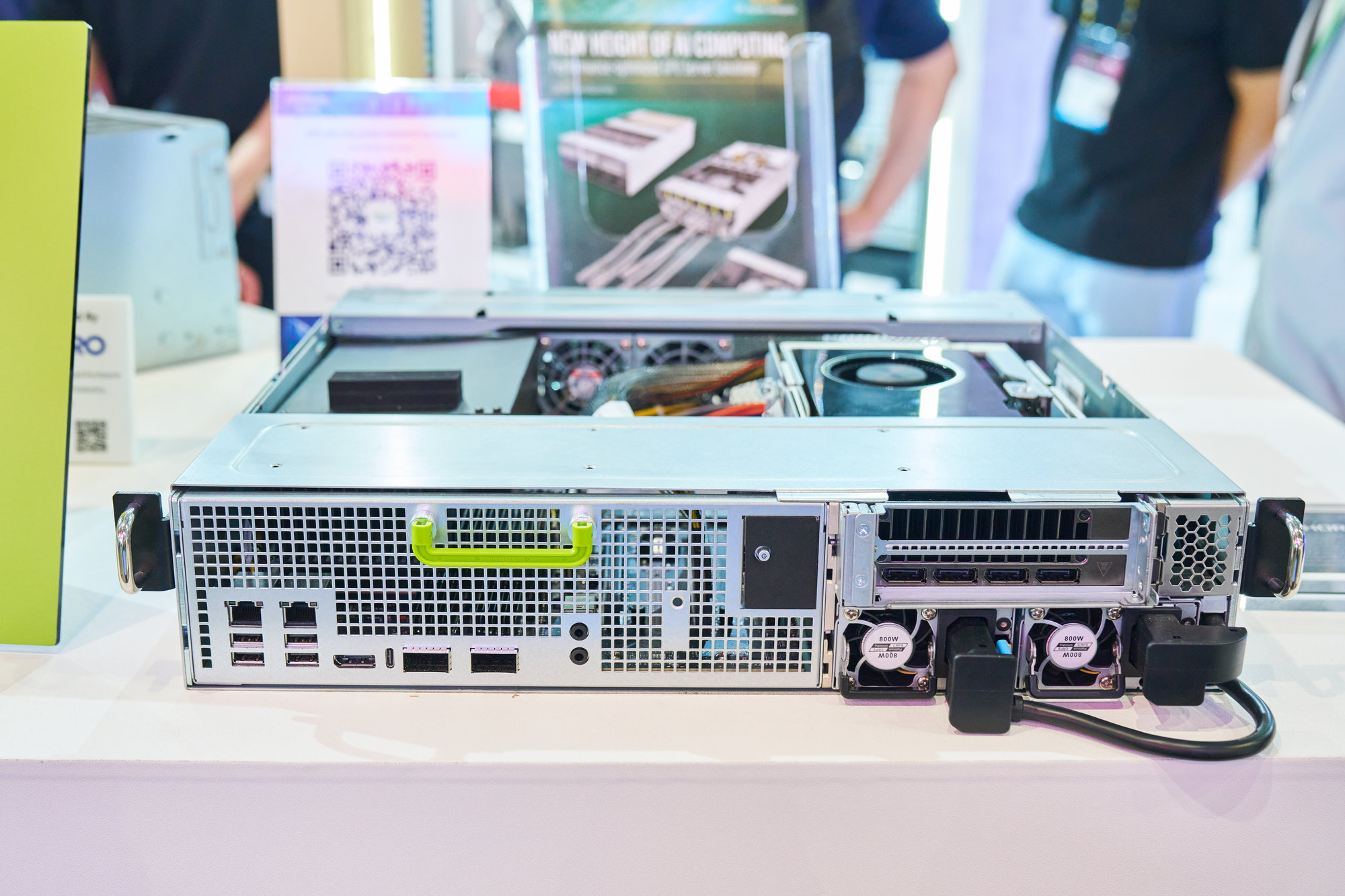
With the biggest theme of this year’s Computex 2026 trade show being all things AI, we saw a wide variety of systems for the task, big and small. But between the desktops, workstations, and rackmount servers galore, one of the most interesting bits we came across was a far less conventional server from ASRock Rack. The server company had a new 2U short-depth server on display with an interesting twist: this one was based on NVIDIA’s Thor SoC.
ASRock Rack 2UXGI-THOR #
Dubbed the 2UXGI-THOR, the dense name packs a lot of information into a handful of characters. The box is fundamentally a 2U server built to meet NVIDIA’s modular MGX server specification, which allows for compute servers (and racks) to mix and match various processors to allow for customized servers to meet a vendor or customer’s specific needs. Normally, these MGX servers are filled with datacenter-grade x86 or NVIDIA Grace CPUs, but ASRock Rack has taken the form factor and its molecularity to the extreme to build an AI edge server for the industrial market based around the IGX Thor platform.
What makes an edge server an industrial server in particular? In this case, the biggest factor is the SoC at the heart of the device. IGX Thor is the industrial version of NVIDIA’s latest generation automotive/industrial SoC, which combines 14 Arm Neoverse-V3AE CPU cores with an NVIDIA Blackwell integrated GPU. And surrounding that is a whole host of additional specialized hardware for the automotive/industrial field, including a programmable vision accelerator, sensor bridging, and camera-over-Ethernet support. In short, IGX Thor is designed to excel at ingesting and processing sensor data in real time.
ASRock Rack, in turn, has adopted the Thor platform to develop an AI edge server specifically aimed at the industrial and medical markets – two fields where systems are expected to process a great deal of sensor data. Specifically, ASRock Rack has built a server around NVIDIA’s IGX T7000 platform, which is a full microATX motherboard that combines an IGX Thor module and its 128GB of LPDDR5X memory with an NVIDIA ConnectX-7 NIC. ASRock Rack then put this in a server chassis and paired it with appropriate hardware, making it suitable for placement in a small server rack.
Besides the processing capabilities of the Thor SoC, ASRock Rack is also taking advantage of the PCIe capabilities of the T7000 motherboard to add an NVIDIA Blackwell PRO video card. The server can accommodate a single FHFL PCIe card, which ASRock Rack fills with either a PRO 5000 or PRO 6000 video card, which in turn is meant to provide the bulk of the AI processing power, well beyond what the Thor SoC could accomplish on its own.
The resulting server comes with quite a bit of I/O connectivity for its size. Along with a 1GbE RJ45 jack provided by Thor’s integrated NIC, the system also comes with a pair of 200GbE QSFP28 ports powered by the ConnectX-7 NIC built into the T7000 motherboard. This is joined by 5 10Gbps USB ports – four USB-A ports and a single USB-C port.
Meanwhile, beyond the system’s form factor, its server credentials come through more strongly in a couple of other ways. For starters, the server is powered by dual 800W redundant power supplies. And since this is a server, there is an ASPEED AST2600 BMC on board to remotely manage the system, as well as an RJ45 jack for connecting it to a dedicated management network.
Beyond that, this is notably a server meant to process data rather than store it. The only storage available is a single M.2 2280 slot running at PCIe Gen5 x2 speeds, so the system has enough room for an OS drive, and that is it.
Similarly, while the T7000 motherboard on which this server is based has multiple PCIe slots, ASRock Rack is not making use of the additional slots; there is only a single I/O bracket opening for the RTX PRO video card.
Final Words #
Edge servers such as the 2UXGI-THOR show just how wide a variety of systems are being offered to customers who want to run AI at the edge, whether on desktops or, in this case, in small server rooms nearby. Placing an automotive/industrial SoC in a server is certainly an unusual approach at a time when most servers are built from data center hardware, but it also makes ASRock Rack’s product a unique offering in a crowded commodity market. The 2UXGI-THOR is a much more niche piece of hardware as a result, but for customers who want to ingest and process large amounts of images with local servers, the underlying Thor SoC is particularly well optimized for the task.