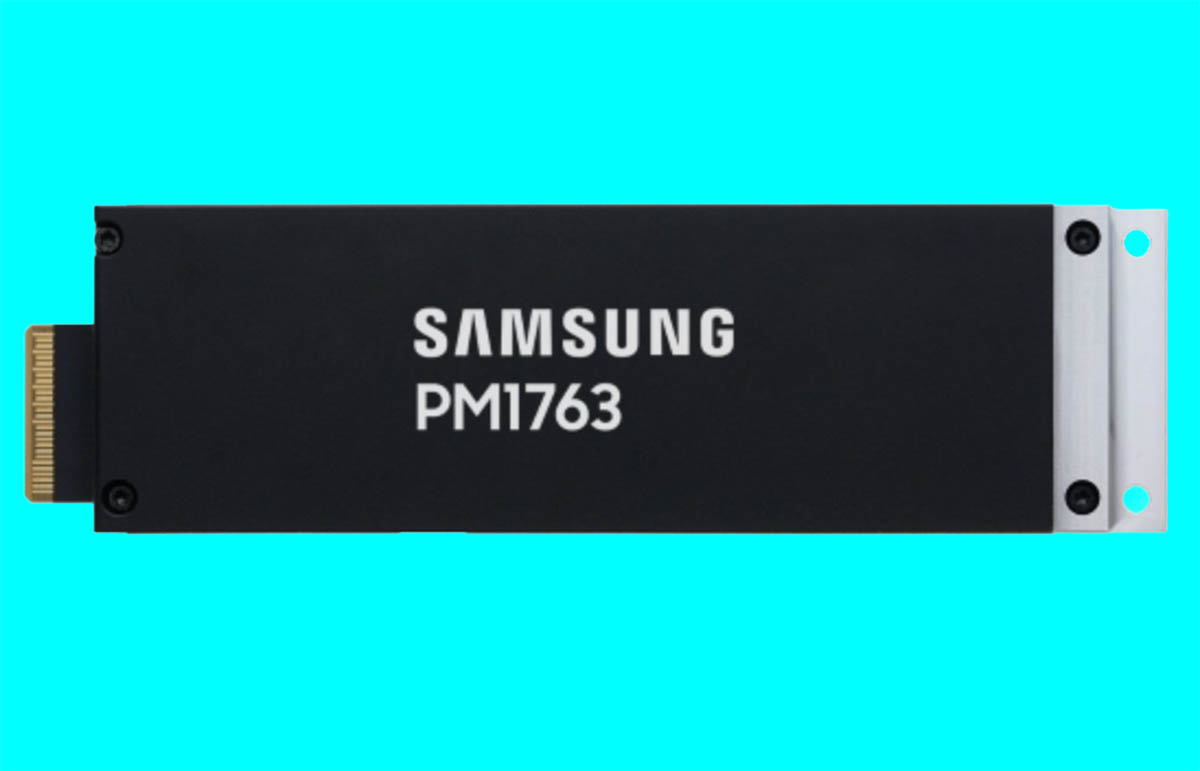
Samsung Electronics announced mass production of the PM1763, its first PCIe 6.0 enterprise SSD built for AI and HPC server environments. We are just starting the transition to PCIe Gen6 systems with some hyper-scale CPUs, NVIDIA Vera, and soon AMD EPYC Venice launching with support. As a result, we need devices like SSDs to take advantage of the new, higher-speed interface.
Samsung PM1763 PCIe Gen6 Enterprise SSD #
Incorporating Samsung’s 9th-generation V-NAND flash memory and a newly developed 4-nanometer controller, the PM1763 delivers sequential read speeds up to 28,400 MB/s while writes hit 21,900 MB/s in the 16TB configuration. This represents more than double the performance of the previous PM1753 model.
Samsung claims this performance level allows the drive to transfer a 40GB large language model in approximately 1.4 seconds, reducing data latency between processors and accelerators during AI operations. It used to be that these things were measured in video or other files, but let us face it, AI is driving PCIe Gen6 SSD adoption.
Samsung’s new drive is also said to be optimized for liquid cooling, which sets this drive apart from many current enterprise SSDs. Newer AI servers will be completely liquid-cooled to move fans out of the compute rack, and so the SSDs must also be oriented so they can be liquid-cooled. We showed this some time ago in: This is the Solidigm Liquid-Coolable NVMe SSD Design.
Since these drives will be deployed for some time, they now support post-quantum cryptography (PQC) algorithms designed to protect against future quantum computing threats, which is a big deal in the storage world these days. They also support TEE Device Interface Security Protocol (TDISP) for securing data pathways in virtualized environments.
Final Words #
Instead of being focused at the high-capacity market, the Samsung PM1763 ships in 4TB, 8TB, and 16TB capacities. These are more focused on the high-performance in-server local storage, which makes sense for a new SSD on a new PCIe interface. That is what we saw with the PCIe Gen4 and Gen5 NVMe SSD transitions as well.
Perhaps the most exciting thing about this announcement is that PCIe Gen6 servers are coming.