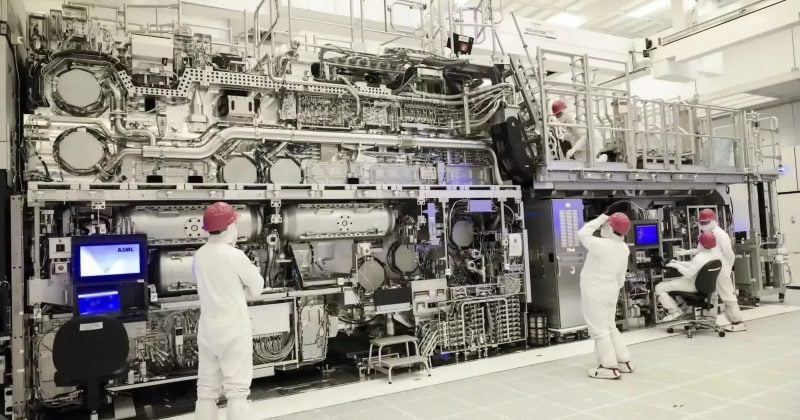
The Dutch lithography giant is racing to prevent its machines from becoming the bottleneck in the AI chip supply chain
ASML, the company that makes the machines that make the chips that power basically everything, is cranking up production. CEO Christophe Fouquet announced during the company’s Q1 2026 earnings call on April 15 that ASML will boost its Low-NA EUV lithography system capacity by roughly 30% for 2027, targeting at least 80 units and possibly as many as 85.
For context, the company shipped 44 of these systems in 2025 and is aiming for around 60 to 65 in 2026. So we’re looking at a trajectory that could see output nearly double in just two years. The reason is exactly what you’d guess: AI won’t stop being hungry for chips.
Why this matters beyond the semiconductor world #
Here’s the thing about ASML. It occupies one of the most extreme monopoly positions in the global economy. It is the only company on Earth that makes EUV lithography machines, the tools required to print the most advanced semiconductor chips. Every cutting-edge processor from TSMC, Intel, and Samsung runs through ASML’s equipment first.
That supply chain chokepoint has been a growing concern as hyperscalers like Microsoft, Google, and Amazon pour tens of billions into data center construction. The capacity ramp announced by Fouquet is a direct response to that pressure, an attempt to ensure EUV tools don’t become the limiting factor in a semiconductor expansion cycle driven by AI demand.
Bank of America analysts have already adjusted their models, projecting 85 Low-NA EUV units in 2027 and 87 by 2028. ASML itself has floated the possibility of reaching 110 systems by 2028 if demand warrants it, though that figure remains aspirational rather than committed.
Low-NA stays king, for now #
A quick translation for anyone not fluent in semiconductor jargon. “NA” stands for numerical aperture, which essentially determines how fine the details a lithography machine can print on a chip. Low-NA EUV systems have been the workhorse of advanced chip production for several years. High-NA systems, which can print even smaller features, are ASML’s next-generation platform.
One notable detail from the earnings call: ASML sees no immediate need to accelerate production of High-NA EUV systems. In English, Low-NA machines are handling the current generation of chips just fine, and chipmakers aren’t yet at the point where they need the more advanced (and significantly more expensive) High-NA tools at scale.
What investors should watch #
The capacity expansion reinforces ASML’s position as perhaps the most strategically important company in the global technology supply chain. For semiconductor investors, the ramp from 44 shipped units in 2025 to a potential 85 in 2027 represents a massive revenue tailwind, given that each Low-NA EUV system carries a price tag in the hundreds of millions of dollars.
The downstream effects matter too. TSMC, Intel, and Samsung are ASML’s primary customers for these machines. More EUV tools available means more advanced fabrication capacity coming online, which should help alleviate chip supply concerns that have periodically rattled tech markets over the past several years.
The risk side of the equation is worth considering too. ASML’s aggressive capacity targets assume sustained demand. If AI spending cools, or if geopolitical tensions further restrict chip equipment exports to China, some of that planned production could end up without buyers.
The 110-unit figure floated for 2028 is particularly worth tracking. If ASML commits to that target in future guidance, it would signal that the company’s customers, the world’s most sophisticated chipmakers, see AI-driven demand continuing to accelerate well into the second half of the decade.
Disclosure: This article was edited by Editorial Team. For more information on how we create and review content, see our