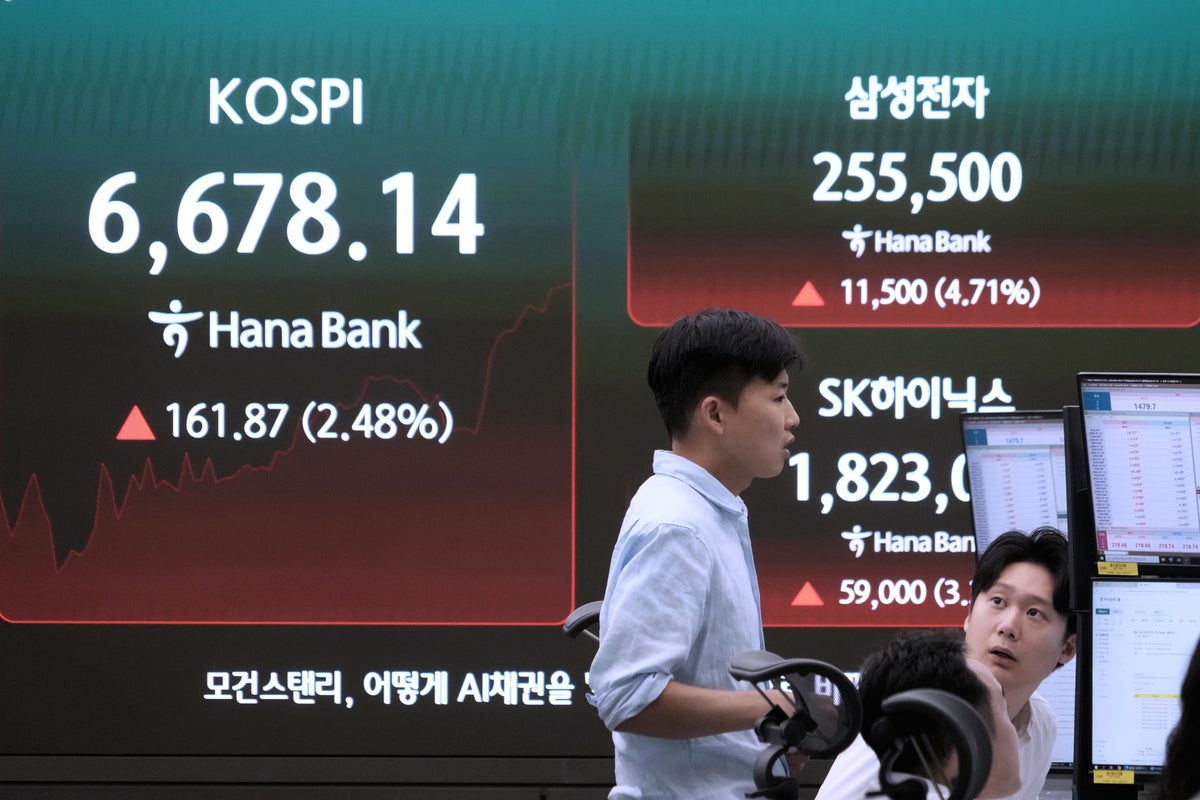
Asian shares have mostly gained, with markets in South Korea and Japan trading higher after recent declines due to heavy selling of stocks linked to artificial intelligence #
- Bookmark
Asian shares mostly gained on Tuesday, with markets in South Korea and Japan trading higher after recent declines due to heavy selling of stocks linked to artificial intelligence.
U.S. futures edged higher, while oil prices slipped.
South Korea’s Kospi, which is heavily reliant on AI and chipmaking-related shares, jumped 4.7% to 6,821.41. It fell 4.5% a day earlier. Samsung Electronics surged 7.4%, while memory chip maker SK Hynix gained 6.4%.
The Kospi has gained more than 50% so far this year, but fell more than 20% over the past month as investors sold to lock in profits, wary of worries about a potential bubble in AI investments.
Tokyo’s Nikkei 225 added 2.8% to 65,926.41 after a holiday on Monday, recovering from some of its losses from last week.
Computer memory maker Kioxia Holdings surged 15.9%, while chip testing equipment maker Advantest jumped 6.9%. OpenAI investor SoftBank Group climbed 6.1%, while chip equipment maker Tokyo Electron added 1.3%.
Taiwan’s Taiex, which also has benefited from the AI boom, was up 3.6%. Its advanced AI chipmaker TSMC, or Taiwan Semiconductor Manufacturing Co., advanced 2.8%.
Hong Kong’s Hang Seng edged less than 0.1% higher to 25,150.75. The Shanghai Composite index added 0.6% to 3,819.66.
Australia’s S&P/ASX 200 climbed 0.1% to 8,798.00.
India’s Sensex gave up 0.1%.
Oil prices fell early Tuesday after gaining the day before. Brent crude, the international standard, fell below $90 a barrel, down 0.7% to $88.63. But it’s still well above the roughly $72 per barrel level it was at before the war started in late February.
Benchmark U.S. crude lost 0.3% at $82.24 a barrel.
Early Tuesday, Iran attacked another tanker in the Strait of Hormuz, a crucial waterway for global oil and gas transport. The U.S. announced another round of strikes targeting Iran for a 10th straight night. Iran has been retaliating against the U.S. strikes by targeting U.S. allies across the Middle East.
As the U.S. and Iran traded fire, Iran’s interior minister traveled to Pakistan, a main mediator, for talks, but it’s still unclear if a new deal may be reached.
“There’s some hope of de-escalation between the U.S. and Iran,” ING commodities strategists Warren Patterson and Ewa Manthey wrote in a commentary Tuesday. “This won’t be an easy task. Large divisions remain between the U.S. and Iran.”
A naval blockade by Yemen’s Iranian-backed Houthis against Saudi Arabia has increased risks to oil supplies, they said.
On Monday, Wall Street’s benchmark S&P 500 slipped 0.2% to 7,443.28. The Dow Jones Industrial Average dropped 0.6% to 51,839.26, while the technology-heavy Nasdaq composite dipped less than 0.1% to 25,508.07.
Many of the major chipmaking and other AI-related stocks gained. Nvidia climbed 0.2%, Micron Technology rose 1.9%, and Broadcom was up 2%. AMD, or Advanced Micro Devices, added 1.6% after it announced an expanded partnership with Microsoft on AI.
In other dealings early Tuesday, the U.S. dollar fell to 162.48 Japanese yen from 162.50 yen. The euro was unchanged at $1.1414.
AP Business Writers Stan Choe and Matt Ott contributed to this report.