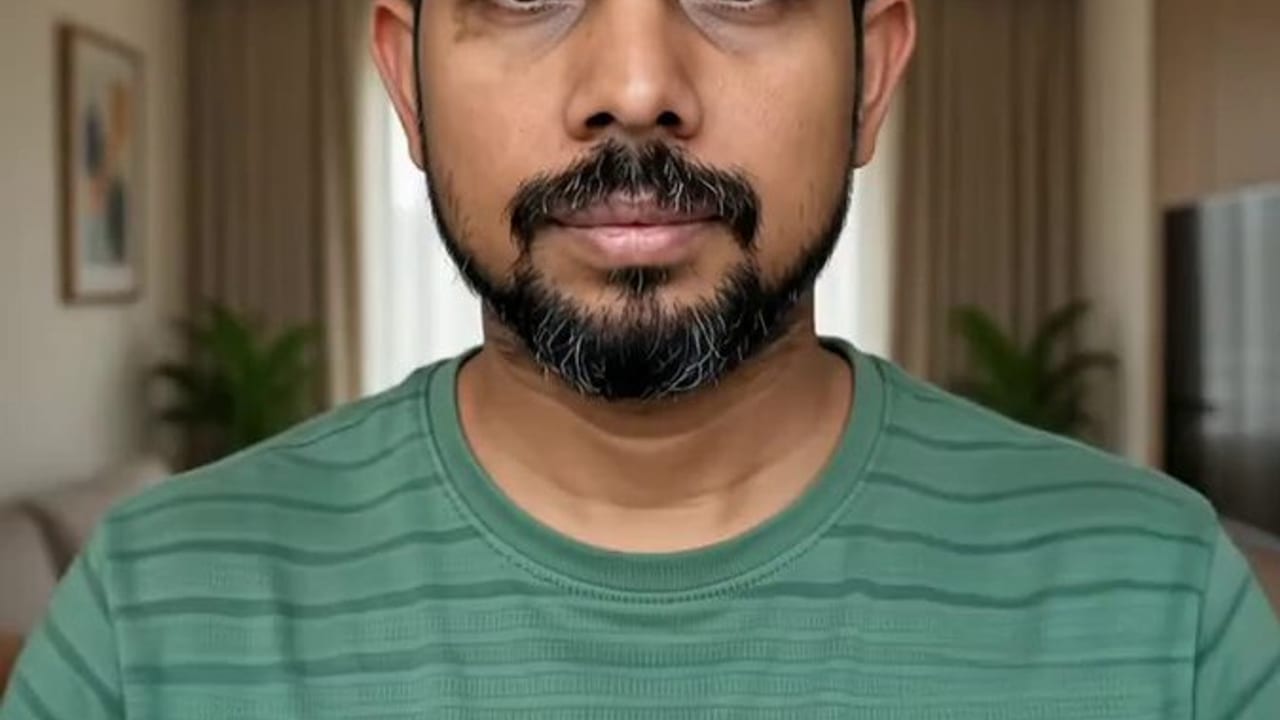
On May 25, 2026, AI consultant and technology creator Ashutosh Shrivastava posted a Gemini Omni Flash clip showing a synthetic version of himself delivering a prompted video. The demonstration exposed a useful product inside Google's sweeping pitch for a model that can create "anything from any input": record yourself once, write a prompt and send a synthetic version of yourself in front of the camera.
Ashutosh Shrivastava on X Shrivastava is an AI consultant and technology creator rather than a Google employee. His website says he has worked with more than 150 clients and participates in early-access programs for Gemini and other generative-media products. That makes him part of an increasingly important distribution layer for AI labs: creators who test unfinished products, identify the legible use case and put a human face on capabilities that are difficult to explain in a model card. (Ashutosh Shrivastava)
In Shrivastava's case, the human face is also the product input. Google's avatar workflow asks a user to record a short sample of their face and voice, then select that personal avatar inside a Gemini prompt. In Gemini Apps, avatar creation requires users to be at least 18 and signed in to a personal Google Account with a Google AI plan. Eligible Google Workspace users can also use personal avatars in Google Vids. Personal-account video generation in Gemini Apps requires a Google AI plan, while work or school accounts require a qualifying Google Workspace license. (Google Gemini Apps Help)
A broad video model finds a specific job
Google introduced Gemini Omni Flash on May 19, 2026, as the first model in its Gemini Omni family. The model accepts combinations of text, images, audio and video, then generates short videos with audio. Users can request changes to objects, action, camera position, environment and style through a continuing conversation. Google began rolling it out through the Gemini app and Google Flow. Google said availability for YouTube Shorts and YouTube Create was planned. (Google)
The avatar capability is a workflow within Gemini Apps, rather than a separately announced product called "Gemini Avatar." That distinction matters because Google's advantage comes from combining several creation modes inside products it already distributes. A user can supply their own identity, generate a scene and continue editing it through prompts without moving to a dedicated presenter-video service.
Specialists have built around narrower versions of this job. HeyGen's Avatar IV animates a single image with synchronized speech, facial movement and hand gestures. Synthesia packages avatars with scripts, translation, brand controls and collaboration for business video. Google's model is less purpose-built. Its pitch covers personal avatars alongside cinematic generation, video editing and multimodal references. (HeyGen)
That breadth gives Google several routes into the market, but Shrivastava's clip is a clearer sales argument than the phrase "anything from any input." Founders and small marketing teams can understand a reusable digital presenter. It could turn a script into a product update, localization test or social clip without another recording session. The demo does not establish that the workflow is reliable enough to replace a production process.
The same test exposed the cost of getting there
On May 26, Shrivastava reported that one avatar-video prompt ran for roughly four minutes, consumed his entire five-hour Gemini usage allowance and initially failed to produce a video, according to ComputerBase. The report said the clip was completed after the restriction expired.
The episode captured the gap between an impressive output and a dependable tool. Video generation carries a heavier compute bill than text or image generation, and a workflow becomes difficult to build around when a failed attempt can exhaust the user's available capacity. Google had opened Gemini Omni Flash to developers in preview by June 30, but the published API limits remain modest: three-to-10-second output at 720p and 24 frames per second. The preview model uses the ID gemini-omni-flash-preview
. (Google AI for Developers) Google's own Gemini Omni Flash model card puts boundaries around the polished demonstrations. It says complete consistency across edits, complex motion and accurate text rendering remain challenging. (Google DeepMind)
Those caveats do not erase what Shrivastava produced. They define the work still required before personal avatars become routine production infrastructure. The strongest immediate use is short-form experimentation, where a creator can tolerate another attempt and a brief clip can still carry the message. Longer, repeatable campaigns demand predictable generation times, clearer capacity limits and continuity across multiple scenes.
Creators are part of Google's launch machinery
Shrivastava describes his work as testing early products, giving feedback and translating new capabilities into stories for an audience. Gemini Omni Flash shows why that role matters. Google's announcement explained multimodal inputs and conversational editing. Shrivastava reduced the pitch to a person typing an instruction and watching a version of himself perform it. (Ashutosh Shrivastava)
The relationship also cuts both ways. A creator can produce the demonstration that makes a model understandable, then publish the failed generation and rate-limit problem that an official launch video would leave out. That is more useful to builders than another perfect sample. It shows both the destination and the current cost of reaching it.
Google's rapid release cadence makes those outside tests increasingly important. Gemini Omni Flash is a different product line from the company's other recent model releases, but the operating pattern is familiar: models reach users quickly, and production behavior becomes visible only once real workloads arrive.
Shrivastava's avatar video remains a compelling demonstration because the use case is immediate. It also remains a single creator's result, produced under conditions that have not been independently benchmarked. Google's larger bet is that a general multimodal model can absorb jobs served by separate avatar, video-generation and editing products. The clip shows that consolidation beginning. The exhausted usage allowance shows why specialist tools still have room.