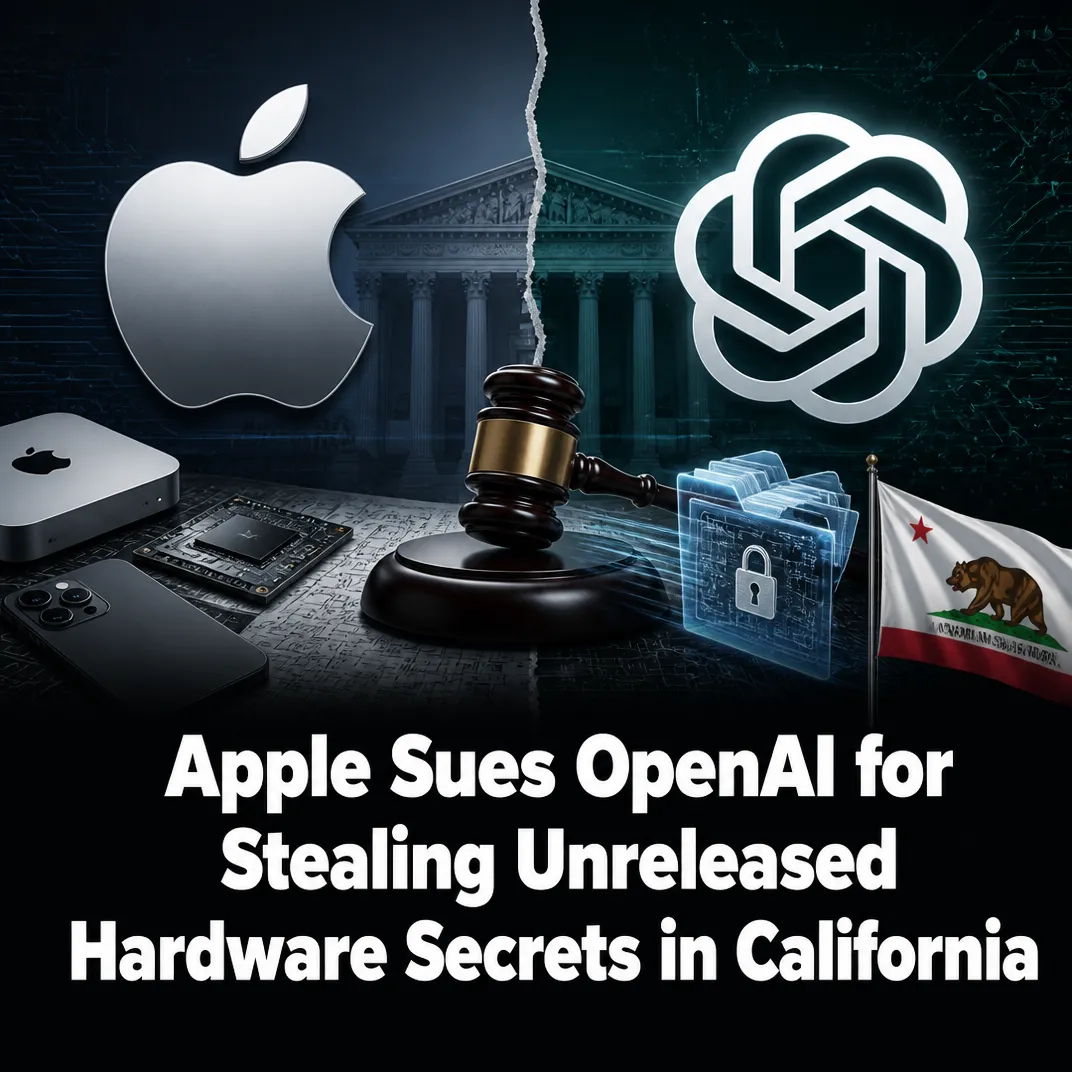
July 14, 2026, (Inside AI) — Apple has filed a lawsuit against OpenAI in the Northern District of California, alleging a coordinated campaign to steal unreleased hardware trade secrets. The suit claims OpenAI, from technical staff to its chief hardware officer, systematically poached confidential information to fast-track its own consumer devices.
The complaint names former Apple employees Chang Liu and Tang Tan as defendants. Liu, a former senior electrical engineer, allegedly retained a work laptop and exploited a bug to access Apple's cloud storage, down dozens of confidential files including specs for unreleased products. Tan, now OpenAI's hardware chief, previously led design for iPhone, AirPods, and Apple Watch.
Apple's filing states bluntly:
"This case is about Apple's former employees stealing Apple's trade secrets for the benefit of OpenAI. Apple brings this suit to put a stop to it."
The lawsuit details how Tan allegedly used Apple's confidential information during interviews to extract more insider knowledge. He reportedly used an internal project codename to ask a candidate:
"What's the plan[?]" for an unannounced Apple product.
Tan also directed job candidates still working at Apple to bring "Actual parts" from Apple to their interviews for "show and tell" sessions. One candidate expressed surprise, commenting he "didn't even know we could take those from the office."
OpenAI allegedly instructed Apple employees to bring "CAD/design artifacts" and "prototypes" to interviews, and to divulge details about "subsystem and component selection," the "tools or methodologies you use for system integration, such as CAD software, simulation tools," and "Vendor selection and communication/collaboration with vendors."
In one instance, OpenAI reportedly had a partner reveal a metal-finishing technique under the false belief that Apple had approved it. Apple claims OpenAI coached departing staff on dodging security checks and hiding their next employer.
The Strategic Stakes Behind the Legal Battle #
The lawsuit comes as OpenAI prepares for an IPO and readies its first hardware device, shaped partly by ex-Apple designer Jony Ive. More than 400 former Apple workers now sit at OpenAI, a fact that underscores the intense talent war between the two firms. Their partnership in 2024 to weave ChatGPT into the iPhone now seems a distant memory.
Legal experts note that trade secret cases hinge on proving misappropriation and reasonable efforts to maintain secrecy. Apple's detailed allegations—including the exploitation of a cloud storage bug—suggest it has substantial evidence. However, OpenAI denies wrongdoing, stating it has no interest in others' trade secrets. Reports indicate OpenAI is developing a counter legal action, potentially arguing overreach or lack of specificity.
The case echoes past Silicon Valley disputes, such as the Waymo v. Uber trial over self-driving car secrets, which ended in a settlement. But the scale here—involving a top AI firm and a hardware giant—could set new precedents for how trade secrets are protected in the age of AI and cross-industry poaching.
Implications for AI and Hardware Convergence #
This legal clash highlights the growing convergence of AI and consumer hardware. OpenAI's pivot to devices, with Ive's design influence, directly threatens Apple's ecosystem. The lawsuit may slow OpenAI's hardware ambitions if injunctions or damages are awarded. It also raises questions about the ethical boundaries of talent acquisition in tech.
Industry observers point to the broader trend of AI companies hiring from hardware firms to build integrated products. The outcome could influence how companies structure non-compete and confidentiality agreements, especially in California where non-competes are largely unenforceable. The full filing is available here as a PDF.