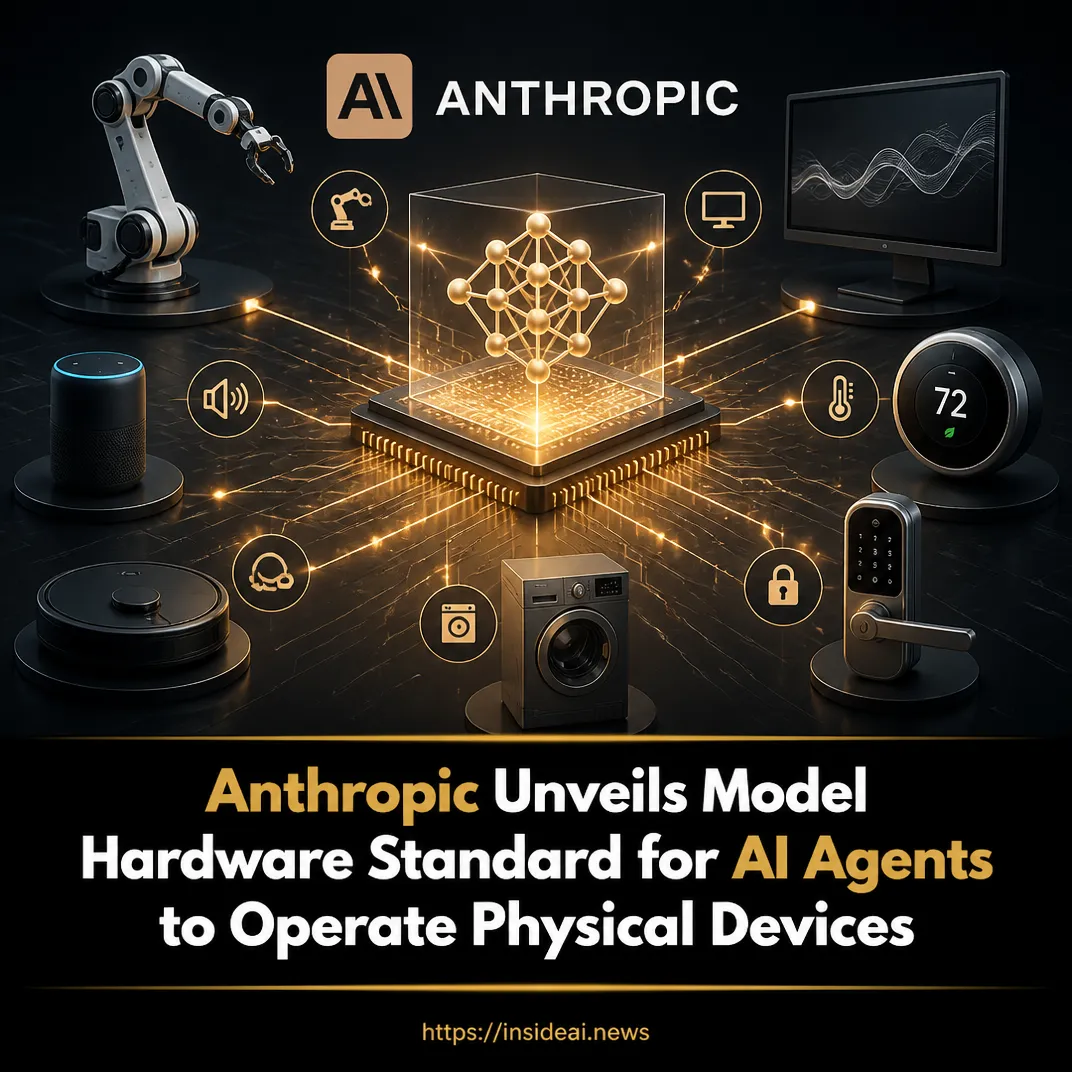
August 28, 2026, (Inside AI) — Anthropic has introduced a research preview of a new framework called Model Hardware Standard, or MHS, designed to let AI agents operate physical devices in scientific research and advanced manufacturing.
The framework enables AI agents to work with lab and manufacturing instruments such as microscopes and robotic arms in tandem. It can handle complex tasks ranging from routine drug discovery experiments to laser calibration on a quantum computer.
Anthropic aims to integrate agentic AI capabilities with lab and manufacturing hardware. The goal is to help researchers and engineers execute autonomous, round-the-clock workflows with minimal human intervention, speeding up processes.
MHS works on any device that has a programmable interface. It allows devices and agents to communicate across networks, according to the company.
Anthropic said it is sharing an early version of the MHS with partners. The purpose is to help build out safety evaluations before making it open source.
The announcement marks a significant step in Anthropic's push beyond software-only AI. The company, known for its Claude chatbot, is now targeting physical automation in high-stakes environments.
Industry observers note that AI agents operating physical devices raise new safety and reliability questions. Unlike software tasks, hardware actions can cause physical damage or safety incidents if errors occur.
Anthropic's decision to share the framework with partners before open sourcing reflects a cautious approach. Safety evaluations are critical when AI controls instruments like robotic arms or quantum computer lasers.
The MHS framework could accelerate research cycles in pharmaceuticals and materials science. Autonomous workflows may run experiments continuously, reducing time from hypothesis to result.
Competing AI labs have also explored hardware integration. However, Anthropic's focus on a standardized framework could lower barriers for labs and manufacturers to adopt agentic AI.
One challenge is interoperability across diverse lab equipment. MHS addresses this by requiring only a programmable interface, which many modern instruments already have.
Security experts caution that networked AI agents controlling physical devices expand the attack surface. A compromised agent could potentially manipulate experiments or damage equipment.
Anthropic has not disclosed which partners are testing the early version. The company also did not provide a timeline for open source release.
The move aligns with broader industry trends toward embodied AI and autonomous systems. Physical AI is seen as the next frontier after language and vision models.
For researchers, the promise is fewer manual steps and more consistent results. For manufacturers, it could mean lights-out operations with minimal human oversight. Still, adoption will depend on trust. Labs and factories will need robust validation before letting AI agents control expensive or sensitive equipment.
Anthropic's framework may influence standards in the emerging field of AI-driven laboratory automation. If adopted widely, MHS could become a de facto protocol for agent-hardware communication.
The company's cautious rollout suggests it is aware of the stakes. Safety evaluations with partners are a way to gather real-world feedback before broader release.
While the research preview is early, the direction is clear. Anthropic is positioning itself not just as a chatbot maker but as a provider of infrastructure for autonomous physical work. Future developments will likely include more detailed safety guidelines and expanded device compatibility. The open source release will be a key milestone to watch.