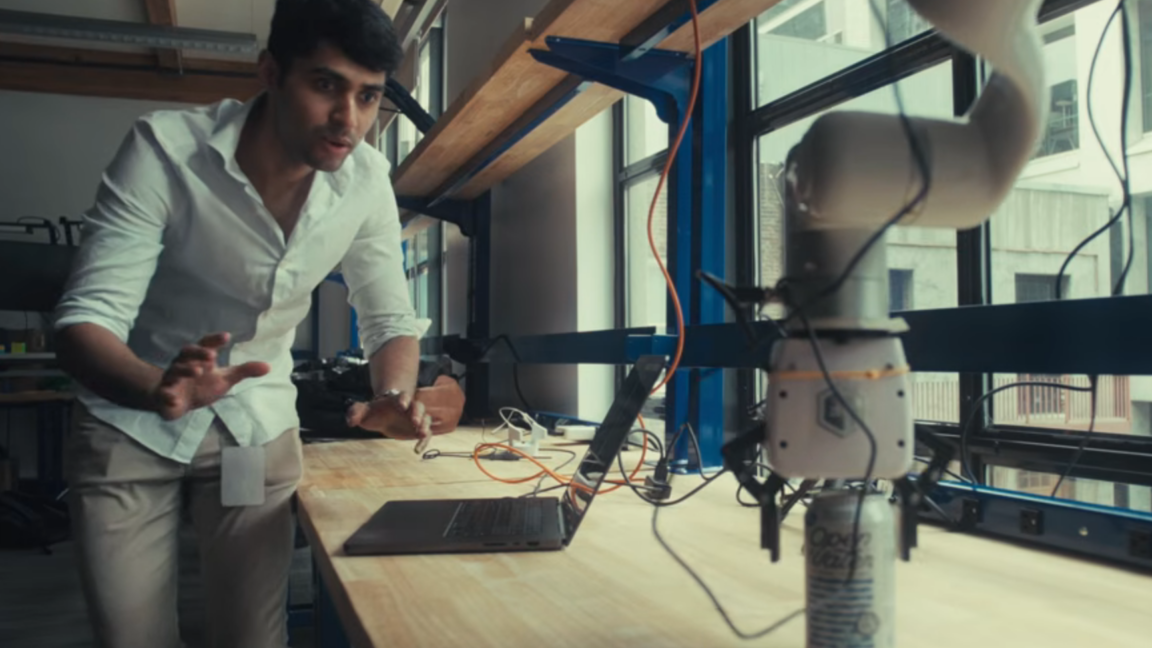
For all the [interest in](https://arstechnica.com/information-technology/2025/12/how-do-ai-coding-agents-work-we-look-under-the-hood/) and [uptake](https://arstechnica.com/ai/2026/08/metas-scrapped-plans-to-go-ai-native-included-slashing-teams-by-60-percent/) of [agentic AI systems](https://arstechnica.com/ai/2026/02/sixteen-claude-ai-agents-working-together-created-a-new-c-compiler/) over [the past year or so](https://arstechnica.com/features/2025/10/we-let-openais-agent-mode-surf-the-web-for-us-heres-what-happened/), the world of automated AI has thus far been primarily limited to text, images, code, and other data and actions that take place inside a computer. Anthropic is now aiming to change that somewhat with what it’s calling [the Model Hardware Standard](https://www.anthropic.com/news/model-hardware-standard-research-preview) (MHS), a set of standardized drivers designed to let AI agents easily interface with and control arbitrary devices.

For now, the “research preview” of the MHS effort is being sold mainly as a way to help scientists streamline the arduous process of creating the custom software integrations that are often needed to get disparate components of an experiment working in concert. MHS can provide a common interface and common format for data sharing between these devices, Anthropic says, allowing them to talk to each other across a network “without needing a bespoke ‘translator’ program in between.” The standardized system could reduce weeks or months of exacting experimental setup down to “hours or minutes,” Anthropic writes.
In a video posted alongside the announcement, Anthropic Technical Staffer Alek Kemeny says the MHS effort was inspired by observing neuroscientist Arco Bast work through an experiment on memory formation in the brain at the HHMI Janelia Research Campus in Ashburn, Virginia. Kemeny said Bast had worked out an interface to get the rotating laser beams, microscopes, cameras, and myriad other components of the experiment to coordinate through a common interface. “This idea could be used to have AI run any science experiment in the world,” Kemeny recalls thinking at the time.
Your new robotic lab assistant? #
There’s nothing about a common machine interface language that requires the use of AI models, of course. And Anthropic says MHS devices can be controlled directly in real time via command-line prompts and API code files. But integrating an MHS system with an AI model through the Model Context Protocol lets scientists interact with devices using natural language, and lets models “reason through each step in an experiment, update parameters in real time, and, in some cases, recover from hardware errors without intervention,” Anthropic writes.