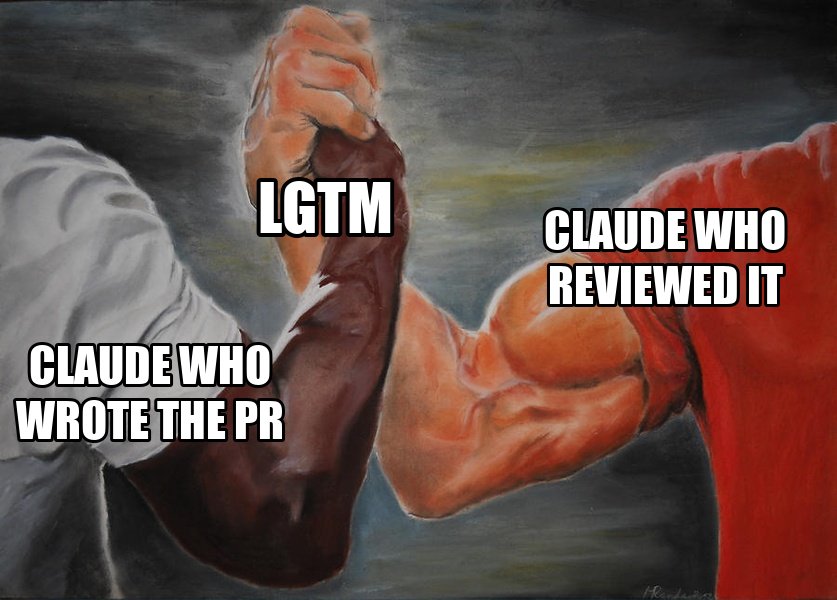
Anthropic shipped Claude Ship in beta on 23 November. It reviews pull requests, fixes them, and approves the ones a team’s policy allows. The stated goal is blunt: “ship code as fast as teams write it.”
The joke wrote itself, and @p_wilfried_ wrote it first.
It is funny because it is accurate. Claude Ship is three pieces, and only one of them is new in kind:
Code Review , already generally available, reviews a PR against the codebase through several lenses, adversarially verifies its own findings, and posts them #
PR Steward , in beta, keeps a PR green by fixing failing checks and merge conflicts, and is explicitly*“designed not to approve or merge”* #
Claude Approvals , in beta, applies an approval policy written as a file in the repository
So the model that writes code, the model that reviews it, and the model that approves it can all be the same weights.
The policy file is the entire safeguard #
Anthropic describes Claude Approvals as “a smarter CODEOWNERS file”. Teams can have it weigh Code Review findings, or their own classifiers written in natural language, and decide whether a change is routine enough to approve without a person.
Anthropic’s own recommendation is the honest part: enable it in observe-only mode first, build confidence, and only then configure branch protection to require Claude’s green light. That is a company telling you its own approval agent should be watched before it is trusted.
What Anthropic admits about its own code #
Buried in the framing is a number worth extracting. On the Claude Code team, Claude writes most of the code, and Code Review is one layer of that process. The results they cite are their own: merged PRs more than doubled from June to September, and the share of changes reverted fell by more than 40 percent.
Those are vendor numbers on a vendor’s workflow. They are also the most plausible argument in the announcement, because a team whose agent writes the code has already accepted the thing the product is selling.
Why this is a governance story, not a productivity one #
A code review was never only a reading exercise. It was a second party with something at stake if the change broke. Removing that party does not remove the review; it changes what “reviewed” means, and the policy file is now the only independent actor in the loop.
That is the same shape as the rest of this month. Banks writing clauses that make your agent’s action your action. Hosted inference where prompts leaked at resellers and nobody could tell which provider processed what. When the author and the approver are the same artifact, the audit trail becomes a statement of configuration rather than evidence of deliberation.
The parts worth using #
None of this means turn it off. PR Steward keeping a branch green, and Code Review catching what a tired reviewer misses, are real gains, and both stop short of the merge.
The line to draw is the one Anthropic drew for itself: let the agent fix and comment, keep the approval human until you have watched it be right for a while, and write the policy file as if it will one day be read in a postmortem. Because it will.
Eligible Claude Enterprise organisations can claim at least $10,000 in Claude Ship credits, within 30 days of claiming and by 15 January 2027.
Sources: [Anthropic: introducing Claude Ship](https://claude.com/resources/articles/introducing-claude-ship) - [the LGTM thread](https://x.com/p_wilfried_/status/2124960103942000938) - [the announcement](https://x.com/ClaudeDevs/status/2124959436640858475)

Related on this site: [Google and Microsoft now sell the harness, not the model](https://tokenstead.ai/guides/harness-comparison)