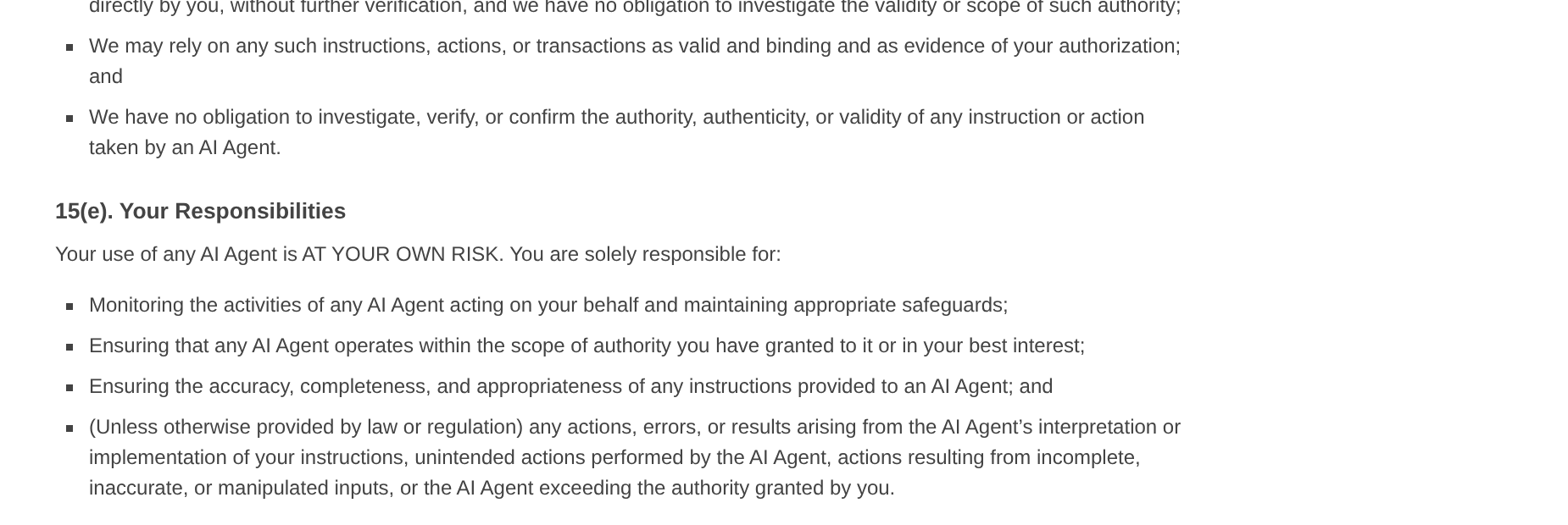
If you hand an AI agent your banking login and it moves the wrong money, the bank’s position is that you did it. Wells Fargo has written that down. Its Online Access Agreement, in a version effective 24 November 2026, carries a new Section 15, “Third-Party Artificial Intelligence Agents or Agentic AI”. The operative sentence is in 15(e):
“Your use of any AI Agent is AT YOUR OWN RISK.”
The capital letters are Wells Fargo’s. What follows is an enumeration of what you are now solely responsible for: monitoring the agent, keeping it inside the authority you granted, the accuracy of what you told it, and — “unless otherwise provided by law or regulation” — “any actions, errors, or results arising from the AI Agent’s interpretation or implementation of your instructions, unintended actions performed by the AI Agent, actions resulting from incomplete, inaccurate, or manipulated inputs, or the AI Agent exceeding the authority granted by you.”
The mechanism is authorization, not negligence #
The clause that does the work is 15(d). Any instruction, action or transaction an agent initiates is “deemed to be made directly by you, without further verification, and we have no obligation to investigate the validity or scope of such authority”, and the bank “may rely on any such instructions, actions, or transactions as valid and binding and as evidence of your authorization.”
That is the hinge. Consumer protection turns on whether a transfer was authorized. An agent acting on credentials you supplied is authorized by definition here, so the dispute never reaches the question of whether the agent was having a bad day.
The definition is broad enough to catch almost anything: “any software, application, program, or other technology that takes autonomous, semi-autonomous, or non-autonomous action on behalf of any person or entity.” And 15(g) keeps the exit open — the bank can require you to register agents, restrict which actions they may take, or block them entirely, “including by restricting certain actions by AI Agents.”
Ally says it in one sentence #
Ally’s security page needs no clause numbering. Under credential confidentiality: “We don’t share your usernames and password — and we strongly recommend you also don’t share them, with either humans or artificial intelligence (“AI”). When you use an AI service, you’re responsible for any actions that the AI takes.”
Read the next block on that same page and the tension is visible in one screen. Ally also promises that “you will not be liable for any unauthorized Online or Mobile Banking transaction” as long as you report it within 60 days.
Both statements can be true at once, and that is the trick. The guarantee covers transactions you did not authorize. The agent clause defines your agent’s transactions as authorized.
The caveat that keeps a lawyer in business #
Wells Fargo’s language preserves any protection the law provides: the responsibilities apply “unless otherwise provided by law or regulation.” Regulation E still governs unauthorised electronic fund transfers, and a customer who never instructed an agent to make a particular transfer has an argument that nobody asked them to make it.
That argument is untested. Terms written in the last few weeks have not been through a dispute, a regulator or a court, and the clause’s own escape hatch is the part worth watching.
What this means if you run an agent #
The clause is not absurd. A bank cannot audit software it never sees, and 15(g) shows it will start demanding registration. But it moves the burden in a way that anyone wiring an agent to real money should plan for:
Scope the credential, not the account. A bank login is unlimited authority. An agent that needs to see balances should not be able to move money. #
Keep an audit trail you control , because 15(e) makesyou responsible for monitoring what the agent did. #
Revoke in writing and keep the receipt. 15(f) holds you responsible for the agent’s activity until you notify the bank, and requires you to prove you did. #
Assume every agent transaction is yours until a regulator says otherwise, because that is what the contract says.
The uncomfortable part is how well the clause matches reality. If you gave an agent your password, the bank genuinely cannot tell your instruction from its interpretation of your instruction. The contract is honest about a problem the technology has not solved.
Sources: [Wells Fargo Online Access Agreement, version effective 24 November 2026](https://www.wellsfargo.com/online-banking/online-access-agreement/upcoming/) - [Ally: our security approach](https://www.ally.com/security/our-approach/) - [TFTC on Citi’s AI agent clause](https://www.tftc.io/citi-ai-agent-liability-customers-section-h)

Related on this site: [Microsoft demos Hermes at Ignite without announcing it](https://tokenstead.ai/guides/hermes-microsoft-ignite)