TL;DR — Key Takeaways
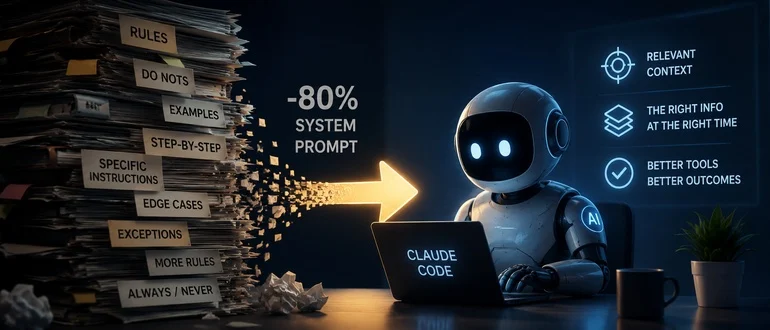
- Anthropic removed more than 80% of Claude Code’s system prompt for its newest models without reducing performance on coding evaluations.
- The company says overly detailed rules, examples and instruction files can restrict capable models rather than improve their decisions.
- Developers should keep CLAUDE.md files focused, improve tool interfaces and load specialized context only when an agent needs it.
- The new
claude doctor
and/doctor
tools help teams identify outdated, excessive or conflicting instructions.
Anthropic just told developers something that runs against a decade of prompt-engineering instinct: Stop writing so many rules.
In a post published July 24, the company described how it removed more than 80% of Claude Code’s system prompt for its newest models, including Claude Opus 5 and Claude Fable 5, without losing ground on coding evaluations. That’s not a minor trim. It’s a rethink of how context should be built for agentic coding tools, and it has implications well beyond Claude Code.
The company frames this as context engineering — a discipline distinct from prompt engineering. Where a prompt is specific to one request, context is assembled from system prompts, skills, memory, and other sources, and gets reused across many requests. Anthropic argues that the old approach to building that context, heavy with explicit rules and examples, was built for less capable models. Newer models don’t need as much hand-holding, and over-specifying instructions can actually work against them.
“Prompt engineering optimized a single request. Context engineering decides what the model sees across thousands of them, which is an architecture problem, not a wording problem,” said Mitch Ashley, vice president and practice lead for software lifecycle engineering and AI-native software engineering at The Futurum Group. “Teams that treated CLAUDE.md as a rulebook are now maintaining technical debt.”
“Anthropic cutting 80% of that prompt says the models can finally be trusted to decide,” Ashley said.
Where the Old Rules Stop Working
Anthropic’s team found that earlier guardrails, like telling Claude to never write code comments or never create planning documents, were often wrong for specific situations. The company said that while these constraints were once necessary to avoid worst-case outcomes, it has since found it can delete many of them and let the model rely on context and judgment instead.
The blog post lays out several “then and now” shifts. Instead of giving Claude explicit rules, Anthropic now leans on the model’s judgment. Instead of up tool descriptions with examples, which the company found actually narrowed how Claude explored a problem, it’s investing in better-designed tool interfaces. And instead of front- every possible instruction into the system prompt, Anthropic has moved toward progressive disclosure: information only when it’s needed, through tools like ToolSearch and dedicated skills for verification and code review.
That last point echoes what independent researchers have been documenting. A recent empirical study of AI context files across hundreds of open-source projects found there’s still no established structure for how developers should organize this information, and that the files themselves evolve significantly over a project’s life as teams figure out what actually helps their AI agents develop solutions in line with a project’s standards, policies, and workflows. In other words, the industry is still working out these conventions in real time, and Anthropic’s guidance is one data point in a broader shift.
Why This Matters Beyond Claude Code
Academic researchers have started treating context engineering as its own field of study rather than an offshoot of prompting. One recent paper proposed five criteria for evaluating context quality: relevance, sufficiency, isolation, economy, and provenance, treating context as something closer to an agent’s operating system. That framing matters because it shifts the conversation from “what do I tell the model” to “what environment am I building for it to operate in.”
“Most enterprises building their own agent harnesses have a year of instruction files nobody has audited,” Ashley said. “Anthropic’s /doctor command makes that pile measurable. Teams should run something like it and expect to delete more than they keep.”
Ashley added that the same logic extends to governance. “An agent’s real policy is whatever context loads at runtime, which makes the path the control point,” he said. “Audit what your agents see before the next model upgrade changes their judgment.”
Anthropic isn’t just publishing advice here. It rolled out a new command, claude doctor, along with the /doctor command inside Claude Code, meant to help developers rightsize their own skills and CLAUDE.md files automatically. For teams that have spent the past year stacking up instructions in these files, that’s a practical tool for finding out what’s actually still useful.
The Practical Takeaway
For developers building their own agents, not just those using Claude Code, the shift suggests a few concrete changes worth testing. Keep CLAUDE.md files lightweight and focused on genuine gotchas in a codebase rather than restating what the model can already infer. Design tools with clear, expressive parameters rather than burying instructions in examples. And build a tree of reference files that load progressively, rather than a single document meant to cover every scenario. None of this means throwing out guardrails entirely. Anthropic still keeps system prompts specific to each product’s context, and the company is clear that some constraints remain necessary in high-stakes areas. But the broader message is that as models get more capable, the job of context engineering shifts from constraining the model to curating what it sees and when it sees it.
That’s a meaningful distinction for any team building production agents right now, and it’s likely to keep evolving as the next generation of models arrives.