How the verification workflow actually works #
The core idea here is to turn Alexa into a real-time fraud detection agent. When you receive a text, an email, or even a suspicious phone call that claims to be from Amazon, you can trigger the assistant to run a check.
The AI doesn't just look at the sender's name. It performs a multi-layered analysis:
Internal Record Matching: The AI compares the message against a massive, real-time database of every single communication Amazon has officially dispatched.Content Analysis: It looks at the specific wording and the actual payload of the message.Formatting Verification: It checks if the structure of the message (headers, links, layout) matches the official templates used by the company.Sender Metadata: It evaluates the origin of the message to see if it aligns with known Amazon protocols.
The "Certainty" threshold #
One thing that stood out to me in the technical rollout is how conservative the AI is being. Amazon has explicitly stated that the assistant will only give a green light if it is "completely certain" that the message is authentic.
If there is even a shred of doubt—perhaps because the timestamp is slightly off or the formatting is slightly off-brand—the AI won't validate it. This is a smart move for a security feature. In a real-world scenario, a false positive (telling a user a scam is real) is far more dangerous than a false negative (telling a user a real message might be fake).
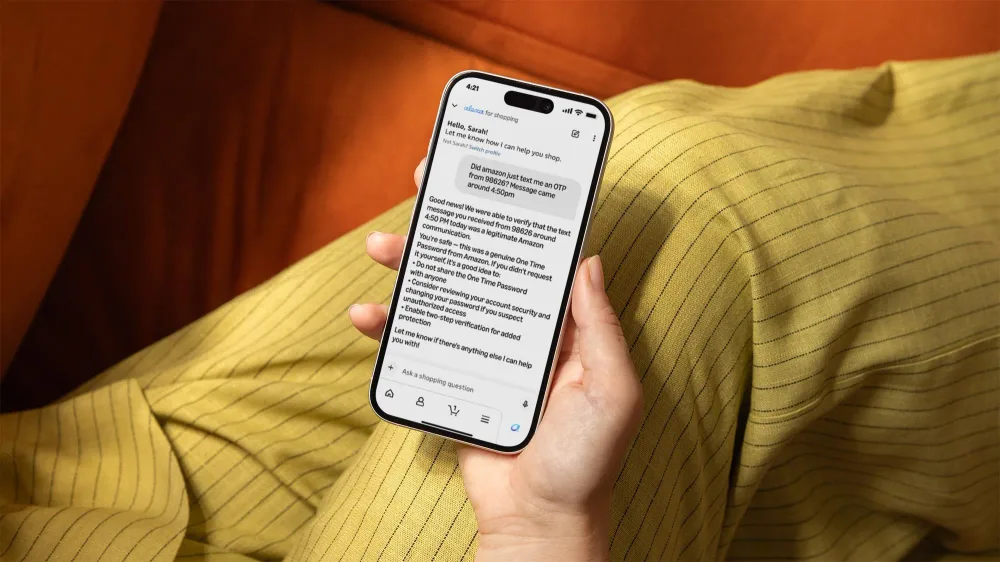
For example, if you get a text asking for an OTP (One-Time Password), you can ask:
"Alexa, did Amazon just text me an OTP from 98626 around 4:00 PM?"
The assistant will then run that specific query against their communication logs. If the records show a text was indeed sent from that specific short code at that exact time, it confirms it. If not, it warns you.
Is this a practical solution for most users? #
From a deployment standpoint, this is a very beginner-friendly way to handle digital security. Most people aren't going to inspect email headers or check SPF/DKIM records to see if an email is spoofed. By moving the verification into a natural language interface, Amazon is making prompt engineering-style security checks accessible to anyone with an Echo device.
It's essentially a specialized LLM agent focused entirely on identity verification. While it won't stop a hacker from sending a message, it provides a massive safety net for the millions of users who are prone to clicking on "urgent" account suspension links. It’s a solid step toward integrating AI into the actual utility of cybersecurity rather than just using it for generative fun.
Next GPT-5.6 Sol and Claude Fable 5.1 are fighting for LLM supremacy →
a guide to making money with AI, with plenty of directly applicable cases.