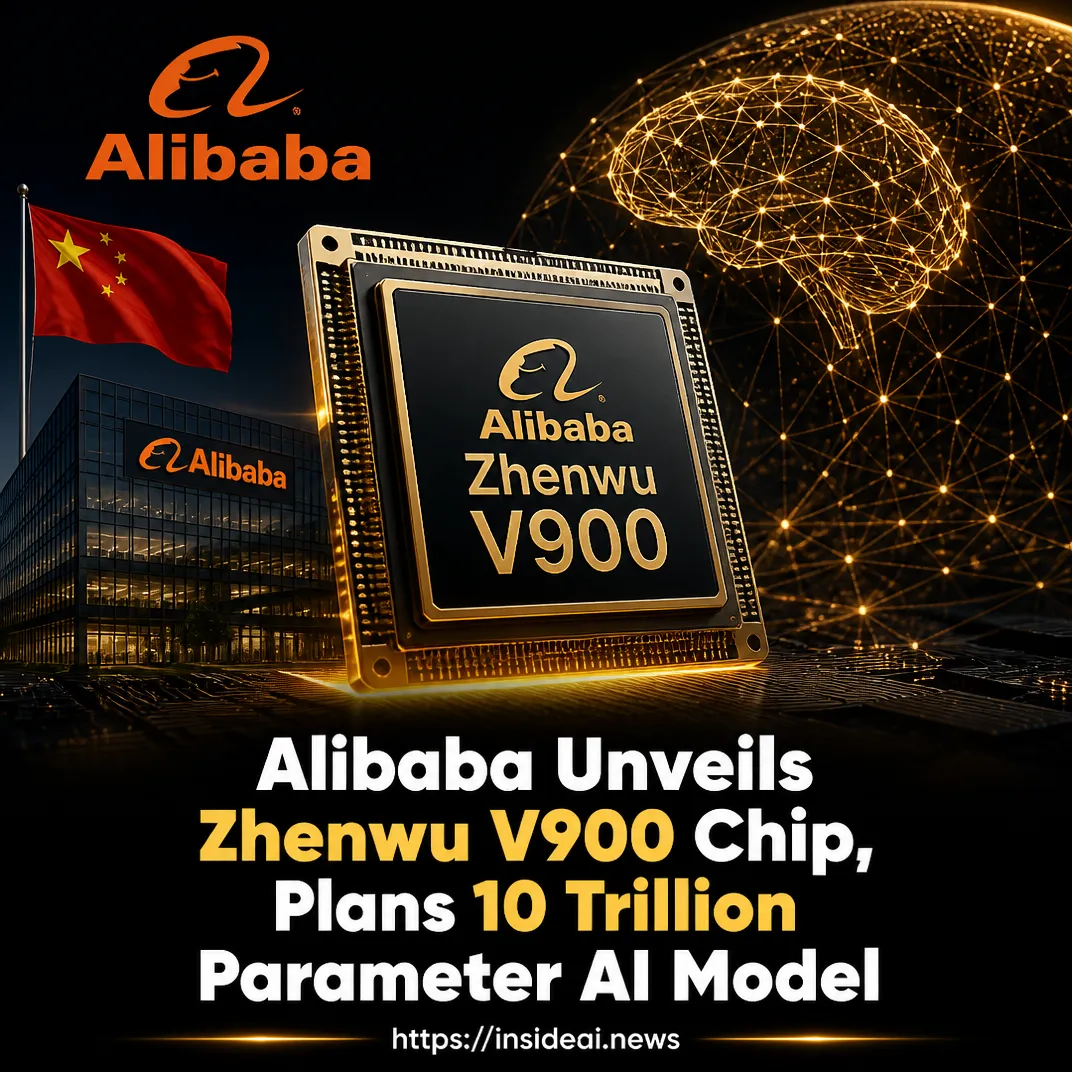
September 23, 2026, (Inside AI) — Alibaba Group unveiled its Zhenwu V900 AI chip and confirmed plans to build a 10 trillion parameter model, sending its shares up 5% to a one-month high. The announcements came Tuesday at the company's Apsara conference in Hangzhou, where CEO Eddie Wu framed the moves as steps toward artificial superintelligence.
Wu said machines will eventually generate more than a thousand times humanity's collective thinking. Today's AI systems produce less than 3% of human cognitive output, he added. The claim sets an unusually aggressive target for a company still shipping 2.4 trillion parameter models.
The V900 delivers three times the performance of its M890 predecessor. Clusters can link up to 500,000 chips to train massive models, and the processor handles both training and inference workloads. Alibaba plans mass production and commercial release in the first quarter of 2027, with customers expecting significant availability increases through the year.
Alibaba Cloud will begin bringing AI supernodes online at commercial scale this quarter. Wu tied that rollout to demand that he said far exceeds what the company can currently supply.
Read: Huawei Ascend 960 SuperPoD Challenges NVIDIA AI Dominance
"The industry's mid-to-long-term demand far outpaces our supply capabilities," Wu said, adding that Alibaba Cloud would begin bringing its AI supernodes online at commercial scale this quarter.
The infrastructure target is 20 gigawatts of global data center capacity by 2032. Supply chain constraints limit how fast Alibaba can expand, a bottleneck that affects every major cloud provider racing to build AI capacity.
Alibaba's current flagship, Qwen 3.8 Max, carries 2.4 trillion parameters. The Qwen team is training next-generation models Qwen 4, Qwen 4.5, and Qwen 5, which will eventually reach 5 trillion to 10 trillion parameters by design. That puts Alibaba on a direct capability collision course with OpenAI's GPT-4.5.
The scale matters because parameter count correlates with a model's ability to handle complex reasoning, though it is not the only factor. Training a 10 trillion parameter model requires compute clusters that only a handful of companies can assemble. Alibaba's 500,000-chip cluster design is built for exactly that workload.
Alibaba's share price reaction suggests investors see the chip and model roadmap as a credible challenge to Nvidia's dominance in AI accelerators. The V900 is not just a training chip. By supporting inference efficiently, it targets the growing cost of running AI models in production, where power and latency matter as much as raw throughput.
The company's cloud division is the commercial engine behind these ambitions. Alibaba Cloud competes with Amazon Web Services, Microsoft Azure, and Google Cloud, all of which are expanding AI-specific infrastructure. Wu's 20 gigawatt target by 2032 implies a buildout comparable to the largest data center programs announced by U.S. hyperscalers.
Read: Nebius raises AI cloud prices again as demand for computing power soars
Regional dynamics add another layer. As Alibaba scales globally, businesses in markets like Pakistan increasingly look for alternatives to Nvidia-dependent systems. Domestic cloud investment becomes a competitive necessity, not just a cost center. Alibaba's chip strategy gives those customers a path that does not rely solely on U.S. silicon.
The superintelligence framing from Wu is notable for its specificity. Most executives avoid quantifying future machine cognition. Wu's comparison, machines producing a thousand times humanity's collective thinking, is a claim that invites scrutiny. It also signals that Alibaba wants to be seen as competing at the frontier, not just in cost-efficient cloud services.
Execution risk remains. Mass production of the V900 is scheduled for early 2027, and the 10 trillion parameter model has no public release date. Supply chain constraints could delay both. The Qwen 4 family will serve as the bridge, with parameter counts stepping up gradually rather than jumping straight to 10 trillion.
For now, Alibaba has given investors a concrete roadmap: new silicon, bigger models, and a cloud network scaled to train and serve them. The market's 5% vote of confidence reflects how much is riding on whether Alibaba can deliver on that timeline.