Summarize Content With:
AI Voice Agent Phone Payments: How to Accept PCI-Compliant Credit Card Payments Automatically #
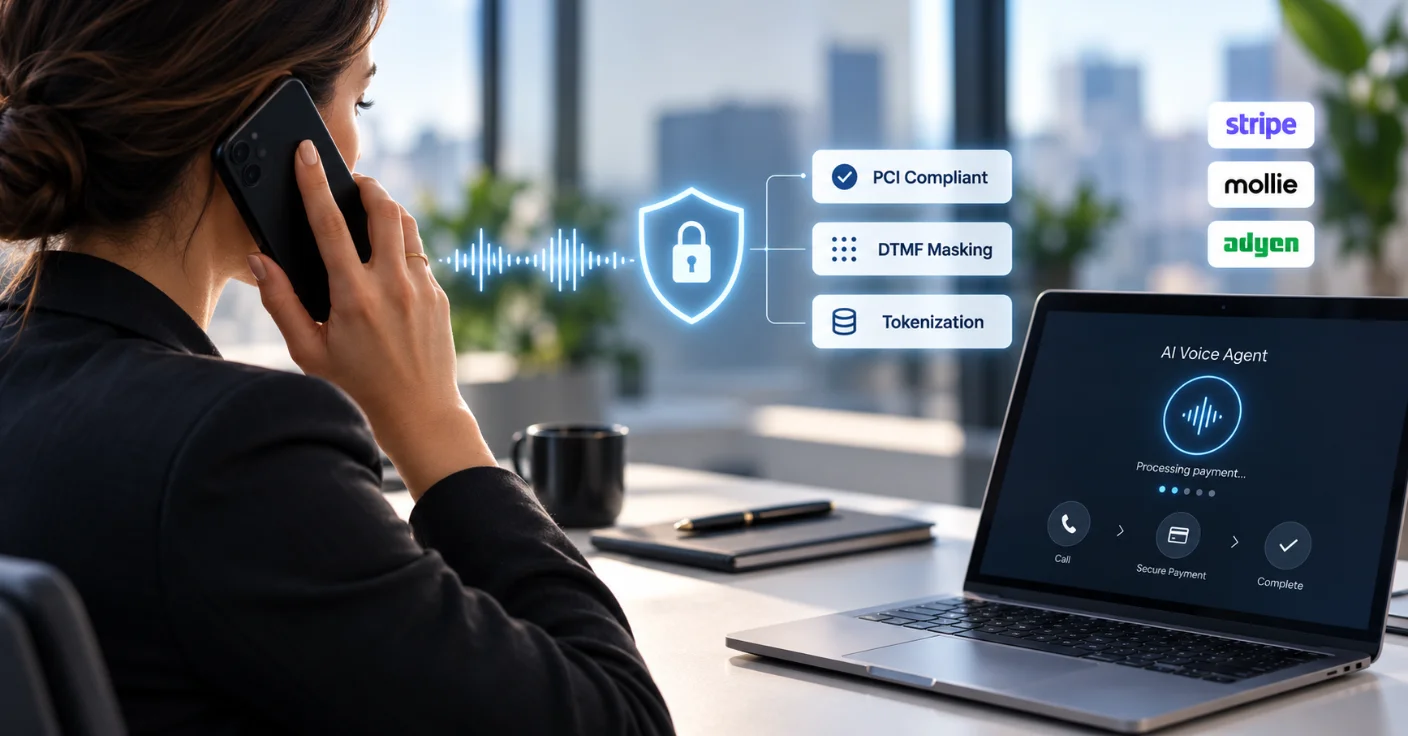
Can an AI voice agent securely accept credit card payments over the phone? Yes — with the right architecture. Modern AI phone assistants use DTMF masking and tokenization to capture card data without sensitive information ever reaching the AI system. The result: fully automated payment processing around the clock, PCI-DSS compliant, with zero human intervention.
For businesses that handle phone orders, appointment deposits, or outstanding invoices via calls, integrating payment capabilities into an AI phone assistant is a decisive competitive advantage. This guide explains how the technology works, which compliance requirements apply, and how to implement secure phone payments with your voice agent step by step.
Why Phone Payments Still Matter in 2026
Despite the e-commerce boom, billions in transactions are still processed over the phone every year. Medical practices collect copayments and deposits, home service companies take upfront payments before starting work, hotels confirm reservations with credit card guarantees, and e-commerce businesses handle reorders from returning customers who prefer calling. The common thread: the customer is on the phone and wants to pay immediately — not open a link, log into a portal, or initiate a bank transfer.
The problem until now has been binary: either an employee takes card details verbally over the phone — a PCI-DSS nightmare, since recordings, transcripts, and CRM systems all fall in scope — or the business forgoes phone payments entirely and loses revenue. AI voice agents resolve this dilemma, provided the architecture is set up correctly.
PCI-DSS Fundamentals: What Applies to Phone Payments
PCI-DSS (Payment Card Industry Data Security Standard) is the mandatory security standard for any organization that processes, stores, or transmits credit card data. Phone payments carry specific rules that every business must understand:
- Card data in the audio stream — When a caller reads their card number aloud, that data enters the speech-to-text engine, the transcript, the call recording, and potentially the LLM context. Every one of these systems then falls under PCI-DSS scope.
- MOTO transactions — Phone payments are classified as "Mail Order / Telephone Order" (MOTO) and are exempt from PSD2 two-factor authentication, which simplifies processing.
- SAQ types — Merchants who outsource card data handling to a certified third party can use the simplified SAQ-A questionnaire instead of the comprehensive SAQ-D.
The core principle is straightforward: card data must never touch the AI system. Any architecture where card numbers flow through speech-to-text, LLM inference, or transcript storage is a compliance violation — regardless of whether a human or an AI handles the call.
Three Methods for Secure Payments with AI Voice Agents
There are three established approaches to processing payments through an AI phone assistant without expanding PCI-DSS scope across your entire platform:
| Method | How It Works | Advantages | Disadvantages | PCI Scope |
|---|---|---|---|---|
| DTMF Masking | Caller enters card data via phone keypad. Tones are intercepted at carrier edge, masked, and routed directly to payment provider. | Instant in-call payment, no app needed, familiar IVR experience | Keypad entry can be cumbersome for long numbers | Only API connection to payment layer |
| SMS Checkout Link | AI agent sends a secure payment link via SMS. Customer pays on a hosted checkout page (Apple Pay, Google Pay, card). | Mobile-optimized, supports Apple/Google Pay, no keypad needed | Customer must switch to phone screen, completion rate drops to 60–70% | No PCI scope for voice platform |
| Transfer to Payment IVR | AI agent transfers the call to a certified payment IVR that captures card data, then hands back to the agent. | Proven technology, highest certification level | Breaks conversation flow, customer notices the system switch, return isn't always seamless | Only the payment IVR |
For most use cases, a combination works best: DTMF masking as the primary method for landline callers and those who prefer immediate settlement, and SMS checkout as the fallback for mobile callers who would rather pay on their screen.
The Secure Payment Flow — Step by Step
Using the example of Dr. Becker's dental practice (45 employees, 800 calls per month), which collects deposits for dental prosthetics over the phone:
- Detect payment intent — The AI voice agent recognizes during conversation that the patient wants to make a deposit: "I'd like to pay the 1,200 euros for the crown right away."
- Confirm amount — The agent responds: "Of course. The outstanding amount is 1,200 euros. I'll now transfer you to our secure card payment system. Please enter your card number using your phone keypad."
- Initiate payment session — The platform sends an API call to the payment provider (e.g., Stripe, Mollie) with amount, currency, and merchant ID.
- Start DTMF capture — The audio channel splits: keypad tones are isolated and routed directly to the payment provider. In the agent's audio stream, they're replaced with neutral beep tones.
- Tokenize card data — The payment provider receives the DTMF digits, tokenizes the card, and authorizes the transaction — all in under 200 milliseconds.
- Return result — The provider sends via webhook: transaction successful, reference ID, masked card (****4242). No raw data reaches the voice platform.
- Continue conversation — The AI agent confirms: "The payment of 1,200 euros was successful. Your reference number is FB-2026-4242. Would you like me to send the receipt via email?"
- Automate follow-up — Viaintegration , the payment is recorded in the practice management system and a confirmation email is sent automatically.
The critical point: at no stage do card data touch the AI system. Tokenization occurs exclusively within the payment provider's PCI-Level-1-certified environment. The voice platform receives only a success or failure signal plus a masked reference.
Security Architecture Deep Dive: Why Data Stream Separation Is Essential
The security of AI-powered phone payments stands or falls with the strict separation of conversation data and payment data. In a properly designed architecture, two completely isolated channels exist:
Channel 1 — Conversation: The audio stream between caller and AI agent. Speech, context, intents, and confirmations flow here. This channel is recorded, transcribed, and processed by the LLM. It must never contain card data at any point.
Channel 2 — Payment: The DTMF signal stream between phone keypad and payment provider. This channel is encrypted (TLS 1.2+), not recorded, and bypasses all speech-to-text processing. Tokenization occurs exclusively within the payment provider's PCI-Level-1-certified environment.
This dual-channel architecture reduces PCI-DSS scope to an absolute minimum: only the API connection between voice platform and payment layer must meet the standard (TLS encryption, access controls). The entire AI infrastructure — ASR pipeline, LLM inference, transcript storage, call recordings, CRM connections — stays outside the scope.
For comparison: without this architecture, if card data were captured via the voice channel, all of these systems plus networks, databases, and personnel access would need to meet the full PCI-DSS standard. The cost starts in the five-figure range per year and scales exponentially with company size.
Implementation with Famulor: DTMF + Mid-Call Tools
Famulor provides a native solution for secure phone payments that supports both methods — DTMF capture and SMS checkout links — and integrates seamlessly with your existing payment provider.
Setup in five steps:
- Activate the DTMF feature — In the Famulor Flow Builder, enable DTMF capture for your payment node. The platform automatically handles audio isolation and tone masking through the underlyingSIP trunking infrastructure.
- Configure a Mid-Call Tool — Create a mid-call tool that initiates the payment session via webhook to your provider (Stripe, Mollie, Adyen, PayPal). Famulor supports over 300 integrations via its no-code automation platform.
- Define the payment flow — In the Flow Builder, specify when the agent offers payment, which amounts are pulled from your CRM or knowledge base, and how success and error messages are phrased.
- Set up webhook callback — Configure the return channel so the agent receives transaction results in real time and can continue the conversation naturally.
- Test and go live — Run test calls, verify DTMF masking in recordings, and validate that no card data appear in transcripts.
Thanks to Famulor's no-code automation, you don't need a developer for setup. The entire configuration happens visually in the Flow Builder — from payment intent detection to confirmation email.
Industry Use Cases: Who Benefits Most?
Medical and dental practices: Copayments, patient shares, and deposits for dental prosthetics or cosmetic treatments. Dr. Becker's practice processes an average of 120 phone payments per month — without the receptionist ever hearing or writing down a card number.
E-commerce and retail: Phone reorders, return exchange payments, and subscription renewals. A mid-sized online retailer can accept orders around the clock with an AI phone agent and settle payments instantly.
Home services and trades: Deposits before job start, progress payments after partial completion. When Schröder Electric (18 employees) calls a customer after sending a quote, the AI agent can process the deposit during the same conversation.
Hotels and hospitality: Reservation guarantees, no-show fees, prepayments for events. The AI agent confirms the booking and secures it with a card payment — 24/7, even when the front desk is busy.
Legal firms: Initial consultation fees, case retainers, and installment payments for ongoing matters. Wagner Law (12 attorneys, Munich office) uses an AI phone assistant to collect consultation fees during appointment scheduling — eliminating unpaid initial consultations and manual payment reminders.
SaaS companies: Upgrade payments, contract renewals, and one-time license fees. The agent pulls pricing information from the knowledge base and closes the payment within the same call.
Cost Comparison: Manual Phone Payment vs. AI Solution
| Cost Factor | Manual Processing (Staff) | AI Agent with DTMF |
|---|---|---|
| Staff cost per payment | $4.00–$8.00 | $0.15–$0.45 |
| Availability | Business hours | 24/7/365 |
| PCI compliance effort | SAQ-D (comprehensive, annual audit) | SAQ-A (simplified) |
| Card entry error rate | 5–8% (mishearing, typos) | Under 2% (direct DTMF transmission) |
| Average processing time | 3–5 minutes | 45–90 seconds |
| Scalability | Linear (requires more staff) | Unlimited parallel processing |
Estimate your ROI from automating calls #
See how much your business could save by switching to AI-powered voice agents.
ROI Result
ROI 0%
Get started No credit card required
Outbound Payment Campaigns: Automated Collection of Outstanding Invoices
A frequently overlooked use case: AI voice agents can not only process inbound payments but also proactively call customers to collect outstanding invoices. With Famulor's outbound telephony, you create campaigns that contact overdue payers professionally and courteously.
The workflow: the AI agent calls the customer, identifies them, informs them about the outstanding invoice, and offers immediate card payment via DTMF. On successful payment, the invoice is automatically marked as settled and a receipt is sent. If the customer can't be reached, the agent schedules a follow-up call or sends an SMS with the checkout link.
For businesses with a high volume of outstanding receivables — such as e-commerce companies, fitness studios dealing with failed direct debits, or service providers with net payment terms — this means a dramatic reduction in Days Sales Outstanding (DSO) while simultaneously lowering collection costs.
Best Practices for Secure Phone Payments with AI
- Never capture card data via speech. Even though modern STT models can recognize card numbers, any voice capture brings your entire system into PCI scope.
- Verify DTMF masking in recordings. Ensure that your call recordings contain only neutral beep tones, not the original keypad tones.
- Define transaction limits. Set a per-transaction cap (e.g., $5,000) above which the AI agent transfers to a human agent.
- Limit retry attempts. After three failed card entries, the agent should offer an alternative (SMS link, callback from staff).
- Automate receipt delivery. Use thewebhook integration to automatically send a confirmation via email or SMS after successful payment.
- Test regularly. Conduct monthly test calls and verify that no sensitive data appear in transcripts, logs, or CRM fields.
Common Implementation Mistakes to Avoid
Mistake 1: Using speech recognition for card data. Some providers advertise that their STT model can recognize card numbers. Technically possible — but a PCI-DSS violation, since the data then sits in the transcript and LLM context.
Mistake 2: Hardcoding a single payment provider. Enterprise customers often have existing contracts with specific payment providers and negotiated rates. A solution supporting only Stripe excludes these customers.
Mistake 3: Not planning a fallback. Not every caller has a phone keypad readily accessible (e.g., hands-free in a car). The SMS checkout link as a fallback catches these cases.
Mistake 4: Treating compliance as a one-time project. PCI-DSS requires quarterly vulnerability scans and annual penetration tests. Plan for these costs permanently — or outsource compliance to a certified payment layer.
Conclusion: Phone Payments with AI — Secure, Fast, and Scalable #
PCI-compliant payments via AI phone assistant are no longer a future concept — they are implementable today. The key lies in the architecture: card data is isolated via DTMF or SMS checkout, tokenized, and routed directly to the payment provider — without the voice AI ever touching sensitive data.
The advantages are compelling: 24/7 availability, cost reduction of up to 90% per transaction, drastically reduced PCI compliance burden, and error rates far below manual processing. Businesses of every size — from solo practices to enterprise customers — can automate phone payments without compromising on security or customer experience.
With Famulor, you can implement this solution in hours: the DTMF feature, mid-call tool integration with Stripe, Mollie, or your existing payment provider, and a no-code automation platform that orchestrates the entire payment flow. Start your free trial today — and turn your AI phone assistant into a fully functional payment channel.
Try our AI Assistant
Experience how natural our AI phone assistant sounds.
Enter your details and receive a call from our AI agent within seconds.
Agent is trained to discuss Famulor services and book appointments.
Demo AI agent
Famulor representative
FAQ #
Can an AI phone bot accept credit card payments?
Yes. AI voice agents can process secure card payments via DTMF masking. Card data is entered through the phone keypad and routed directly to the payment provider without touching the AI system.
What is DTMF masking in phone payments?
DTMF masking replaces keypad tones in the audio stream with neutral beep sounds. The original digits are transmitted encrypted to the payment provider. No card data appears in recordings or transcripts.
Is speech recognition of card numbers PCI-compliant?
No. When card numbers are captured via speech, they enter the STT system, transcript, and LLM context. This brings the entire platform into PCI-DSS scope and constitutes a compliance violation.
Which payment providers does Famulor support for phone payments?
Famulor integrates via mid-call tools and webhooks with all major payment providers, including Stripe, Mollie, Adyen, PayPal, and Authorize.Net. Over 300 additional integrations are available through the no-code automation platform.
How long does an AI-powered phone payment take?
On average 45 to 90 seconds — from payment intent detection to confirmation. The tokenization itself takes under 200 milliseconds.
What does it cost to set up phone payments with an AI agent?
Setup through Famulor is included in the platform. Additional costs are limited to your payment provider's transaction fees, typically 1.4–2.9% plus a fixed fee per transaction.
Do I need a PCI-DSS audit if I use Famulor?
With proper DTMF architecture, your PCI scope is limited to the simplified SAQ-A questionnaire. The comprehensive SAQ-D audit is not required since card data never touches your systems.
What happens when card entry fails?
The AI agent detects errors within 150 milliseconds and offers up to three retry attempts. After that, it automatically sends an SMS checkout link as an alternative or transfers to a human agent.
Does DTMF payment work for mobile callers?
Yes. Most smartphone users can switch to the keypad during a call. Alternatively, Famulor offers the SMS checkout link as a mobile-optimized payment option.
Are card details stored in call recordings?
No. Through DTMF masking, recordings contain only neutral beep tones. Neither card numbers nor CVV codes can be found in transcripts, logs, or recordings.
Writer at Famulor