ResearchPublished Key Takeaways
- This is an update to our AI Tells study that includes Claude Opus 5.5.
- Claude’s word choice is becoming more similar to human writing, while GPT’s is becoming less similar.
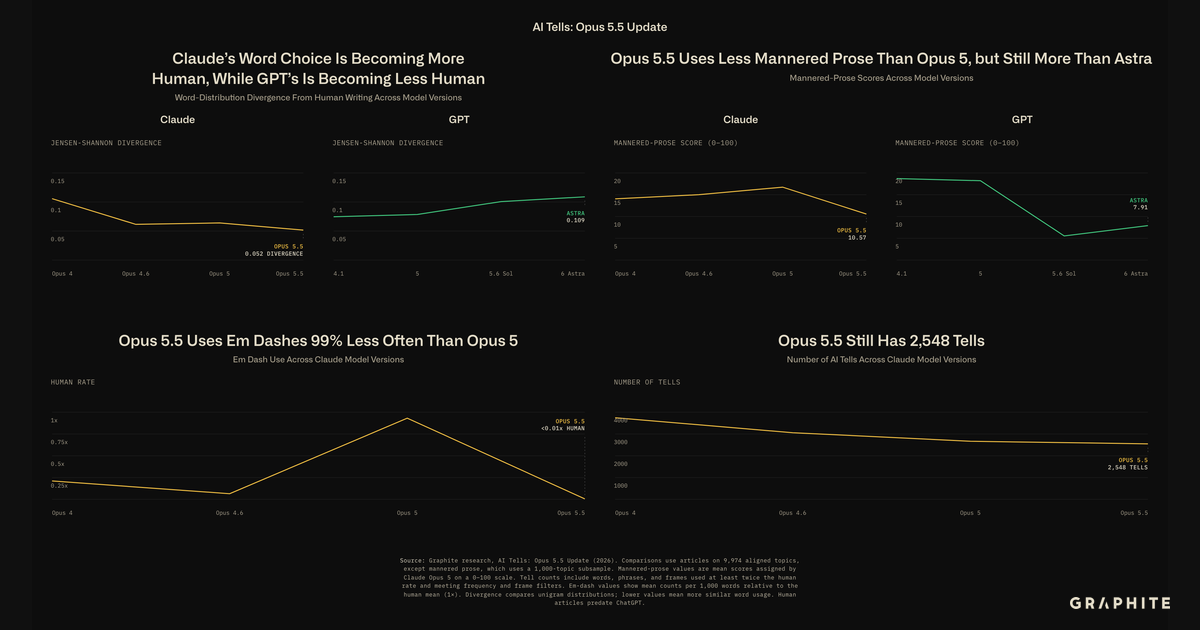
- Opus 5.5’s word-distribution divergence from human writing is 19% lower than Opus 5's. GPT-6 Astra’s is 8% higher than GPT-5.6 Sol's.
- Opus 5.5 uses less mannered prose (metaphor and flourish in place of direct statements) than Opus 5, but still more than Astra.
- Opus 5.5’s mannered-prose score is 37% lower than Opus 5's, but it remains about 1.6 times the human score, compared with 1.2 times for Astra.
- Both Claude and GPT now use well-known tells like the em dash less often.
- Opus 5.5 uses em dashes 99% less often than Opus 5. Astra uses them 95% less often than GPT-5. Both now have much lower em-dash usage rates than human articles published before ChatGPT.
- Opus 5.5 still has many tells. AI tells change between models and versions, but do not go away.
- Opus 5.5’s overall word use is more similar to human writing, but it still overuses many words and phrases. We find 2,548 tells, just 4% fewer than in Opus 5.
- Opus 5.5 uses more language about helpfulness. For example, “can help you” appears eight times as often as in Opus 5. Opus 5 uses the emphatic phrase “is genuinely” 26 times as often as Opus 5.5.
- Opus 5.5 uses more superlatives than Astra. For example, “the most powerful” appears 24 times as often.
- The tells data and raw article data are available to download .
Introduction #
On September 16th, 2026, we published our research on AI tells. On September 22nd, Anthropic released Claude Opus 5.5. In this paper, we extend our analysis to include Opus 5.5.
The tells data and raw article data are available to download.
Opus 5.5 Still Has Many Tells #
We use the same methods as in our original study. We identify words, phrases, and frames (word patterns with underscores representing gaps of up to three words) that occur at least twice as often in AI writing as in human writing, after normalizing for the amount of text and applying frequency thresholds. We also compare stylistic features, such as em-dash use and variation in sentence length.
We find 2,548 word, phrase, and frame tells in Opus 5.5, just 4% fewer than the 2,666 we find in Opus 5.
The examples below show recurring themes in Opus 5.5’s tells.
Evaluative Adjectives
Words that rate something without describing it.
| Tell | Times the Human Rate |
|---|---|
| dependable | 23x |
| thoughtful | 9x |
| steady | 11x |
| meaningful | 8x |
Transitions
Transition words and phrases that connect ideas.
| Tell | Times the Human Rate |
|---|---|
| what comes next | 24x |
| looking ahead the | 40x |
| adds another layer | 27x |
| in practice | 7x |
Contrastive Phrasing
Describing something by contrasting it with an alternative.
| Tell | Times the Human Rate |
|---|---|
| rather than simply | 32x |
| is more than a _ it | 98x |
| not only about | 13x |
| instead it | 8x |
Flagging Importance
Telling the reader that something matters.
| Tell | Times the Human Rate |
|---|---|
| this matters | 116x |
| why _ matters | 92x |
| matters most | 12x |
| just as important | 13x |
Tells by Model
The explorer below shows disproportionately used words, phrases, and frames, differences in stylistic features, and LLM-summarized themes. For the stylistic features, the larger the absolute Cohen's d, the more strongly the feature distinguishes AI from human writing.
Opus 5.5 Has Different Tells Than Astra #
We next compare Opus 5.5 directly with Astra.
Less Qualification
Opus 5.5 qualifies claims less often than Astra.
GPT-6 Astra
| Tell | Times the Opus 5.5 Rate |
|---|---|
| may provide | 18x |
| not simply | 10x |
| does not establish | 275x |
| not necessarily | 17x |
More Superlatives
Opus 5.5 uses more superlatives than Astra.
Claude Opus 5.5
| Tell | Times the Astra Rate |
|---|---|
| the most popular | 45x |
| perhaps the most | 29x |
| the most powerful | 24x |
| one of the best _ about | 79x |
More Differences Between Opus 5.5 and Astra
Below, we show disproportionately used words, phrases, and frames, differences in stylistic features, and LLM-summarized themes for Opus 5.5 and Astra.
Opus 5.5 Has Different Tells Than Opus 5 #
More Language About Helpfulness
Opus 5.5 uses more language about helping and making things easier.
Claude Opus 5.5
| Tell | Times the Opus 5 Rate |
|---|---|
| is especially helpful | 12x |
| can help you | 8x |
| makes it easier | 6x |
| helps you avoid | 5x |
Less Emphatic Phrasing
Opus 5.5 uses emphatic phrases less often than Opus 5.
Claude Opus 5
| Tell | Times the Opus 5.5 Rate |
|---|---|
| is genuinely | 26x |
| matters enormously | 15x |
| an enormous amount | 8x |
| remarkably | 3x |
Less Mannered Prose
Mannered prose substitutes metaphor and flourish for direct statements. We include Anthropic’s definition verbatim in our scoring prompt. We use Claude Opus 5 to score each article’s mannered prose from 0 to 100, using a subsample of 1,000 matched topics. Opus 5.5’s mannered-prose score is 37% lower than Opus 5’s, at 10.57 compared with 16.75. It remains about 1.6 times the human score, compared with 1.2 times for Astra.
Em Dashes Nearly Disappear
Opus 5.5 uses 0.015 em dashes per 1,000 words, compared with 2.92 for Opus 5, a decrease of 99%. Both Opus 5.5 and Astra have much lower em-dash usage rates than human articles published before ChatGPT. Astra uses them about one-eighth as often, while Opus 5.5 has nearly stopped using them.
More Differences Between Opus 5.5 and Opus 5
Below, we show the words, phrases, frames, and features that differ most between Opus 5 and Opus 5.5, along with LLM-summarized themes.
Opus 5.5’s Word Choice Is Becoming More Similar to Human Writing #
Well-Known Tells Are Becoming Less Prominent
We track the same 11 features as in our original study, including words like “delve,” formulaic closes, and hedging. We measure how much these features differ between AI and human writing using Cohen’s d.
The average strength of these 11 tells is 6% lower in Opus 5.5 than in Opus 5 and 53% lower than in Opus 4. For GPT, it is 46% lower in Astra than in GPT-4.1, but changes little after GPT-5.
Opus 5.5 Still Has Thousands of Tells
The number of tells falls from 3,746 in Opus 4 to 3,059 in Opus 4.6, 2,666 in Opus 5, and 2,548 in Opus 5.5, a reduction of just 4% from Opus 5. Despite this decline, thousands of words, phrases, and frames remain disproportionately common in Opus 5.5’s writing.
Claude’s Word Distribution Is Becoming More Similar to Human Writing
We use Jensen-Shannon divergence to compare probability distributions over words and phrases. Larger values mean greater differences in how the model and human writers use words and phrases.
Opus 5.5’s word distribution is closer to human writing than Opus 5’s. Its unigram divergence falls from 0.064 to 0.052. For GPT, divergence rises from 0.101 for Sol to 0.109 for Astra. Opus 5.5 is also closer to human writing than Opus 4, while Astra is further away than GPT-4.1.
These trends are not driven by a few common words. Claude’s divergence falls from Opus 4 to Opus 5.5, and GPT’s rises from GPT-4.1 to Astra, even after removing the 100 most common words in human writing. The difference also extends beyond common function words. Nouns, verbs, adjectives, and adverbs together account for about 79% of the divergence gap between Astra and Opus 5.5.
These measures capture different aspects of writing. Mannered prose and well-known tells describe specific writing habits. Divergence measures the overall word distribution, while the tell count measures how many words, phrases, and frames are disproportionately common. A model can therefore reduce well-known tells without bringing its overall word use closer to human writing, or move closer overall while retaining thousands of tells.
Methodology #
We use the same article-generation and analysis methods as in our original AI Tells study, adding Claude Opus 5.5.
We analyze n-grams and frames across 9,974 topics with both a human article and an article from every model. Adding Opus 5.5 changes this shared set slightly, so results for earlier models may differ from the original study.
Limitations #
The limitations of our original study also apply to this update.
Conclusion #
Opus 5.5’s word choice is closer to human writing than Opus 5’s. It uses less mannered prose and almost no em dashes, but we still find 2,548 tells, just 4% fewer than in Opus 5. Some tells become less common, while others become more common.
Opus 5.5’s overall word distribution is closer to human writing than Astra’s, even though Astra uses less mannered prose. These measures capture different aspects of writing. Opus 5.5 uses well-known tells less often and its overall word use is more similar to human writing, but it still disproportionately uses thousands of words, phrases, and frames.
Researchers #
Chief AI Officer at Graphite, leading the team building AI tools for growth and researching how AI is reshaping marketing. Previously Chief Data Scientist at Yummly and an NLP and search researcher at Yahoo! Research, with internships at Google and Microsoft. Ph.D. in machine learning from UMass Amherst, advised by Andrew McCallum.
Read Full Bio Senior Data Scientist at Graphite. Ph.D. and Master's from the University of Delaware, followed by more than two decades as a professor at the University of Los Andes. Author of over 50 peer-reviewed research papers and holder of 5 U.S. patents. Previously Head of Data Science at GoToDigital.
Read Full Bio Founder and CEO of Graphite, the research-driven growth agency behind work for Webflow, Adobe, and Upwork. Teaches SEO and AEO at Reforge and is an adjunct professor at IE Business School. Research published in the Financial Times, Axios, and The Atlantic. Previously a growth advisor to Masterclass, Robinhood, and Honey.