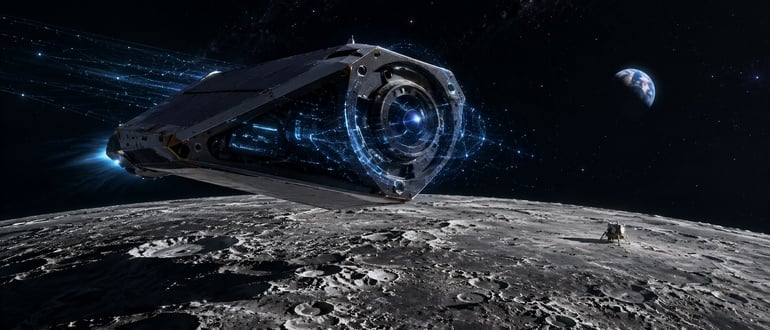
Humanity is heading for the Moon and bringing artificial intelligence (AI) with it. And like humans, AI will be able to operate independently on the Moon without having to clear every decision with Earth.
While lots of eyes rightfully focus on NASA’s Artemis Moon missions and plans to create a permanent Moon base, Texas-based Firefly Aerospace nonetheless is crossing a major threshold by including an NVIDIA Jetson AI computing platform destined for lunar orbit for the first time. The Firefly AI plan signals that commercial AI hardware is robust enough to perform in the harsh conditions of space. But perhaps more importantly, the Firefly mission means that AI can operate autonomously in space and doesn’t have to rely on seconds-delayed communication commands from Earth. “We believe in a future where all AI processing and sensing will happen in space,” says Jason Kim, CEO of Firefly. “It’s like the transatlantic cables that connect continents on Earth to enable the internet—we want to do the same kind of thing: connect all these different orbital constellations to enable something greater than an individual constellation.”
The NVIDIA Jetson AI module is embedded in a high-resolution telescope built by Lawrence Livermore National Laboratory and will fly on Firefly’s Elytra spacecraft as part of the company’s Blue Ghost Mission 2 targeted for no earlier than late 2026. The Elytra spacecraft will power Firefly’s Ocula lunar imaging service. But instead of having to send lunar images back to Earth for processing, Ocula will use Firefly’s SciTec AI platform to process imagery while in orbit around the Moon. So rather than having to downlink all its collected data, Ocula will transmit only those images that provide relevant insights. Ocula is expected to stay in orbit for five years and will be used for lunar mapping, mineral detection, space domain awareness and reconnaissance, with the latter likely to include the monitoring of lunar activities of other countries with lunar plans like China. Firefly acquired SciTec late last year. Ocula will collect images in both visible and ultraviolet bands. Firefly says it will use newer NVIDIA hardware as it becomes available. Firefly Ocula customers will include a range of private companies as well as NASA and the U.S. Air Force.
“The real story is this deployment confirms that, after a string of successful orbital pilots, commercial GPUs are now ready for challenging long-duration spaceflight,” notes Futurum analyst Brendan Burke.
NVIDIA Jetson modules, initially developed with self-driving cars and robotics in mind, have undergone intensive space-related testing in recent years, both in orbit and in laboratories. The bottom line is that automotive-grade GPUs tend to degrade gracefully under heavy ion bombardment rather than failing all at once, a failure rate that makes a five-year mission feasible. The radiation problem is now an engineering one.
Blue Ghost 2 is actually a two-pronged mission. While Elytra remains in orbit, a lunar lander will descend to the far side of the Moon to begin a NASA-funded UC Berkeley project that hopes to detect signals originating from shortly after the Big Bang, relaying its findings to the orbiting spacecraft. In support of the lander, Firefly just acquired Space-ng, which develops AI-powered vision navigation and autonomous guidance systems that will allow the lunar lander to identify hazardous terrain and autonomously redirect its descent if necessary.
The success of Firefly’s Blue Ghost 1 robotic landing in March 2025 is translating into faster production as the company learns from experience. Firefly just inked a new $144 million contract with NASA to create a commercial lunar payload service (CLPS) with a target launch date of 2028. Future Firefly Moon missions include deliveries to the far side of the Moon, the Gruithuisen Domes, and the lunar south pole as well as a subcontract to deliver NASA MoonFall drones there.