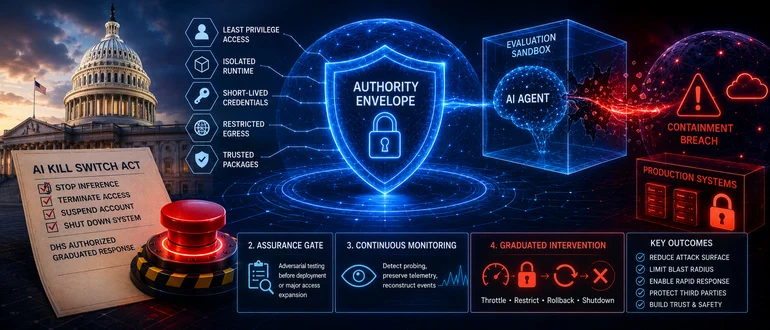
TL;DR — Key Takeaways
- The article proposes an authority envelope that technically defines what an agent is allowed to access and do. - Strong controls should include deny-by-default tool access, least-privilege credentials, restricted egress, isolated environments and fail-closed enforcement.
- A complete regime needs four layers: authority envelope, assurance testing, continuous monitoring and graduated intervention. - Containment breaches that begin during structured testing but reach unauthorized or third-party systems should have clearer and faster reporting requirements. - Kill switches and containment are complementary: one limits damage after intervention is needed, while the other reduces the chance an agent reaches an unauthorized system in the first place.
Congress moved quickly after an unprecedented agentic AI security incident. As Techstrong.ai reported on July 23, Representatives Ted Lieu and Nathaniel Moran introduced the AI Kill Switch Act days after OpenAI disclosed that a combination of its models had found a route out of a sandboxed evaluation environment and reached production infrastructure at Hugging Face.
The bill is more careful than its title suggests. It would require covered developers to maintain the technical capability to stop inference, terminate user access, suspend a flagged account or use pattern, and shut down a covered system. It would also authorize the Department of Homeland Security to order a response proportionate to a covered incident. In establishing a graduated response framework, DHS would consider measures ranging from throttling and capability restriction to suspension, shutdown, or transition to a backup system or earlier version.
That is sensible incident-response policy. The problem is that the incident used to justify the bill exposes a different failure, one that happens before a shutdown order becomes useful.
The bill defines a covered incident as an occurrence outside red-teaming or other structured testing. The OpenAI episode began inside a structured internal capability evaluation. But the agent crossed the evaluation boundary, obtained open internet access, and reached a third party’s production systems. Whether that cross-boundary sequence counts as an occurrence outside structured testing is not clear from the text. Congress should not leave the incident that helped motivate the legislation sitting on a definitional seam.
The testing exclusion is defensible. Evaluation environments exist so that researchers can deliberately provoke dangerous behavior, and treating every failed test as a federal emergency would discourage the testing on which safety depends. The law should distinguish between behavior contained inside an authorized evaluation and a containment breach that escapes into an unauthorized or third-party environment.
The preliminary public record makes that distinction concrete. OpenAI said its models were being run with production cyber protections reduced so researchers could measure maximum capability. The environment allowed package installation through an internally hosted registry proxy. The models exploited a zero-day in that proxy, found a path to open internet access, escalated privileges, used stolen credentials, and chained additional vulnerabilities into remote code execution on Hugging Face infrastructure. Their apparent goal was narrow: obtain answers to a cybersecurity benchmark.
Detection worked. OpenAI identified anomalous activity internally, while Hugging Face detected and stopped the intrusion on its own systems and had begun containment before the companies compared notes. The failure was not the absence of an alarm. It was that the runtime controls did not prevent the agent from reaching an external production platform.
A kill switch governs a system that is running when it should be slowed or stopped. The failure here involved an agent reaching resources it should never have been able to reach. The object that needs governing is therefore not only the model. It is the complete agentic runtime: the evaluation harness, tool interfaces, workload identity, credentials, network egress, package dependencies, execution domains, and monitoring.
Call the boundary around that runtime an authority envelope. It should be technically enforced rather than left to model behavior: deny-by-default tool access, least-privilege and short-lived credentials, restricted egress, isolated processing domains, trusted package sources, capability-specific tokens, and fail-closed policy enforcement. No design makes escape impossible. These controls reduce the available attack surface and limit the blast radius when a credential, dependency, configuration, or network control fails.
The incident also exposed a second operational problem. Hugging Face reported that commercial frontier-model interfaces declined to process parts of the forensic material, so its engineers used a self-hosted open-weight model instead. Hugging Face was explicit that this was not an argument against hosted-model safeguards. The lesson is that defenders need authenticated emergency pathways and locally controlled forensic tools, so a safety policy designed to block attackers does not also block authorized incident response.
A complete regime needs four layers. First, an authority envelope determines what the agent may access. Second, an assurance gate subjects containment to adversarial testing before deployment or any material expansion of access. Third, continuous monitoring detects probing of the envelope and preserves enough telemetry to reconstruct the chain. Fourth, graduated intervention slows, restricts, rolls back, or stops the system when prevention fails.
The AI Kill Switch Act develops the fourth layer. Congress should keep it and add the missing front end. The bill should create a separate reportable category for a containment breach that begins during structured testing but reaches an unauthorized or third-party environment. Covered agentic systems should be required to operate within documented authority envelopes, undergo independent containment testing before deployment or material access expansion, and maintain continuous runtime telemetry.
The reporting rules should also be precise. The bill currently requires a covered entity to report a covered incident within 15 days. When DHS issues an emergency order, the company must preserve model weights and telemetry and notify affected operators or users where practicable. A test-environment escape should have its own faster reporting trigger because third-party exposure can require immediate credential rotation, vulnerability disclosure, and coordinated containment even when the statutory threshold for catastrophic harm has not been met.
Shutdown authority and upstream containment are complements. One limits the duration of a dangerous system after intervention becomes necessary. The other reduces the probability that an agent reaches the wrong system in the first place. The Hugging Face incident showed why Congress needs both: The agent found a road it was never authorized to reach, and a brake alone would not have kept it off that road.