Blog
Camilo Nova
CEOOn Christmas Day in 1969, Seiko released a watch that looked nothing like the beginning of an industrial collapse.
The Quartz Astron 35SQ came in an eighteen-karat gold case and cost ¥450,000, more than many popular cars in Japan at the time. Its development team had produced only 20 watches by December.
This was not a cheap watch for the masses. It was an expensive technological demonstration.
Inside it, however, was a completely different way to tell time.
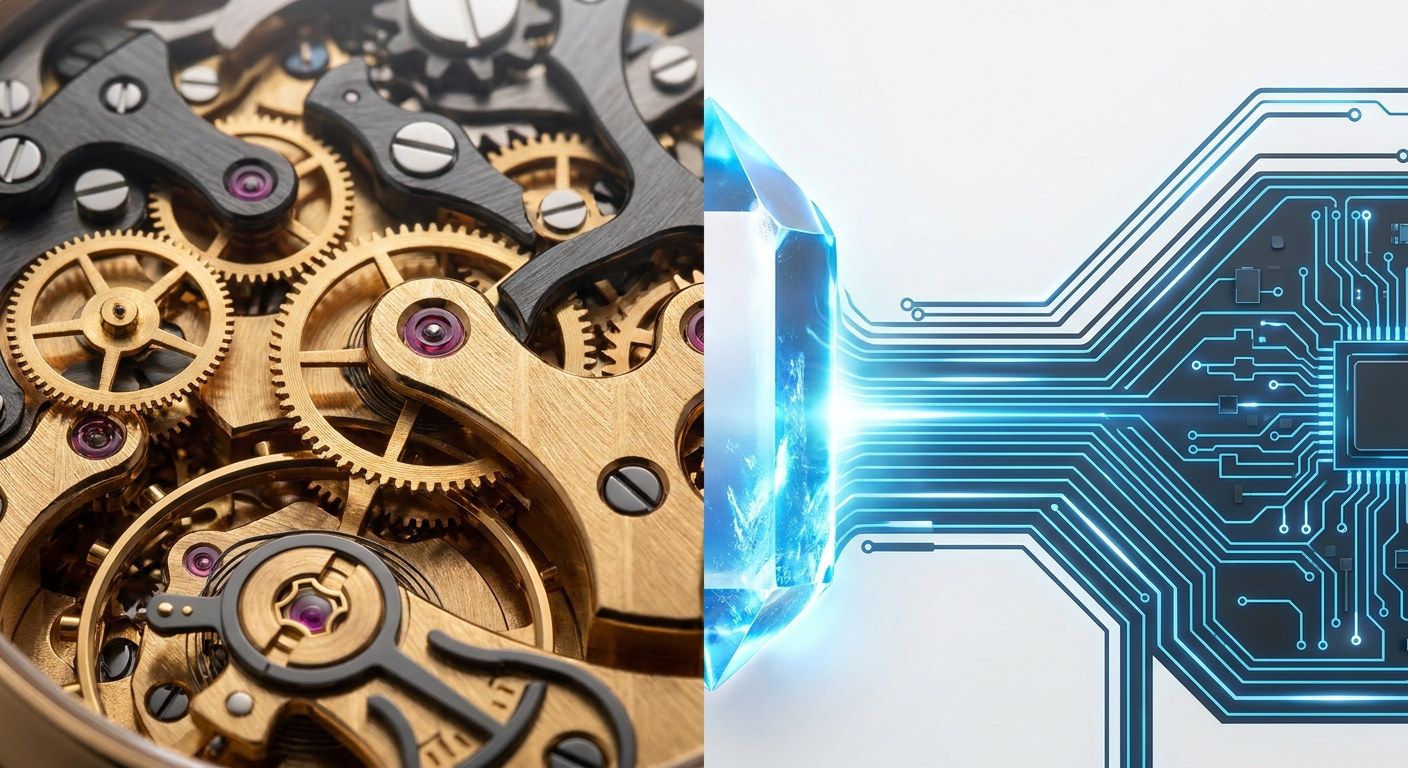
Instead of relying on a carefully assembled system of springs, wheels, jewels, and escapements, the Astron used a battery, an integrated circuit, a small motor, and a quartz crystal vibrating 8,192 times per second.
It was accurate to within five seconds per month, about 100 times more accurate than a typical mechanical watch of the period.
The first Astron did not look disruptive because people were looking at the product rather than the technology beneath it.
It was expensive. It was difficult to manufacture. It did not yet threaten an industry that had spent centuries perfecting mechanical watchmaking.
But quartz was not competing on the same production curve.
In 1945, Switzerland produced approximately 19 million of the world’s 21.5 million watches. That production was distributed across roughly 2,500 companies, 90% of which employed fewer than 50 people.
The industry depended on specialized workshops, skilled labor, apprenticeships, coordination, and knowledge accumulated over generations.
Quartz replaced much of that system with electronics.
Once manufacturers had invested in the necessary machinery, they could produce watches with fewer components, less assembly knowledge, lower labor requirements, and dramatically lower marginal costs.
Quartz watch prices eventually fell by roughly one thousand times. What started at the price of a car became something that could be sold in a convenience store.
A cheaper production method does not simply lower prices. It rewrites the industry map.
Quartz turned precision machinery into mass-market electronics. For the first time, watch manufacturing had the economics of a technology business operating inside an artisan market.
High fixed costs. Low variable costs. Economies of scale. Operating leverage.
Once the curve started moving, the transformation happened quickly.
By the end of the 1970s, quartz watches were cheaper and more accurate than mechanical ones. In most situations, the mechanical watch had become functionally obsolete.
The functional market went to quartz.
The effect on Switzerland was devastating. Between 1970 and 1985, the number of Swiss watch manufacturers fell from 1,618 to 634. Employment collapsed from more than 90,000 people to approximately 33,000.
Quartz did not eliminate watches. It separated the function of telling time from the business of watchmaking.
Mechanical watches survived by becoming something else.
They became objects of craftsmanship, scarcity, identity, heritage, and status. The fact that a mechanical watch was more complicated, less accurate, more expensive, and labor-intensive no longer counted as a weakness.
Those characteristics became exactly the reason to buy one.
Decades later, mechanical watches accounted for only 37 percent of Swiss watch exports by unit volume but more than 85 percent of their value.
Switzerland lost the mass market and captured the premium one (probably by accident).
Not every Swiss company understood what was happening.
Omega entered the 1970s as one of the most important watch brands in the world. Its watches had reached the moon (I'm wearing that one). It sponsored the Olympics. As late as 1977, it remained the third largest watch brand behind Seiko and Timex.
Then it panicked.
Omega launched too many models, moved heavily into quartz, expanded across price points, licensed its brand, and tried to compete with the new manufacturers on their terms.
It attempted to install a new technology within an organization designed for a completely different economic model.
Quartz manufacturing required another culture, cost structure, workforce, and operating model. A mechanical watch company and a quartz company could both produce objects that told time while having almost nothing else in common.
Rolex chose another path.
It did not ignore quartz. Rolex invested heavily in the technology and produced the Oysterquartz in limited quantities. It preserved its ability to follow the market if necessary.
But it did not attempt to beat Japanese manufacturers at producing the cheapest and most accurate watch.
Instead, Rolex leaned into what quartz could not commoditize: consistency, engineering, scarcity, history, distribution, brand, and control over the customer experience.
It stopped competing primarily on the watch's accuracy and strengthened the ** meaning of owning one**.
This is the part of the story the software industry should be studying.
Software has always had unusual economics. Once software exists, distribution is almost free. But creating it remains expensive.
Building serious software requires developers, designers, product managers, infrastructure engineers, security specialists, testing, coordination, and months or years of accumulated context.
AI is blowing away that creation cost.
The foundation model is the expensive factory. Training requires enormous capital, infrastructure, data, energy, and specialized talent.
But once the model exists, generating another function, interface, test, migration, or prototype can have an extremely low marginal cost.
This is remarkably similar to quartz.
High fixed costs. Falling variable costs. Increasing automation. Less dependence on scarce artisanal labor.
The software equivalent of a quartz crystal is not a single coding assistant. It is the combination of foundation models, inexpensive inference, coding agents, automated testing, and natural language interfaces.
Together, they are beginning to separate code production from the traditional craft of programming.
The change is already visible.
Vercel’s v0 allows people to describe an application in natural language and receive the code, interface, and deployable project in return. The user does not need to begin with a programming language. The user begins with an idea.
That is the software equivalent of quartz: a lower-friction core technology that makes a once-specialized craft accessible to far more people.
The numbers show the direction of the curve.
The cost of querying an AI model at approximately the GPT-3.5 level fell from $20 per million tokens in November 2022 to $0.07 by October 2024.
That is a reduction of more than 280 times in approximately 18 months. Depending on the task, inference prices were falling between 9 and 900 times per year.
Capability has been moving almost as quickly. On SWE Bench Verified, a benchmark based on real software issues, the leading model performance rose from approximately 60 percent to nearly 100 percent in a single year.
The systems remain imperfect. But they are no longer toy demonstrations.
The first quartz clock, built at Bell Labs in 1927, occupied an entire room. The first commercial quartz wristwatch was priced like a car.
The mistake would have been measuring the first product and ignoring the learning curve.
The cost of generating code is not the total cost of delivering dependable software.
Architecture, security, integration, product judgment, deployment, maintenance, and accountability remain expensive.
But the marginal cost of producing competent code is collapsing. That changes the industry's structure even before AI becomes fully autonomous.
Software may be approaching the same separation that happened in watches.
Simple interfaces, internal dashboards, administrative systems, integrations, prototypes, reports, marketing sites, and narrow workflow applications are becoming the equivalent of basic timekeeping.
They will not disappear. There may be more of them than ever.
But producing them will require less time, less capital, and fewer people.
A department that previously had to purchase a large platform may generate a small application for its exact process. A company that could afford one major software initiative may launch twenty experiments.
Some applications may be temporary, created for a project and discarded afterward, just as inexpensive quartz watches became accessories rather than lifelong possessions.
The quantity of software could explode while the price of an individual piece of software collapses.
That is bad news for businesses whose value depends primarily on the difficulty of writing code.
It is especially dangerous for consulting firms that charge according to team size, development hours, or the apparent complexity of implementation.
When production becomes faster, maintaining the same organizational structure and billing model does not preserve value. It exposes how much of the old price depended on scarcity.
Many software companies are making the Omega move, and I can't blame them.
They buy AI tools, attach them to the existing workflow, keep the same management layers, same pricing, and ask developers to produce more code.
They treat AI as an efficiency feature rather than a different production system.
An AI native software company does not look like a traditional software company with a coding assistant subscription.
It should have different team sizes, different responsibilities, different margins, different delivery cycles, and a different definition of what customers are paying for.
The software version of Rolex will not be a company that proudly writes every line by hand.
Nobody will pay extra because a developer manually typed a database migration that an AI could have produced safely in seconds.
Romanticizing inefficient code production would be like selling a less accurate watch while refusing to explain why it matters.
The premium layer in software will come from judgment, trust, domain knowledge, product taste, proprietary data, integration, security, distribution, and accountability.
Customers will not pay for the code.
They will pay for choosing the right problem, making the right trade-offs, fitting the system into a complex organization, keeping it reliable, and taking responsibility when something goes wrong.
The strongest companies will use AI aggressively inside their production process while making that process almost invisible to customers.
Their promise will not be that they employ more programmers.
Their promise is that they understand the business, deliver the results, and remain accountable for them.
The quartz revolution did not destroy the watch industry. It destroyed the assumption that telling time was the whole industry.
AI may not destroy software. It will destroy the assumption that writing code is the whole industry.
What happens to software subscriptions when a customer can generate a credible replacement?
What happens to agencies when months of implementation become days?
What happens to junior developers when the repetitive work that once trained them is automated?
Will companies continue purchasing enormous platforms, or will they build hundreds of smaller systems tailored to their specific operations?
Which businesses will become Seiko, producing useful software at an extraordinary scale and low cost?
Which will become Rolex, capturing value through trust, judgment, and ownership?
Which will behave like Omega, trapped between a disappearing craft economy and a production model they were never designed to compete in?
And when code is no longer scarce, what exactly will a software company be selling?
Written by Camilo Nova
Axiacore CEO. Camilo writes thoughts about the intersection between business, technology, and philosophy
Subscribe to our newsletter here:
Learn how to use technology to get back your time and enjoy an empty calendar on a work day.
We respect your inbox. Privacy policy