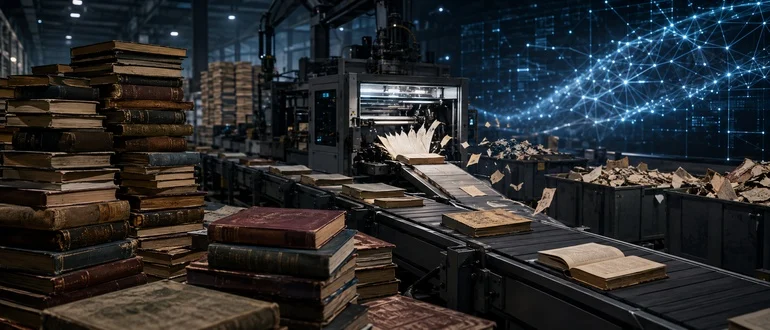
Used book sellers are seeing a massive uptick in sales and they are alarmed. The suspicion is that an AI is the ultimate buyer and that the books are doomed to destruction.
Kennys, a famous bookseller in Galway, Ireland, received a “bananas” order for 5,000 books across an eclectic range of titles that included decades-old driving manuals, for example. Even stranger is that unlike other bulk buyers such as libraries and universities, no one called to haggle over the price. That in itself was a red flag, Kennys told the Irish Times.
Other bookstores in Germany, Sweden, and The Netherlands also took notice of odd, high-volume orders for obscure, low-selling titles. The suspicion grew among booksellers that the books were being acquired by a third-party service to be used to train the large language models critical to AI training. The books, it was believed, were being sent to collection points in Europe before being shipped in bulk to the U.S. Upon receipt, hydraulic machines strip off the book spines and the resulting loose-leaf pages are fed into high-speed industrial scanners. What remains is recycled. Fortune, meanwhile, reported that China appeared to be the destination for an unusually large order placed with a Dutch rare book seller.
“Once a final, non-digitized copy of a book is shredded, it’s gone forever,” intoned an editorial in The Herald, a Scottish newspaper. “And the version that is digitized becomes at the mercy of AI interpretation rather than a straight, accurate representation of the work.”
Contributing to the uproar is the allegation that rare books also are being assimilated by AI in this manner. Even Elon Musk said that sucked.
Who would commit such a spineless act? The question resonated most loudly in Germany where such an act would be a violation of copyright law. In the U.S., however, more liberal “fair use” doctrines deem the scanning of a book by its owner and its destruction afterward perfectly acceptable. China, of course, has a long history of ignoring Western intellectual property rules.
Fair use or not, many feel that AI’s assimilation of used books in this manner feels like a modern-day twist on old-school book burning. The most desirable used books are those published before 2022. Books published before 2022 are certain not to contain AI-generated text. Post-2022 books may contain AI-generated text, aka AI slop, that may lead to model collapse and the creation of an AI prone to errors. Once infected, an AI is nearly impossible to cure.
The mysterious practitioners in this AI trade are now diving for cover. The tech website 404 Media pointed a finger at ISBNdb, citing material on the company’s website that appeared to offer its services to acquire books for AI training. ISBNdb quickly deleted the material from its website, saying that it was all just a marketing experiment.
Many are convinced that this used book AI training trade continues because of a revelation that surfaced in a lawsuit against Anthropic that revealed the existence of “Project Panama,” an alleged effort to destructively scan millions of books the AI-developer acquired. An American judge ruled that while using pirated books was illegal, digitizing legally purchased print books qualified as fair use because they weren’t reproduced for sale and were used internally.
Many observers believe the acquisition of used books for AI training continues, obscured by non-disclosure agreements and the use of AI chatbots. Authoritative, well-edited books existing outside the internet are just too alluring for AI training. The most valuable may prove to be old books without an ISBN tracking number. There’s a good chance an AI doesn’t know of the title’s existence and hasn’t read it yet.