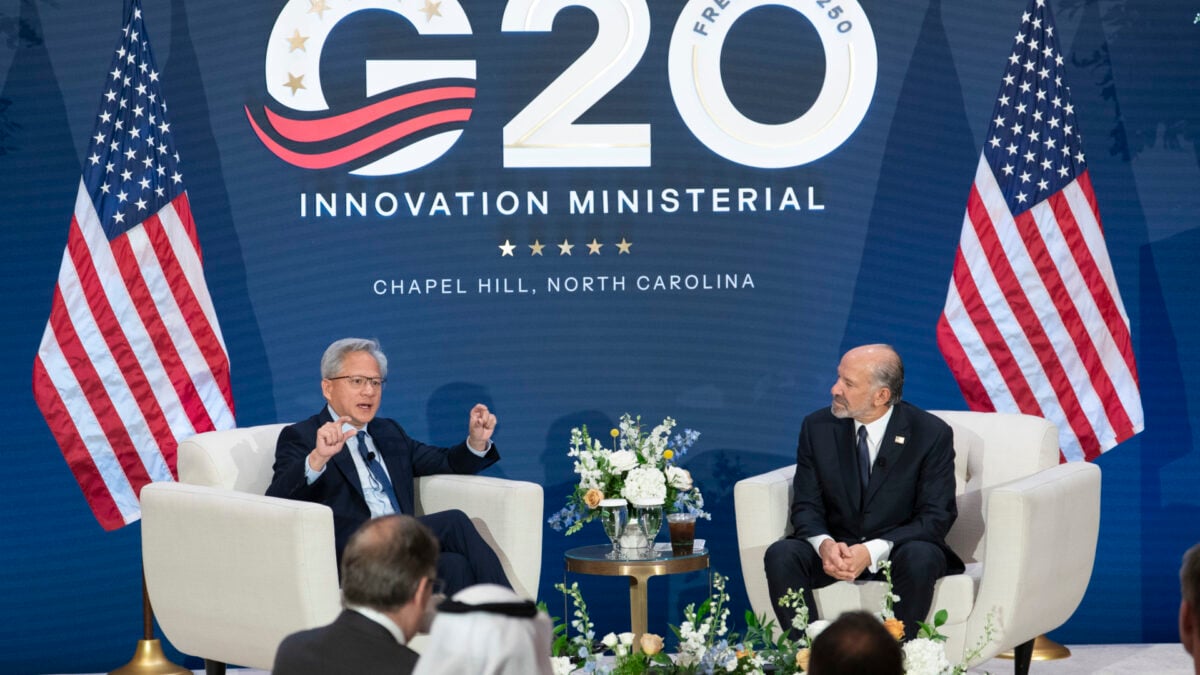
On Wednesday, the trade and commerce ministers of the world’s largest economies gathered in North Carolina for the G20 Innovation Ministerial, hosted by Trump’s Commerce Secretary Howard Lutnick. Also in attendance were executives from America’s most consequential AI companies—OpenAI, Nvidia, and Anthropic—ready to help the Trump administration persuade world leaders to back away from strict AI regulation.
OpenAI CEO Sam Altman, who joined Lutnick for a fireside chat, said adopting AI was “non-negotiable” for the world leaders in attendance, repeatedly comparing the technology to electricity.
“We want to put sufficient constraints on our system to avoid catastrophic risks, but we really do wanna respect all of your sovereignty and that you’re going to use it in very different ways, and we personally may not always like it, but I don’t like everything that people do with electricity either,” Altman told the crowd of ministers.
AI’s economic growth and other benefits will simply be “too high to ignore,” Altman claims. His company is currently facing much stricter regulatory scrutiny in the European Union after the bloc deemed ChatGPT to be a “very large online search engine” on Monday.
“I don’t want to overstate things, but I’m very excited about our new model, so forgive me if I get a little bit too enthusiastic here,” Altman, who was very recently accused of having a history of being untrustworthy, said. “I think this, for example, will be the greatest boom in entrepreneurship and the creation and development of small businesses the world has ever seen.”
Nvidia CEO Jensen Huang also attended a fireside chat with Lutnick earlier in the day, urging the officials in attendance to refrain from regulating “hypothetical, theoretical harm” of artificial intelligence. Companies should instead “take it upon themselves to develop the technology safely,” Huang said.
“Every single country should advocate for AI diffusion or the adoption of AI into your industries,” Huang said. “The worst outcome is that you don’t take advantage of it, that you are left behind. That is the single worst outcome. That outcome can happen if we talk about the technology with fear, with uncertainty.”
The Nvidia chief also urged regulators to loosen the rules governing the unprecedented AI infrastructure buildout.
Data center construction is a contentious topic right now, even in the notoriously pro-AI regulatory environment stateside. In a matter of months, Americans have grown dramatically more hostile toward data centers, with local communities citing air and noise pollution, water shortages, and rising utility bills tied to the massive facilities.
Anthropic co-founder Tom Brown also took the stage, praising President Trump’s recent talking point that the growing public opposition to data centers is a huge mistake because the projects will allegedly only make communities richer, while the opponents would end up “backwards and poor.”
The Trump administration isn’t bringing all these tech CEOs out just because they can’t get enough of them. The admin is reportedly hoping to convince the world leaders in attendance to sign the “Carolina Principles,” a cross-border pact to take a “hands-off” approach to AI regulation and to strengthen commercial AI opportunities.
The Trump team has long argued that a hands-off regulatory approach is necessary to guarantee that the U.S. beats China in the global AI race. But critics say that weak regulations would only make AI companies richer while compounding AI’s economic, environmental, health and societal risks.
Lutnick himself also appealed for less regulatory scrutiny for the model providers. Addressing the G20 officials in the audience, Lutnick advocated in favor of letting AI companies train their models on copyright-protected works, per Reuters. As Lutnick was making those comments, the Administration submitted a brief in support of OpenAI in its lawsuit against the New York Times, which has accused the AI giant of using the news organization’s copyrighted work to train ChatGPT. The Administration claims that using copyrighted material to train large language models is considered fair use.
But while the admin tries to portray its public strategy as the example it wants the rest of the world to follow, Axios reports that officials don’t see eye to eye on AI regulation, with a particular divide allegedly forming between Lutnick and the ministerial’s co-host and White House Office of Science and Technology Policy (OSTP) director Michael Kratsios.