September 7, 2026, (Inside AI) — Most organizations measure AI adoption by counting individual users, but a recent energy company town hall exposed a glaring blind spot. When 200 senior managers were asked who uses AI daily, every hand rose. When asked who uses AI with their teams, nearly every hand fell. The pattern repeats across industries, and it points to a missed opportunity in collaborative work.
The Capgemini Research Institute found that only 7% of managers and leaders actively use AI in team settings. This gap matters because teamwork fills most of a manager's day. Meetings, calls, and work sessions dominate calendars, yet AI rarely enters those spaces. Leaders who track individual adoption may overestimate how deeply AI has embedded into organizational workflows.
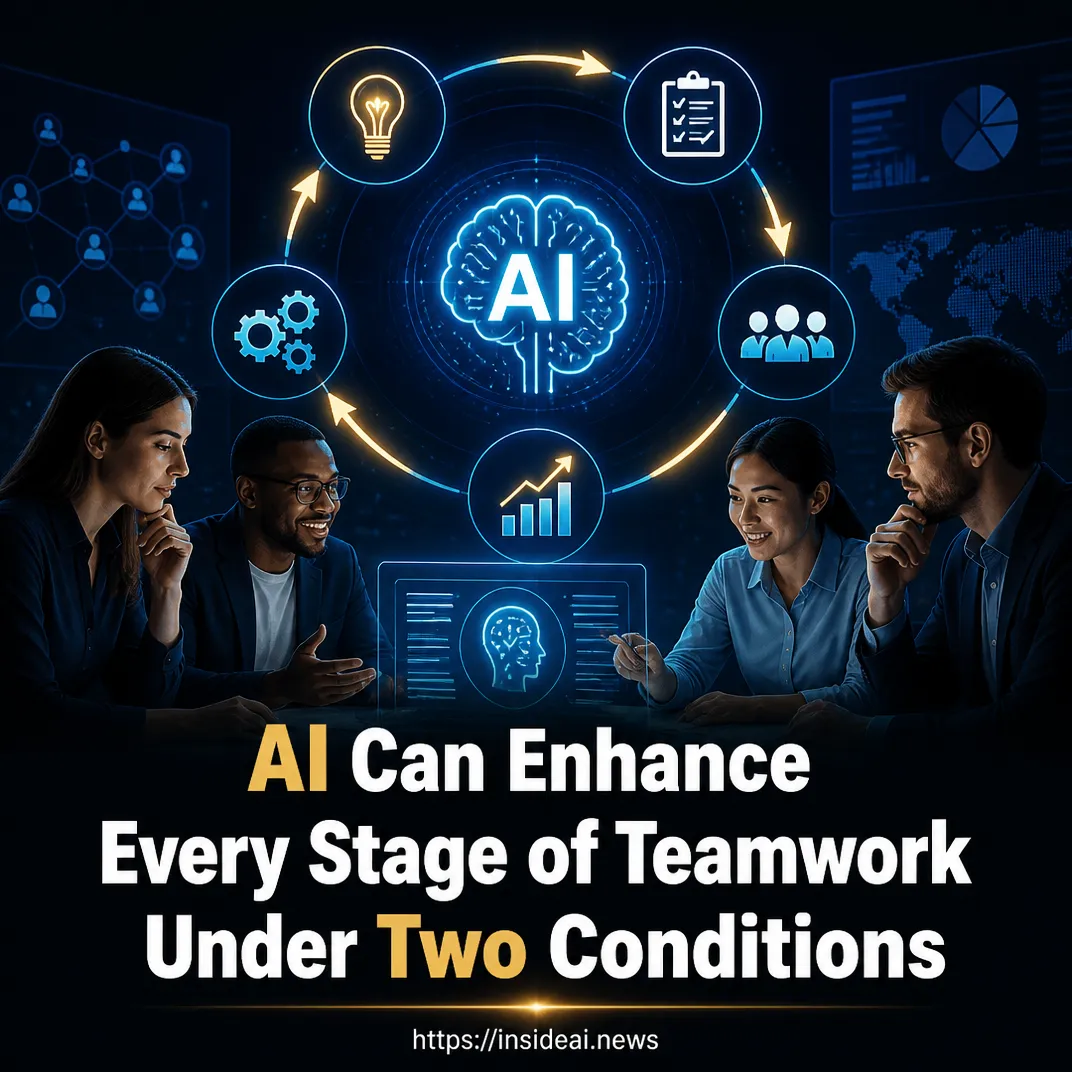
Over 15 months, workshops with 300 managers across 35 organizations revealed how AI can elevate teamwork before, during, and after sessions. The findings challenge the assumption that AI belongs only to solitary tasks. They also show that success depends on two conditions: intentionality and craft.
Preparation Turns Abstract Goals Into Concrete Behaviors #
Team members rarely engage deeply with pre-reads or templates before meetings. AI changes that by turning passive reading into interactive preparation. One automotive company CFO used AI to coach his leadership team on translating a culture shift into tangible behaviors before a workshop.
Each leader arrived with a personal list of behaviors instead of vague statements. The CFO noted that AI helped anchor the discussion in concrete actions. A post-workshop survey showed 80% of participants rated the AI-supported preparation as very or extremely valuable.
A luxury company's CIO team applied a similar approach before a quarterly review. Instead of a standard template, each participant received an AI agent acting as a skeptical peer. The agent pressure-tested recommendations, helping participants arrive with sharper, more defensible ideas. This upstream thinking led to richer debates during the actual session.
Sequenced AI Roles Elevate Live Team Discussions #
During meetings, AI can counter narrow thinking, hidden assumptions, and premature convergence. The luxury company's remote review split 30 participants into 7 breakout rooms. In each room, one person acted as the prompter, sharing the AI interface with the group.
The AI played four sequential roles. First, it facilitated by gathering context on the group and priority. Second, it challenged ideas from the CEO's perspective. Third, it analyzed and prioritized options. Finally, it acted as a storyteller to craft a compelling pitch and anticipate objections. This structured sequence kept the discussion focused and productive.
An Italian consumer products innovation team used AI as a synthetic end-user during a workshop. After drafting a business model canvas, the team described a customer persona to the AI and asked for feedback from that perspective. The team fine-tuned its concept and identified overlooked gaps. Participants raised their average solution quality rating from 3.5 to 4.4 on a five-point scale.
After projects end, teams rarely reflect on what worked. AI can facilitate retrospectives by clarifying context, gathering individual input, clustering responses, and translating lessons into a one-page guide. The Italian team used this process to identify recurring strengths and weaknesses, then selected improvements to carry forward.
Two conditions separate effective team-AI collaboration from failure. Intentionality means leaders deliberately decide to integrate AI into team activities. This change will not happen bottom-up. Craft means designing AI contributions through roles, steps, and s rather than plugging in ad hoc prompts.
A German industrial company's CPO brought AI into a brainstorming session without clear context or a pre-defined prompt. The output fell flat, and the team blamed the technology. The real problem was missing craft. When AI is used without structure, it adds little value. When designed thoughtfully, teams arrive better prepared, converge faster, and produce more robust solutions.
Most AI transformation programs ignore teamwork. Closing that gap is the next frontier. Leaders who bring intentionality and craft to the full flow of teamwork can unlock value that individual AI use cannot reach alone.