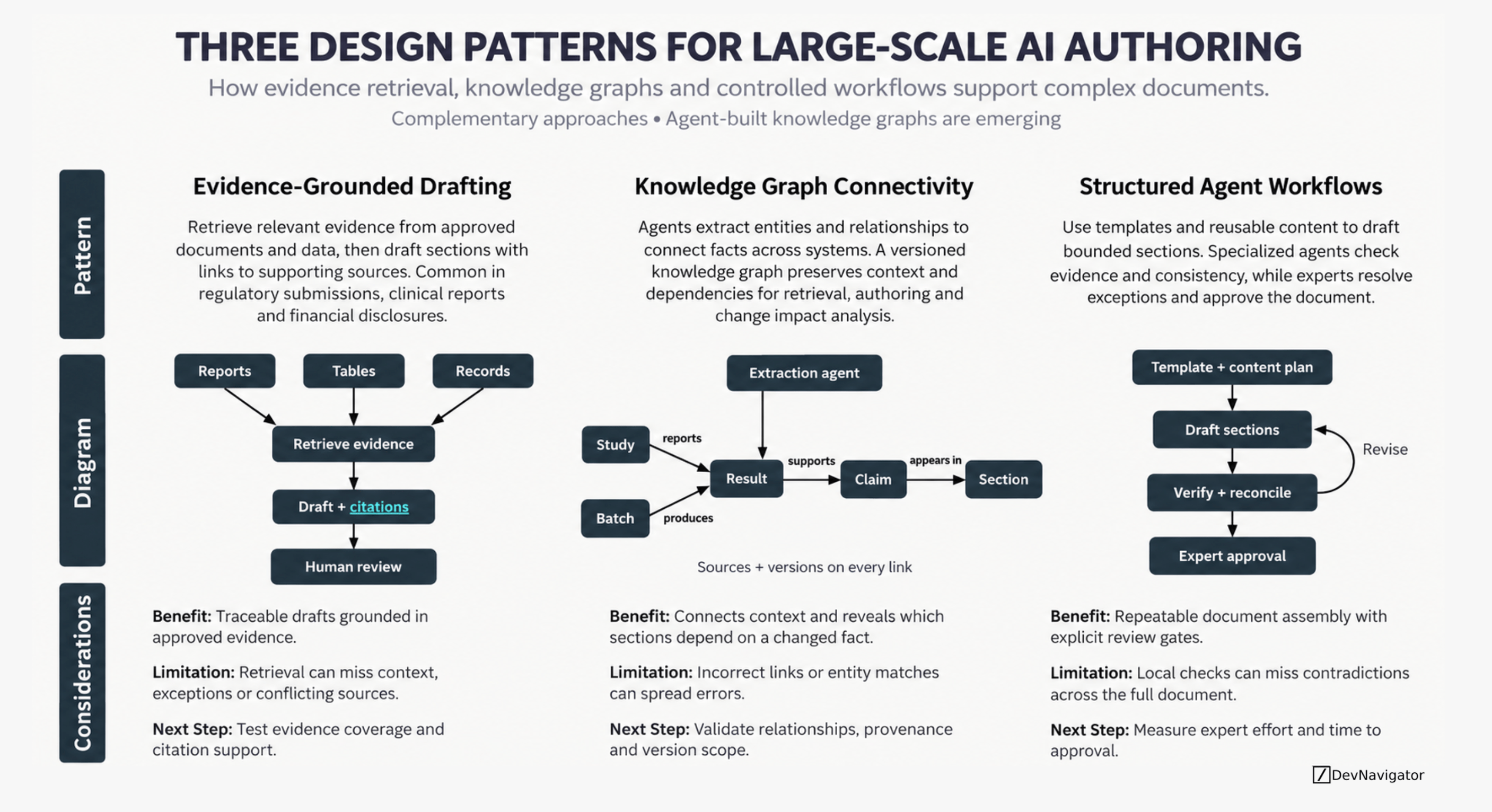
AI authoring is becoming a practical capability for organizations producing regulatory submissions, clinical study reports, financial disclosures and other complex documents. The opportunity extends across evidence gathering, content assembly and review, but faster drafting alone does not establish lower production costs. Three complementary design patterns help explain the architecture: evidence-grounded drafting, knowledge graph connectivity and structured agent workflows. Their value depends on source quality, traceability and effective human judgment. Leaders should evaluate the effort required to produce an approved document, including verification and rework, when deciding where to invest.
Table of Contents #
- Ground every claim. AI authoring needs approved evidence, contextual information and traceable sources to support meaningful expert review.
- Connect the dependencies. Knowledge graphs can reveal relationships between facts and document sections, but extracted connections require validation.
- Measure approved outcomes. Productivity should reflect expert hours, review cycles and material errors across the complete document workflow.
Evidence-grounded AI authoring starts with approved sources #
The first pattern retrieves relevant information before generating text. Reports, tables and records provide the evidence for a section, while source links help reviewers examine the basis for individual claims.
Certara’s CoAuthor illustrates this approach by combining retrieval-augmented generation with templates and structured content authoring. Its product description restricts retrieval to permitted source material. These are vendor-described capabilities, rather than independent guarantees of accuracy.
For a clinical report, the workflow might retrieve the protocol, approved statistical outputs and relevant study records before drafting a results narrative. For a financial disclosure, the equivalent inputs could include controlled financial data and supporting explanations. The limitation is evidence coverage. A retrieved passage may support a statement while omitting an exception elsewhere. AI authoring therefore needs checks for missing information, contradictory findings and source currency alongside citation validation.
Knowledge graphs connect facts, context and dependencies #
The second pattern represents relationships explicitly. A study reports a result, a batch produces analytical evidence, and that evidence supports a claim appearing in a submission section.
Microsoft’s GraphRAG documentation demonstrates how language models can extract a knowledge graph from a document collection and use it to support retrieval. This establishes a technical foundation; it does not demonstrate validated, autonomous production of regulatory dossiers.
Agent-driven graph construction is an emerging extension. Agents can propose entities, identify relationships and reconcile references across systems. With additional dependency tracking, the graph could help identify which sections require reassessment when an underlying result changes.
However, connectivity can propagate mistakes. Incorrectly merging two batches or linking a claim to an obsolete process version can undermine downstream drafting. Each consequential relationship needs supporting evidence, applicable scope and version information. AI authoring benefits when these connections are inspectable and maintained over time.
Structured agent workflows control document assembly #
The third pattern organizes work around a content plan. Templates define required sections, approved components provide reusable material, and agents perform bounded drafting or checking tasks.
A practical sequence is straightforward: establish the template, draft sections, verify evidence, reconcile inconsistencies and obtain expert approval. Findings should return to the relevant drafting step with an explanation of what requires correction.
Checks must span the complete document. Separate sections can each appear reasonable while using different populations, reporting periods or definitions. Calculations and mechanical validations should use deterministic tools where appropriate.
This builds on the distinction explored in DevNavigator’s analysis of AI verifiers: model judgment, observable evidence and explicit constraints serve different purposes. AI authoring should combine these checks while retaining accountable human decisions.
The next step is reducing effort through approval #
These patterns address different needs and can operate together. Retrieval finds evidence, graphs connect context, and workflows coordinate assembly and review. Their usefulness depends on the document family and available data.
Human-in-the-loop review becomes more efficient when reviewers receive exact evidence, source versions, tracked changes and unresolved exceptions beside the proposed text. A polished draft without those supports may simply transfer work from writing to investigation.
Leaders should pilot AI authoring on repeated documents with stable inputs and clear acceptance criteria. Compare total expert hours, review cycles, material errors and update handling against the existing process. Investment decisions should follow demonstrated improvements in approved output and maintained quality.