AI benchmarks influence which models organizations buy and which capabilities developers prioritize. Yet a rising score does not automatically mean a system will perform better on the work people actually need completed. Contrary Research highlights how leaderboard optimization, contaminated test data, and flawed grading can weaken the connection between measured progress and practical value. The leadership challenge is to understand what each score represents, where its limits lie, and how to supplement it with evidence from real workflows. Model selection should ultimately connect technical capability to acceptable outputs, manageable review effort, and measurable business outcomes.
Table of Contents #
- Scores shape priorities. AI benchmarks can steer development toward behaviors that improve rankings while leaving important user needs inadequately measured.
- Passing needs interpretation. Familiar test data, narrow grading rules, and unrealistic tasks can inflate confidence in a model’s readiness.
- Evaluate the actual workflow. Leaders should combine public scores with expert acceptance, correction effort, completion time, and business outcomes.
AI Benchmarks Shape What Gets Built #
Every evaluation makes a choice about what counts as success. When a score becomes commercially important, developers have a strong incentive to improve the behaviors it rewards. A preference ranking may favor presentation; a coding test may reward satisfying automated checks. Neither necessarily captures everything users value.
In The Second Half, researcher Shunyu Yao argues that increasingly capable training methods make defining useful problems more consequential. His thesis places greater emphasis on selecting objectives and measuring meaningful progress. For buyers, that makes understanding the test almost as important as comparing the result.
This does not mean benchmark improvements are meaningless. It means the relationship between a score and a business requirement must be established rather than assumed. A model can make genuine progress on a narrow capability while remaining poorly suited to a particular workflow.
Faster Gains Need Careful Interpretation #
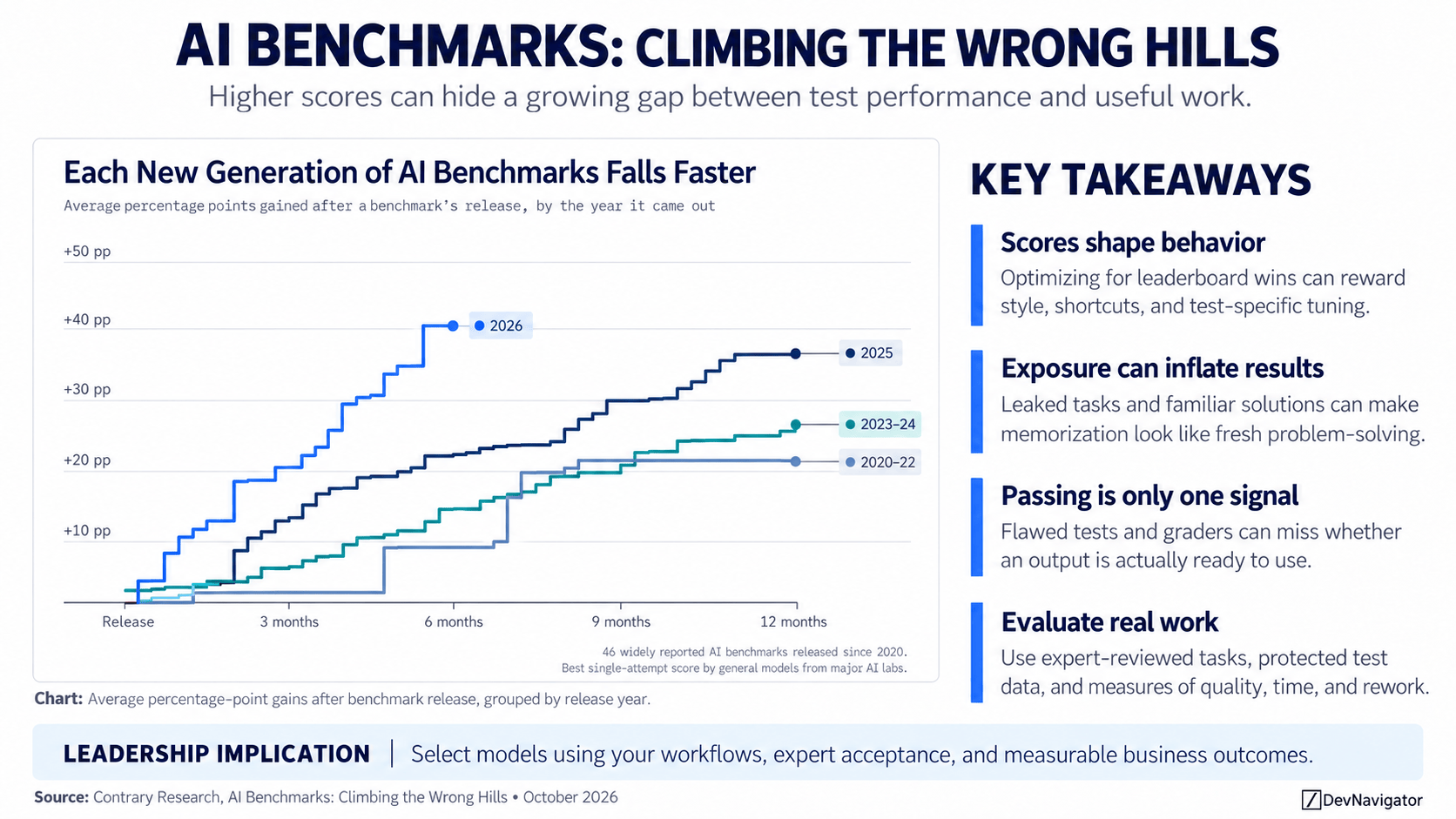
Contrary’s chart groups AI benchmarks by release year and compares average percentage-point gains after launch. Newer groups show faster improvement. That pattern suggests evaluation targets can lose their ability to distinguish models quickly, increasing the need for refreshed tasks and complementary evidence.
The chart does not establish why scores rose. Better general capabilities, targeted optimization, and exposure to evaluation material can all influence performance. Faster gains alone cannot demonstrate cheating or prove that practical usefulness has stalled.
Contamination creates a separate concern: if a model has encountered a question or its solution during training, apparent problem-solving may partly reflect recall. Protected, previously unpublished tasks help reduce this risk, although privacy alone cannot guarantee a representative or well-designed evaluation.
Passing a Test Can Still Leave Unfinished Work #
AI benchmarks also depend on the quality of their graders. A rigid checker can reject an equivalent answer because its formatting differs. Conversely, a permissive test can accept an output that misses requirements a practitioner would consider essential.
METR’s maintainer-review study illustrates this gap. In its sample, roughly half of test-passing AI-generated software patches would still have required changes before maintainers accepted them. The study covered agents from mid-2024 through mid-to-late 2025, and agents could not revise their submissions in response to reviewer feedback.
Those conditions matter. The finding identifies a gap between automated success and reviewer acceptance; it does not establish a permanent limit on AI coding. Evaluation should account for whether the deployed system can ask questions, receive feedback, and iterate toward an acceptable result.
Evaluate AI Benchmarks Against Your Operating Needs #
For an organization choosing a model, public scores offer a starting point. The next step is a representative set of internal tasks, with domain experts defining acceptable performance before results arrive. Include routine cases, ambiguous requests, and consequential exceptions. Consider an investigation assistant. A useful evaluation would examine whether it identifies relevant evidence, distinguishes facts from assumptions, flags missing information, and reduces the time needed to produce an acceptable investigation. Fluent drafting alone would provide an incomplete picture of value.
Track the full workflow, including review time, corrections, failed attempts, and escalation. Repeat the evaluation when models, prompts, tools, or source data change. This connects model selection to the operating decisions explored across DevNavigator’s strategy and governance coverage.
The investment priority follows directly: allocate resources to evaluation ownership, expert review, and maintained test cases alongside model access. AI benchmarks become more useful when organizations can explain how measured improvements translate into work their people will accept.