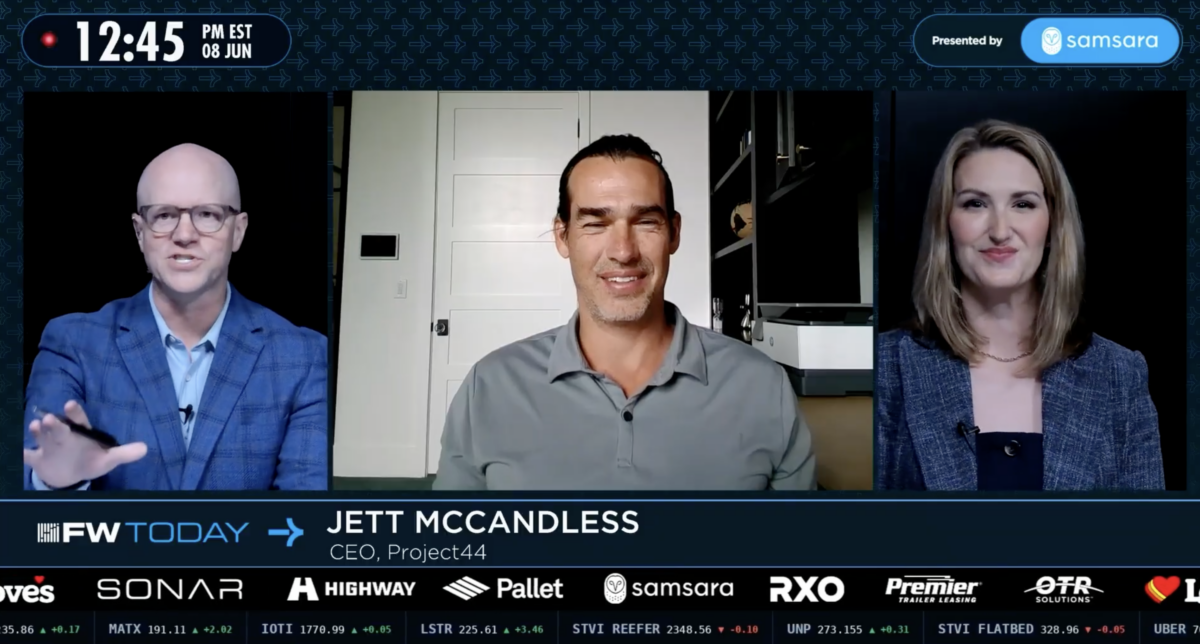
AI agents are only as good as the data they run on. That’s the case project44 CEO Jett McCandless made to FreightWaves CEO Craig Fuller on a recent episode of FW Today. McCandless and Fuller discussed how the freight industry should approach AI: both as an internal efficiency lever and as a customer-facing product.
project44’s Agentic Workflow Manager and the AI orchestration engine underneath it are designed to solve the data quality and operational automation problems that shippers and logistics service providers are dealing with every day, without requiring customers to build anything themselves.
Context, says McCandless, is key.
The foundation of project44’s approach has been to build an engine that orchestrates both first party (via LunaPath acquisition) and third-party agent providers (including Happy Robot andVooma) and layer them on top of the contextual data project44 already holds for its customers.
“AI agents without context are just guessing faster,” McCandless said. “Shippers have found that there’s a lot of work to try to create context so that those agents can actually be effective.”
Shipment-level data, carrier relationships, dispatch history, historical lane and carrier analytics, and mode-specific workflows are the kinds of contextual information that McCandless sees as the competitive moat. project44 ran multiple agent vendors side by side inside the engine for over a year, benchmarking performance across task types, languages, and communication channels. The takeaway was that no single agent excelled at everything.
“Some agents performed better at other tasks than others. Language made an impact,” McCandless said. “And so we focused again on providing the context. We have the distribution and the trust with the customers. When a customer plugs into project44, what they’re really interested in is the outcomes that we drive for them.”
The practical implication for shippers and LSPs is that the AI layer is already embedded in the platform. There’s no integration project, no prompt engineering, and no custom database work required to get started.
“Because it’s already embedded in the platform and it’s clicks, not code, you don’t need prompt engineers,” McCandless said. “You don’t need to set up these databases because we already have the context. It’s really quite easy and adoption is quick.”
Dispatch reconciliation, according to McCandless, is one of the practical use cases for this model that has resonated with shippers and LSPs who run LTL freight.
When a company dispatches shipments to an LTL carrier, a portion of those shipments won’t return a pro number the following day. The reasons vary and include re-proes, capacity constraints, and pallet size changes at a prior stop, but someone always has to track down the missing information. For decades, that work has been handled by staff or by outsourced teams making manual calls to carriers.
project44’s agents now handle that workflow automatically, triggered by the company’s API-level dispatch visibility.
“We can simply dispatch agents to go and search for that pro number by calling the carrier,” McCandless said. “It’s a very easy solution, but it’s practical and useful quite often.”
The scale is significant. McCandless says that project44 processes roughly 75,000 LTL dispatches per day, an estimated 8% to 15% of the market on any given day. On the day before the interview, agents had matched over 2,000 dispatches that would have otherwise required manual intervention.
McCandless draws a clear distinction between what shippers and LSPs are each looking for from AI-driven intelligence tools.
“When we look at the shippers, they’re not primarily interested in reducing the cost of the transportation team,” McCandless said. “That’s relatively small when you look at how much they spend on freight and the margins that they have overall. What they tend to be interested in is how they can reduce the inventory, and how they can reduce the stock outs.”
The concept McCandless finds most impactful is what he calls “infinite labor”: the idea that AI agents can absorb the repetitive, high-volume operational work that logistics teams have historically needed bodies to manage. For shippers, that means the ability to improve supply chain execution without scaling headcount, whether the goal is ensuring a flawless product launch, catching potential stock-outs before they materialize, or getting ahead of disruptions that affect parts availability.
“If they can just improve their supply chain with infinite labor, that’s impactful,” McCandless said.
LSPs whose product is the service itself have a more direct financial calculus. They operate on thin net margins, and the ability to automate carrier communication, data reconciliation, and exception management without adding staff has a direct bottom-line impact.
When asked what single problem AI can most meaningfully address in logistics right now, McCandless was unequivocal that the answer is data quality. There are, however, limitations of an agent-only approach.
“I think the industry is going to realize that it’s good to augment or subsidize or enhance, but it’s never going to replace an EDI or an API in its entirety,” McCandless said.
The nuance matters for shippers. McCandless says that most carriers produce strong structured data, while a middle tier needs moderate agent augmentation, and a smaller segment still depends heavily on agents to fill gaps. The key, he says, is that the platform can now stratify that problem and address it programmatically rather than leaving shippers to manage carrier data quality on their own.
“Everybody needs better data quality to be able to make better decisions when you’re looking at automating these operational decisions, whether it’s execution or visibility,” McCandless said. “Improving data quality has to be done in conjunction with EDI and API. It can’t be just a substitute.”
The results of that approach are showing up across project44’s customer base. McCandless says platform data quality has improved roughly two and a half times over the past three years as a function of carrier investment, platform improvements, and the AI augmentation layer working in concert. That improvement has translated into measurable customer satisfaction gains, with the company’s NPS swinging from negative 34 to positive 39 over the same period.
One limitation that will matter to any shipper or LSP who has to budget for AI-enabled tools is pricing. McCandless acknowledged that project44 itself blew through its internal AI token budget by April, a pattern he says is common across the industry. For many customers, that dynamic creates anxiety around unpredictable costs.
“A lot of companies are struggling with surprise token invoices,” McCandless said. “What they want is some type of pricing and packaging that’s very consistent. Might sound kind of familiar, maybe something like something as a subscription.”
Agentic Workflow Manager is available today and is orchestrating over 53 agents categorized by a series of jobs to be done.
Click here to request a demo of project44’s Autopilot. Supply Chain AI Symposium
Past the hype. Join operators, founders, and enterprise leaders figuring out how to deploy AI in supply chain.
Register Now F3: Future of Freight Festival
Industry-defining keynotes, rapid-fire technology demos, and industry leaders networking in experiences across Chattanooga - plus the inaugural F3 Awards Dinner featuring the FreightTech and Shipper of Choice reveals.
Register Now Past the hype. Join operators, founders, and enterprise leaders figuring out how to deploy AI in supply chain.
The Old Post • Chicago, ILRegister Now Industry-defining keynotes, rapid-fire technology demos, and industry leaders networking in experiences across Chattanooga - plus the inaugural F3 Awards Dinner featuring the FreightTech and Shipper of Choice reveals.
The Signal at Chattanooga Choo Choo • Chattanooga, TNRegister Now