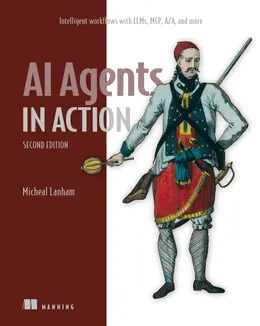
The new book AI Agents in Action, Second Edition by Micheal Lanham is a practical guide to building agentic systems, covering personas, tools, memory, retrieval, reasoning, evaluation, multi-agent patterns, and the Model Context Protocol (MCP). Manning offers a free online extract and lists the edition as published in June 2026, per the publisher preview on Manning.com. Retail listings on Amazon show a paperback release date of July 14, 2026 and a pre-order price of $59.99. The edition is listed as 392 pages with ISBN-13 978-1633434530 in catalog entries on WOW! eBook and O'Reilly. The Manning preview includes a brief author note describing the book's aim to make agentic development accessible to developers and practitioners.
What happened
AI Agents in Action, Second Edition, authored by Micheal Lanham, has been published in a new, substantially updated edition that concentrates on building and deploying intelligent agent systems. Per Manning's online preview, the edition was published in June 2026 and the publisher provides a free extract of early chapters on Manning.com. The book is listed as 392 pages with ISBN-13 978-1633434530 on catalog pages including WOW! eBook and O'Reilly. Retail listings on Amazon show a paperback release date of July 14, 2026 and a pre-order price of $59.99.
Technical details
The second edition documents core agent components and practical workflows. Manning and O'Reilly table-of-contents excerpts list chapter-level material on LLMs, agent personas, tools and actions, knowledge and memory, retrieval and augmentation, reasoning and planning, evaluation and feedback, and multi-agent architectures such as hub-and-spoke orchestrations and agent collaboration. The book explicitly introduces the Model Context Protocol (MCP) and discusses agent-to-agent interactions (A2A) and multi-agent coordination patterns, per the publisher preview on Manning.com and the O'Reilly catalog.
Editorial analysis - technical context
Industry-pattern observations: developer-focused, example-driven books that combine conceptual layers (persona, tools, memory, planning) with concrete code examples accelerate team adoption of agentic patterns. Readers looking to move from single-turn LLM prompts to longer-lived, stateful workflows often need hands-on recipes for memory management, tool integration, and evaluation; the book's chapter breakdown mirrors those practitioner needs.
Context and significance
agentic systems remain a key area for applied ML and software engineering because they bridge LLM capabilities with external tools and state. Comprehensive, up-to-date resources that cover MCP, agent orchestration, and evaluation frameworks address recurring gaps in practitioner knowledge: designing typed outputs, tracing tool use, and assembling multi-agent flows. Manning's author note in the preview captures this teaching aim: "I hope this book inspires you to see intelligent agents as partners in innovation," per the Manning online extract.
What to watch
For practitioners: watch for sample repositories, code walkthroughs, and any publisher-provided exercises that accompany the book; Manning's live preview notes exercises in agent building and O'Reilly lists chapter exercises and runtime topics. Observers should also track whether the author or publisher publishes companion code, notebooks, or a GitHub repo that implements the MCP examples and multi-agent orchestrations described in the text.
Scoring Rationale #
This is a useful practitioner resource that consolidates agent design patterns and protocols. It is valuable for engineers adopting agentic workflows but does not introduce a new model or paradigm-shifting technology.
Practice interview problems based on real data
1,500+ SQL & Python problems across 15 industry datasets — the exact type of data you work with.