Member-only story
Open the Agno performance page and the first thing you see is a number designed to end the argument: an Agno agent instantiates in about 3 microseconds, which the docs report as 529× faster than LangGraph and using 24× less memory. Agno shipped version 2.8.2 to PyPI on July 24, 2026, and that benchmark is still the headline of the pitch.
A 529× speed difference is the kind of claim that makes you switch frameworks. So I installed the current releases of Agno, LangGraph, and Pydantic AI on one Linux box and ran the comparison myself. The gap is real and it is enormous. It is also measuring something much narrower than “which framework is faster,” and once you see what’s actually on the clock, the number stops being a reason to choose anything.
What the benchmark actually times #
Agno’s methodology is public and simple: build the same one-tool agent 1,000 times, and use Python’s tracemalloc
to isolate the per-instance memory delta against an empty-function baseline. Nothing in it calls a language model. It is a pure measurement of how expensive it is to construct the agent object in Python, before a single token is generated.
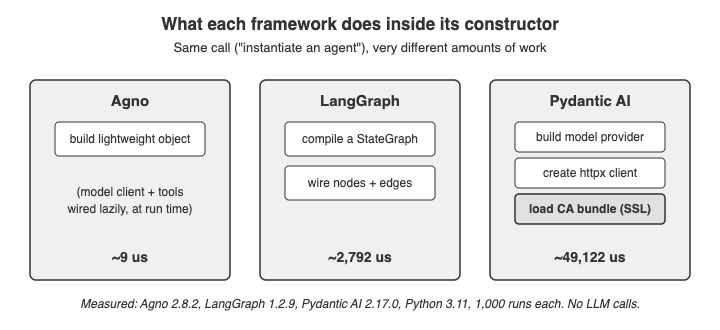
That matters because the three frameworks do very different amounts of work in their constructor:
Agno builds a lightweight agent object and defers almost everything else until you actually run it.