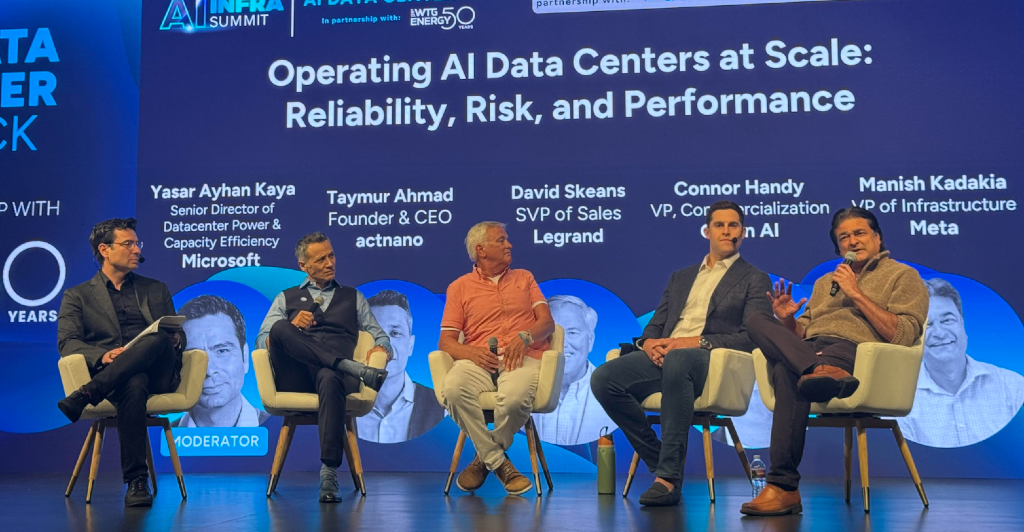
AI Infra Summit 2026 Meta's Vice President of Infrastructure Manish Kadakia traced changes across servers, networks, power and cooling.
Akul Saxena
SANTA CLARA, Calif., Sept. 16, 2026 – A data center runs on four systems: servers, networks, electricity and cooling. All four are changing at once, driven by the racks of chips that train and run AI models.
"All four are drastically changing," said Manish Kadakia, vice president of infrastructure at Meta, on Wednesday at the AI Infra Summit. Improvements in one system did not previously require the other three to change with it.
Servers: More computing in each rack
Racks that once drew about 10 kilowatts are giving way to AI racks pulling 100 kilowatts or more, Kadakia said. A rack is the tall cabinet holding servers and networking equipment, and chipmaking giant Nvidia now ships its processors by the rack, with dozens of chips wired together and installed as one unit.
A rack that draws 100 kilowatts also produces 100 kilowatts of heat. The power distribution and the cooling in most buildings were designed for a tenth of that per rack.
Networks: Connecting chips to one another
AI training adds a second high-speed network at a scale most facilities never needed. The front-end network, which every data center already has, connects the computing cluster with storage, applications and users. The back-end network is the addition, and it links processors to one another so they can work on the same model.
Those processors exchange data constantly while a model trains. Kadakia said that takes a "humongous amount" of fiber running among the machines.
The back-end network cannot tolerate delay. Speed matters because a processor waiting for another’s results can sit idle. Across thousands of expensive chips, network delays waste computing time and stretch out the training run.
Electricity: Managing sudden swings in demand
The coordination also creates an electrical problem. Thousands of processors can ramp up or ease off together, sending power demand sharply up or down. Electrical systems must handle those swings as well as the higher demand.
Sharp swings in AI power demand can resemble the electrical faults that backup systems are designed to detect, said David Skeans, senior vice president of sales at electrical equipment maker Legrand. Equipment built to keep servers running through outages must now handle abrupt changes caused by the servers themselves.
Cooling: Bringing liquid to the chips
Workers once were not allowed to bring a water bottle onto the data center floor, Kadakia recalled. Now liquid circulates through metal plates attached to processors, drawing heat from the chips faster than moving air can.
That puts liquid close to expensive electronics. A leak can damage equipment and interrupt computing.
Operators have placed sandbags around racks, alongside sensors and cables that detect escaping liquid, said Taymur Ahmad, founder and chief executive of protective-coatings company actnano.
But trouble can start before liquid escapes. Changes in its chemistry can encourage corrosion. Worn parts can shed metal particles, and microbes can grow inside the cooling system. Those problems can clog passages or reduce the system’s ability to carry heat away, said Connor Handy, vice president of commercialization at cooling-monitoring company Omen AI. His company monitors the liquid for early warning signs.
The shift also changes who keeps the facility running. Electricians and network technicians may increasingly work beside plumbers, Ahmad said.
Operations: Upgrading while keeping systems running
New AI hardware can arrive every few months, bringing different power, cooling and repair requirements, Kadakia said. The buildings housing it cannot change that quickly. Operators must make room for new racks while keeping older equipment in service. Air-cooled and liquid-cooled systems will have to coexist, requiring technicians who can maintain both.
Repairs are becoming harder just as delays become more expensive. Technicians sometimes replace parts without knowing exactly what failed, Kadakia said. Taking equipment offline leaves costly processors idle and can lengthen the time needed to train a model.
Each hardware upgrade therefore presents a bigger decision: How much of the surrounding infrastructure must change, what will it cost and how can the work proceed without interrupting the computing already underway?