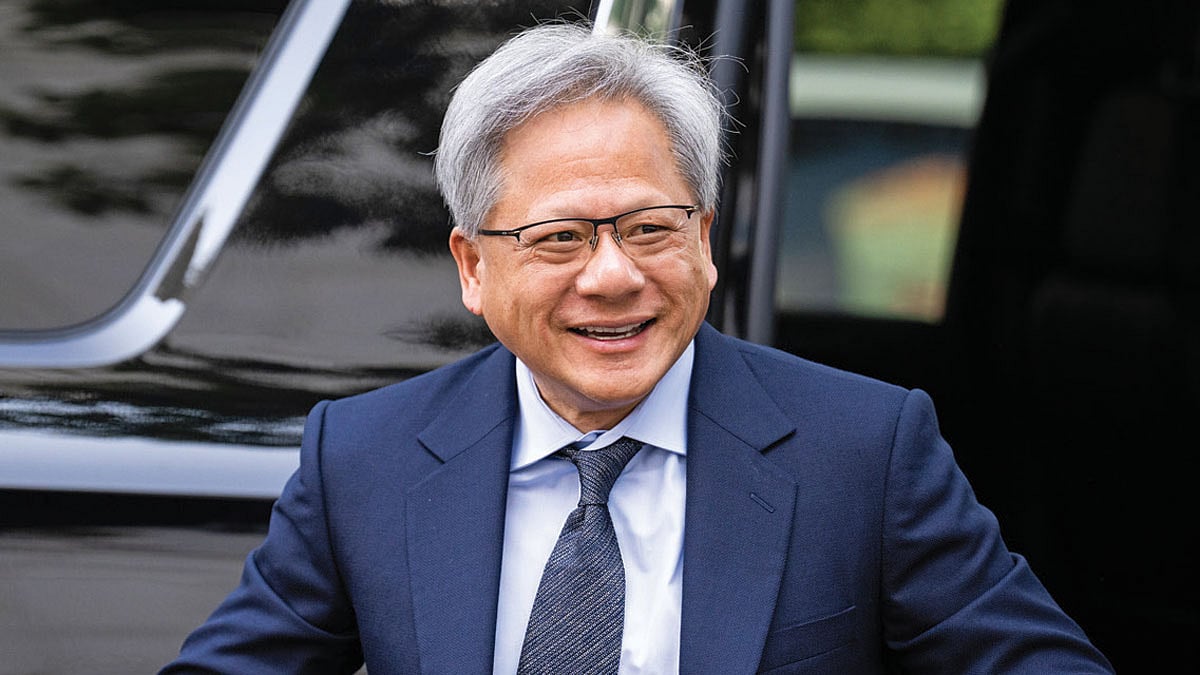
Jensen Huang, chief executive of American chip designer Nvidia, is facing scrutiny after reports that a Chinese business contact gathered information for Beijing. China denies the allegations, while Nvidia says their dealings were routine.
On October 31, Singapore added a significant clarification. It rejected reporting that its officials had investigated the woman’s alleged intelligence ties, while confirming that a separate investigation into her associated company, Megaspeed, remains ongoing. The dispute brings renewed attention to who buys Nvidia’s powerful AI chips, who uses them and how effectively governments can control that access.
Who is Jensen Huang, and why do Nvidia’s chips matter? #
Huang is Nvidia’s co-founder and chief executive. Its graphics processing units, or GPUs, are processors capable of handling many calculations at once. Originally associated with computer graphics, they have become important tools for training and running artificial intelligence systems.
Training involves processing large amounts of data so a system can learn patterns. Running the trained system allows it to answer questions or perform other tasks. Powerful chips help do this work faster. That makes access to them commercially valuable and politically sensitive.
The Era of Forever Wars #
30 Oct 2026 - Vol 05 | Issue 44
Coping with an explosive Middle East
Read Now The Era of Forever Wars
What exactly are the spy allegations? #
The New York Times reported on October 29 that US intelligence officials believed Alice Huang, also known as Huang Le, was gathering information for China. She is a Chinese businesswoman linked to Singapore-based data centre company Megaspeed and is unrelated to Jensen Huang.
According to the report, scrutiny over whether chips were being diverted to China led officials to examine her relationship with Nvidia’s chief executive. What information she allegedly provided, its value and when any intelligence gathering began remain unclear. The reporting does not establish that Jensen Huang knowingly assisted an intelligence operation.
China rejected the allegations on October 30 as “groundless speculation”. Nvidia said Megaspeed received ordinary business information, without sensitive company secrets or information relevant to national security.
What does “unmasking” mean here? #
It means revealing an American’s identity within an intelligence report to an authorised recipient who needs that information.
The BBC reported that surveillance of Alice Huang revealed communications involving an American subsequently identified as Jensen Huang. US intelligence guidance explains that reports can initially replace an American’s name with a generic description to protect privacy. An approved request can disclose the identity when necessary to understand the intelligence. The process itself establishes neither guilt nor wrongdoing.
What did Singapore confirm, and what did it deny? #
Singapore denied that its officials had investigated Alice Huang over her alleged Chinese intelligence links, challenging that part of a Wall Street Journal report.
Its Ministry of Home Affairs nevertheless published a police response confirming an ongoing investigation into Megaspeed, without giving further details. Singapore’s clarification concerns its own authorities’ actions. It does not resolve the reported American intelligence assessment.
Nvidia says earlier chip-smuggling allegations involving Megaspeed were investigated and debunked. Reuters, reporting a Bloomberg interview, quoted Jensen Huang saying: “We’ve studied all their deployments of our GPUs and counted every one.” That is the company’s account of its checks; Singapore’s statement confirms its investigation remains open.
Why does Huang want to keep selling to China? #
China represents business for Nvidia and an important market for American technology. Huang argues that continued sales help maintain US competitiveness in AI.
Nvidia’s financial filings spell out its concern: exclusion encourages Chinese customers to build relationships with competing chip suppliers and use their software tools. Once developers build their systems around alternatives, winning them back could become harder.
Critics prioritise the risk that the technology could strengthen China’s military capabilities. On October 29, Senator Elizabeth Warren demanded answers from Huang and Nvidia’s board, and called for stronger restrictions. The disagreement is over whether controlled sales preserve American influence or give a strategic rival too much computing power.
Where does Trump fit into this? Are sales to China banned? #
President Donald Trump’s administration controls important licensing decisions. It has allowed some sales under conditions, while restrictions continue to limit access to advanced technology.
On January 13, the US Commerce Department announced case-by-case consideration of licences for Nvidia’s H200 and comparable chips. Requirements included customer screening and independent testing in the United States. The administration argued that controlled sales could strengthen America’s technology ecosystem.
Permission from Washington also does not guarantee sales. Nvidia subsequently disclosed that Chinese restrictions limited purchases even where American licences existed. The company needs approvals and willing buyers on both sides.
Can customers use the chips without bringing them into China? #
Yes. Computing work can be sent over a network to servers in another country. A customer can rent their processing capacity while the chips remain in the overseas data centre.
This makes controlling access more complicated than checking shipments at a border. In January, US Representative Mike Lawler argued for legislation addressing remote access to restricted technology through cloud services.
Whether a particular arrangement breaches restrictions depends on the applicable rules, customers and use. Remote access alone does not establish smuggling. Singapore has not disclosed its findings on Megaspeed.
Why has Beijing put Nvidia under pressure too? #
China has raised both security and competition concerns.
In July 2025, its internet regulator summoned Nvidia over possible security risks in H20 chips, including concerns about hidden access mechanisms. Nvidia denied that its processors contained backdoors, which are concealed ways around security controls, or kill switches allowing remote shutdown.
Separately, China’s competition regulator announced preliminary findings in September 2025 concerning Nvidia’s compliance with conditions attached to its acquisition of networking company Mellanox. It ordered further investigation. That is a distinct regulatory dispute, separate from the espionage allegations.
What is the India angle here? #
India is expanding access to the same kind of high-performance computing needed to develop AI. An August government backgrounder said the IndiaAI Mission had expanded shared capacity to more than 45,000 GPUs by June 2026.
For Indian startups and researchers, the broader issue is reliable access to chips and computing services. The China dispute illustrates why technology procurement can depend on government policy as well as price. It does not establish any new restriction on Indian users.
What happens next? #
Singapore’s Megaspeed investigation remains open. Further official findings could clarify the company’s conduct and whether the reported intelligence concerns lead to public action.
For Nvidia, the next policy test is whether Washington permits wider access to its products and whether Beijing allows customers to buy them. Changes to licences, purchasing restrictions and enforcement will show how much room Huang has to do business with both.