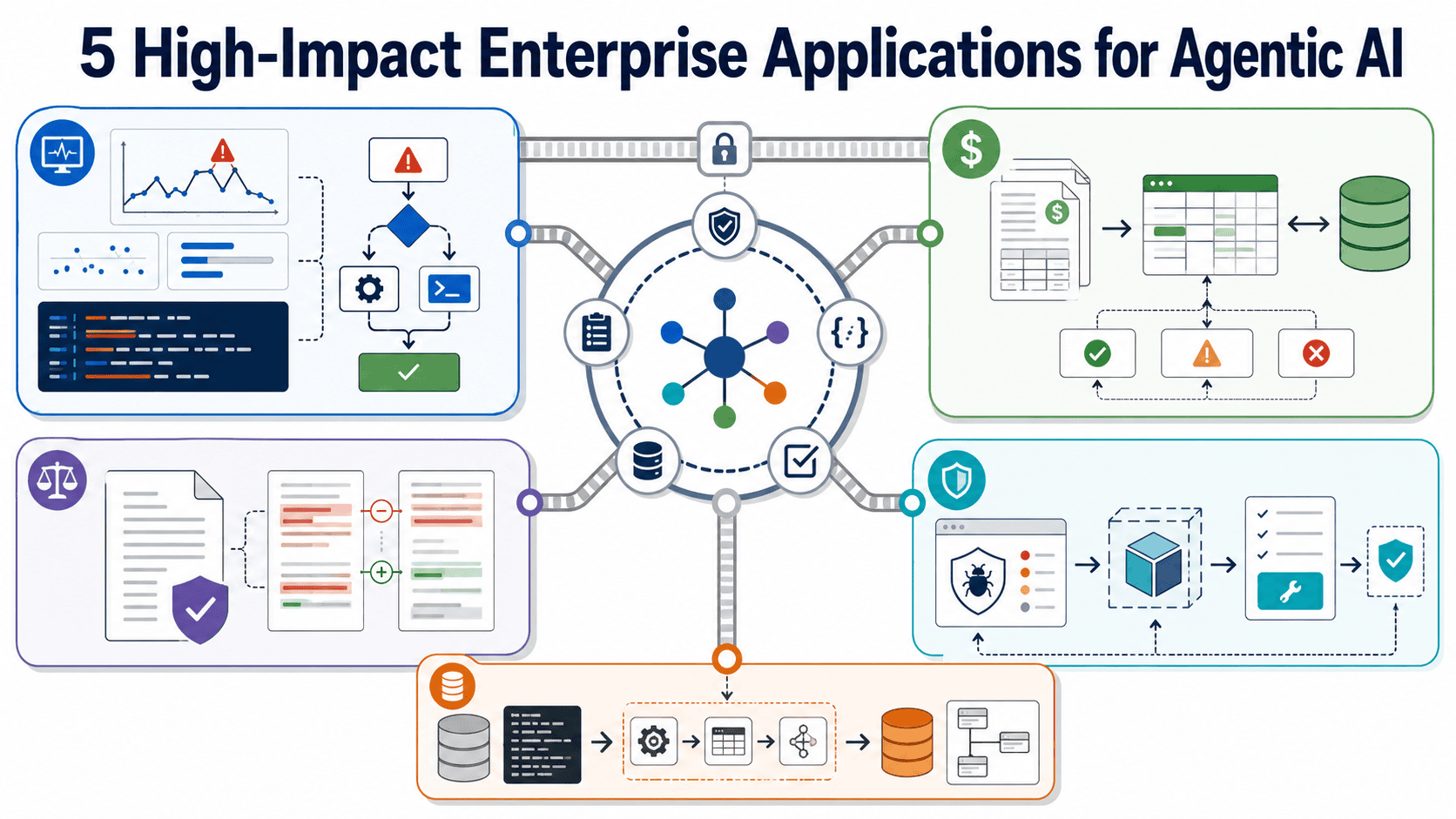
Deploy agentic AI across SRE, finance, legal, migration, and security with deterministic safety constraints.
Wrapping an LLM in a ReAct loop with a few Python tool definitions works fine in a demo sandbox, but deploying it against enterprise infrastructure turns minor hallucinations into cascading outages, ghost database writes, and silent data corruption. The naive approach to agentic automation assumes perfect deterministic tool execution, treats every API call as inherently idempotent, and lacks transactional rollback boundaries. When an autonomous agent enters an infinite recovery cycle or executes write operations across heterogeneous systems without distributed locks or two-phase commits, system state falls out of sync fast.
Before getting into architectural patterns, it's worth distinguishing between Deterministic Workflow Orchestration (e.g. DAGs, Airflow pipelines, or finite state machines with hardcoded static transitions) and Agentic System Orchestration (dynamic state machines where an LLM evaluates non-deterministic telemetry, dynamically selects tools, and computes its own next-step execution graph at runtime). The applications below focus on the latter, emphasizing the engineering scaffolding required to keep non-deterministic reasoning bound by deterministic system constraints.
1. Automated Site Reliability Engineering and Incident Remediation #
The Concept: Deploying autonomous multi-agent diagnostic swarms that ingest distributed traces, metrics, and logs to identify root causes and execute deterministic mitigation runbooks with safety gates.
How It Works: The orchestrator ingests alert payloads from ** Prometheus** or
. A triage agent executes read-only diagnostic tools (
Datadogtrace analysis, log pattern aggregation, git commit diffing) to construct a causal graph of the failure. Once the root cause is isolated with an empirical confidence threshold, a mitigation planner synthesizes a remediation sequence (e.g. traffic shedding, rolling back canary deployments, restarting deadlocked worker pools). The sequence is submitted to a policy engine (e.g.
[OpenTelemetry](https://opentelemetry.io/)**) for static constraint checks before executing against**

[Open Policy Agent](https://www.openpolicyagent.org/)**or AWS APIs, pausing for explicit human-in-the-loop approval on high-blast-radius state changes.**
KubernetesThe Catch: Non-idempotent runbook steps and cascading feedback loops break the system. If an agent tries to remediate elevated latency by restarting pods without respecting circuit breakers or rate limits, it can trigger a thundering herd problem that brings down underlying databases. Log volume spikes during severe outages also cause context window thrashing, leading the agent to discard the original triggering alert in favor of noisy downstream symptom logs.
When to Use It: High-throughput distributed microservice architectures where Mean Time to Detection (MTTD) and Mean Time to Resolution (MTTR) are constrained by human triage bandwidth across thousands of disparate telemetry streams.
2. Complex ERP and Accounts Payable Exception Reconciliation #
The Concept: Coordinating multi-step financial document ingestion, structured ledger querying, and cross-entity reconciliation to resolve multi-currency billing discrepancies and unbilled purchase orders.
How It Works: Inbound semi-structured documents (invoices, bills of lading, customs declarations) are parsed into strongly typed schemas using constrained JSON output parsers. An agent orchestrates three-way matching by querying relational ERP databases (e.g. ** SAP**,
) via parameterized SQL tools to match line items against Purchase Orders (POs) and Goods Receipts (GRs). When variance thresholds are violated (e.g. tax discrepancies, currency conversion drift, unit-of-measure mismatches), the agent executes specialized subroutines to query vendor master data, compute fractional rate adjustments, and draft journal adjustments with strict provenance lineage back to the raw source documents.
NetSuiteThe Catch: Ghost ledger mutations and floating-point precision collapse are fatal. LLMs can't perform reliable deterministic arithmetic internally; passing numeric calculations through the model context rather than off to isolated calculation engines creates subtle ledger rounding errors that compound across fiscal periods. And without row-level security (RLS) enforcement on database tool interfaces, prompt injection embedded in malicious vendor invoice PDFs can extract internal financial tables or manipulate approval limits.
When to Use It: High-volume global enterprises handling hundreds of thousands of monthly multi-currency invoices with high exception rates that currently stall in manual finance review queues.
3. Continuous Regulatory Compliance and Multi-Jurisdictional Contract Redlining #
The Concept: Autonomous legal and compliance agents that evaluate enterprise contracts against dynamic legal taxonomies, flag clause drift, and generate enforceable, policy-compliant amendments.
How It Works: Master Service Agreements (MSAs), Statements of Work (SOWs), and vendor contracts are ingested into a graph database where clauses, definitions, and obligations are indexed as interconnected nodes. An agent parses proposed third-party revisions, compares them against internal corporate playbook guidelines, and maps downstream liabilities (e.g. indemnification caps, data sovereignty mandates, SLA penalty structures). It then produces structured diffs — AST-level redlines — containing legal citations, risk ratings, and fallback clause insertions, preserving exact document formatting and metadata.
The Catch: Contextual semantic drift and "hallucinated authority" introduce severe risk. Legal contracts rely heavily on cross-document definitions and reciprocal cross-references; if an agent isolates a single indemnification clause without resolving the root definitions in a schedule attached forty pages earlier, it can incorrectly mark toxic liability terms as standard. Legal review tools also risk leaking privileged attorney-client work product if multi-tenant vector databases lack strict organizational tenant isolation and namespace partitioning.
When to Use It: Enterprise procurement and legal operations processing massive volumes of non-standard counterparty agreements with strict compliance mandates (e.g. GDPR, HIPAA, SOC 2, DORA).
4. Database Migration and Legacy Stored Procedure Transpilation #
The Concept: Autonomous code-translation and validation loops that extract monolithic legacy database logic (e.g. Oracle PL/SQL, Sybase T-SQL) and convert it into modern analytical pipelines (e.g. ** dbt** models,
jobs) with automated parity testing.
PySparkHow It Works: The modernization agent operates across a closed-loop compilation and execution test harness. A parser agent extracts stored procedures, temporary table definitions, and cursor logic, constructing a static Abstract Syntax Tree (AST) and data lineage graph. A transpilation agent converts procedural logic into declarative target syntax. An execution agent then deploys the generated code to an ephemeral sandbox database, runs historical production workloads in parallel across both legacy and modern engines, and executes byte-level and numerical distribution diffs to verify output parity.
The Catch: Non-deterministic side effects and hidden global state. Legacy stored procedures frequently rely on implicit session variables, ambient transaction isolation levels, and non-atomic triggers that don't exist in modern distributed data lakes. If the agent fails to model side effects (e.g. an audit table write buried within a reporting stored procedure), the transpiled pipeline will produce matching analytical outputs while silently breaking downstream compliance and operational reporting systems.
When to Use It: Multi-year legacy core migration projects where manual line-by-line reverse engineering of undocumented, decades-old database procedures creates massive delivery bottlenecks and migration risk.
5. Autonomous Application Security Vulnerability Triage #
The Concept: Validating, prioritizing, and generating verifiable patches for Static Application Security Testing (SAST) and dynamic vulnerability alerts by attempting sandboxed exploit reproduction.
How It Works: The security agent consumes alerts from vulnerability scanners (e.g. ** Snyk**,
,
SonarQube). Instead of routing raw alerts directly to engineers, the agent spins up an isolated, air-gapped ephemeral container representing the target application environment. A penetration-testing sub-agent dynamically synthesizes non-destructive Proof of Concept (PoC) exploits to determine true reachability and exploitability. If verified, a patch synthesis agent analyzes the codebase's AST, generates a targeted remediation pull request, runs the continuous integration (CI) unit and integration test suite to verify zero regression, and attaches the dynamic reproduction trace to the PR for security engineer sign-off.
DependabotThe Catch: Sandbox escape vulnerabilities and autonomous destructive payloads. Granting an LLM tool access to generate and execute exploit payloads, even in containers, presents substantial security risks if container isolation, network egress filters, and cgroup
resource limits are misconfigured. If an agent tries to test a potential SQL injection vulnerability against an improperly isolated staging database that shares underlying storage volumes with production, it risks unrecoverable data deletion or production service disruption.
When to Use It: Enterprise AppSec teams overwhelmed by thousands of false-positive SAST/DAST alerts where the bottleneck is manual reproduction, triage, and standard dependency patching.
Summary #
By Day 100 of running agentic systems in an enterprise environment, the primary operational bottleneck shifts from prompt optimization to state store management and tool catalog governance. Autonomous agents accumulate hundreds of thousands of execution traces, intermediate scratchpad tokens, and dead-letter queue records that bloat relational state databases and vector stores. Without aggressive Time-To-Live (TTL) policies, automated context summarization jobs, and continuous schema versioning on tool interfaces, stale execution metadata will contaminate agent reasoning, leading to compounding latency spikes and tool hallucination rates across long-running sessions.
Enterprise automation with agentic AI works only when non-deterministic LLM reasoning is tightly constrained within deterministic engineering scaffolding: strict schemas, idempotent API operations, and explicit human-in-the-loop rollback checkpoints. The goal isn't to build a fully unguided agent with unchecked autonomy, but to engineer a resilient, auditable distributed system where language models serve as intelligent routers within hardened software architectures.
is an AI and data science educator who bridges the gap between emerging AI technologies and practical application for working professionals. His focus areas include agentic AI, machine learning applications, and automation workflows. Through his work as a technical mentor and instructor, Vinod has supported data professionals through skill development and career transitions. He brings analytical expertise from quantitative finance to his hands-on teaching approach. His content emphasizes actionable strategies and frameworks that professionals can apply immediately.